Guzek Dominika, Kołota Aleksandra, Lachowicz Katarzyna, Skolmowska Dominika, Stachoń Małgorzata, Głąbska Dominika
Department of Food Market and Consumer Research, Institute of Human Nutrition Sciences, Warsaw University of Life Sciences (WULS-SGGW), 159C Nowoursynowska Street, 02-776 Warsaw, Poland.
Department of Dietetics, Institute of Human Nutrition Sciences, Warsaw University of Life Sciences (WULS-SGGW), 159C Nowoursynowska Street, 02-776 Warsaw, Poland.
J Clin Med. 2021 Nov 3;10(21):5156. doi: 10.3390/jcm10215156.
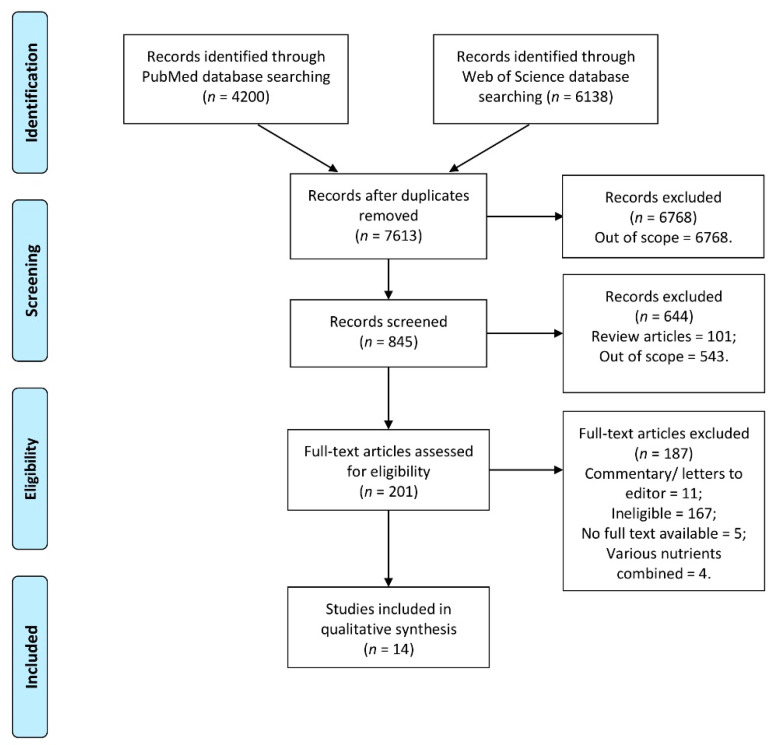
Vitamin D is considered to be a crucial factor that influences symptoms of depression, negative emotions, and quality of life, but to date, no systematic review has been conducted with regard to its effect on other domains of mental health. The aim of the study was to evaluate the influence of vitamin D supplementation on mental health in healthy adults. The systematic review was registered in the PROSPERO database (CRD42020155779) and performed according to the PRISMA guidelines. The literature search was conducted in PubMed and Web of Science databases and included intervention studies published until October 2019. The human studies were included if the supplementation regimen involved the administration of a specified dosage of vitamin D to an adult sample. A total of 7613 records were screened and assessed independently by two researchers, based on their title, abstract, and full text sequentially. Finally, 14 studies were included, and their risk of bias was assessed using the Newcastle-Ottawa Scale (NOS). The studies were included if they presented the results of various doses of vitamin D, compared the supplementation results with the placebo effect, compared the outcome with no supplementation, or observed effect of specific dose applied. The assessed mental health outcomes mainly included depressive symptoms, or depression, well-being, quality of life, mood, general mental component, and anxiety, but single studies also included other parameters such as distress, impression of improvement, and fear of falling and flourishing. The results of the majority of studies did not confirm a positive influence of vitamin D supplementation. None of the high-quality studies (assessed using NOS), which evaluated outcomes other than depression, supported the hypothesis that vitamin D supplementation effectively ameliorates mental health issues, while they present conflicting evidence for depression. Some studies indicated that supplementation should be combined with physical activity to provide effective results, and that supplementation is less effective than vitamin D supply from food sources. The included studies were conducted in diverse populations and followed various doses and intervals of administration, so the results may be incomparable, which should be considered as a limitation. The conducted systematic review did not provide strong evidence for a positive effect of vitamin D supplementation on mental health in healthy adults.
维生素D被认为是影响抑郁症状、负面情绪和生活质量的关键因素,但迄今为止,尚未针对其对心理健康其他领域的影响进行系统综述。本研究的目的是评估补充维生素D对健康成年人心理健康的影响。该系统综述已在PROSPERO数据库(CRD42020155779)中注册,并按照PRISMA指南进行。文献检索在PubMed和Web of Science数据库中进行,纳入截至2019年10月发表的干预研究。如果补充方案涉及向成年样本施用特定剂量的维生素D,则纳入人体研究。两名研究人员根据标题、摘要和全文顺序对总共7613条记录进行独立筛选和评估。最后,纳入了14项研究,并使用纽卡斯尔-渥太华量表(NOS)评估其偏倚风险。如果研究呈现了不同剂量维生素D的结果、将补充结果与安慰剂效应进行比较、将结果与未补充情况进行比较或观察了特定剂量应用的效果,则纳入这些研究。评估的心理健康结果主要包括抑郁症状或抑郁症、幸福感、生活质量、情绪、一般心理成分和焦虑,但个别研究还包括其他参数,如痛苦、改善印象以及跌倒恐惧和蓬勃发展。大多数研究结果并未证实补充维生素D有积极影响。在评估除抑郁症以外结果的高质量研究(使用NOS评估)中(评估抑郁症的高质量研究呈现出相互矛盾的证据),没有一项研究支持补充维生素D能有效改善心理健康问题这一假设。一些研究表明,补充应与体育活动相结合才能产生有效结果,而且补充不如从食物来源获取维生素D有效。纳入的研究针对不同人群开展,采用了不同的剂量和给药间隔,因此结果可能缺乏可比性,这应被视为一个局限性。所进行的系统综述并未提供有力证据证明补充维生素D对健康成年人心理健康有积极作用。