Department of Food Market and Consumer Research, Institute of Human Nutrition Sciences, Warsaw University of Life Sciences (WULS-SGGW), 159C Nowoursynowska Street, 02-776 Warsaw, Poland.
Department of Dietetics, Institute of Human Nutrition Sciences, Warsaw University of Life Sciences (WULS-SGGW), 159C Nowoursynowska Street, 02-776 Warsaw, Poland.
Nutrients. 2021 Oct 20;13(11):3678. doi: 10.3390/nu13113678.
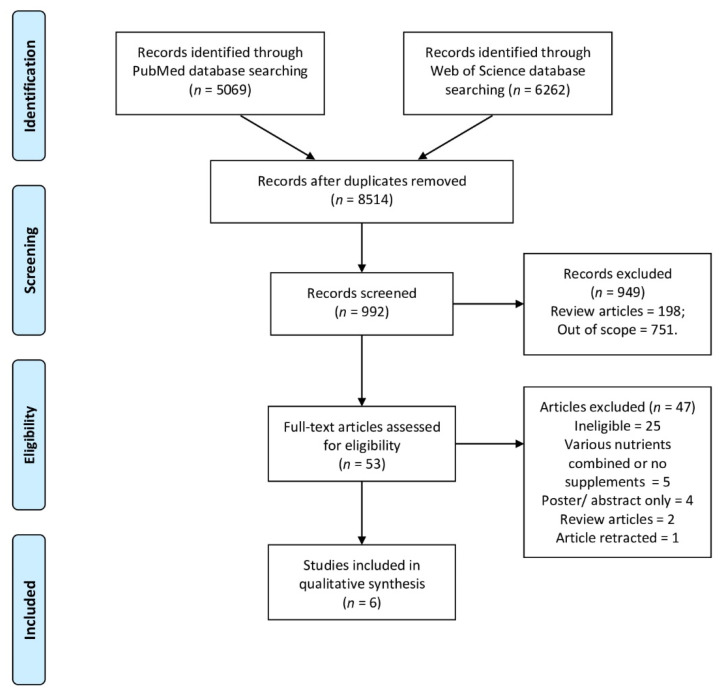
Diabetes is associated with a number of mental health consequences, including enhanced risk of depression and anxiety, as well as decreased quality of life, and vitamin D deficiency is considered to be one of the factors that influence these outcomes in diabetic patients. The aim of the present study was to conduct a systematic review of the literature presenting the data regarding the influence of vitamin D supplementation on mental health in diabetic adults. This study was conducted in accordance with the Preferred Reporting Items for Systematic Reviews and Meta-Analyses (PRISMA) guidelines and registered in the International Prospective Register of Systematic Reviews (PROSPERO) database (Registration number CRD42020155779). A systematic search of the PubMed and Web of Science databases was performed, and the intervention studies published until September 2021 were included in the review. The human studies were included if an adult sample of diabetic individuals received vitamin D supplementation during the intervention and its effect on any mental health aspect was assessed, but studies presenting the influence of combined supplementation of multiple nutrients were excluded. After removing duplicate records, a total of 8514 publications were screened and assessed independently by two researchers, based on their title, abstract, and full text. Finally, six studies were included in the current systematic review, and the risk of bias was evaluated using the Newcastle-Ottawa Scale (NOS). The included studies analyzed the influence of a specific dose of vitamin D, or different doses of vitamin D, or compared the results of supplementation with a specific dose of vitamin D against the placebo group. The supplementation was performed for at least 12 weeks. The mental health outcomes analyzed in these studies included health-related quality of life, depression, anxiety, stress, and general mental health status of adult diabetic patients. The results of the majority of the studies confirmed the positive influence of vitamin D supplementation on the mental health of diabetic individuals. Those studies that analyzed the influence of vitamin D supplementation on depression and anxiety established the beneficial effect of the vitamin. In some studies, the influence of vitamin D supplementation on the health-related quality of life was not considered unless combined with mindfulness training. However, it must be emphasized that different dosage regimens and intervention periods were followed in the reviewed studies, and only a small number of studies were randomized against placebo, which should be considered as a limitation of the present study. The findings of the conducted systematic review demonstrated the positive influence of vitamin D supplementation on the mental health of diabetic patients, which was proved for anxiety and depression, but in the case of health-related quality of life, the positive effect was observed only when the intervention included mindfulness training. These outcomes suggest that supplementation should be recommended to improve the vitamin D status and the mental health of patients in this group.
糖尿病与许多心理健康后果有关,包括抑郁和焦虑风险增加,以及生活质量下降,而维生素 D 缺乏被认为是影响糖尿病患者这些结果的因素之一。本研究的目的是对目前的文献进行系统回顾,以呈现关于维生素 D 补充对成年糖尿病患者心理健康影响的数据。这项研究是根据系统评价和荟萃分析的首选报告项目 (PRISMA) 指南进行的,并在国际前瞻性系统评价登记处 (PROSPERO) 数据库中进行了登记 (注册号 CRD42020155779)。对 PubMed 和 Web of Science 数据库进行了系统搜索,并纳入了截至 2021 年 9 月发表的干预研究。如果成人糖尿病患者在干预期间接受了维生素 D 补充,并评估了其对任何心理健康方面的影响,则纳入人类研究,但排除了同时补充多种营养素的影响研究。在去除重复记录后,根据标题、摘要和全文,由两名研究人员独立筛选和评估了总共 8514 篇出版物。最后,有 6 项研究纳入了当前的系统评价,并使用纽卡斯尔-渥太华量表 (NOS) 评估了偏倚风险。纳入的研究分析了特定剂量的维生素 D、不同剂量的维生素 D 的影响,或比较了特定剂量的维生素 D 补充与安慰剂组的结果。补充时间至少为 12 周。这些研究分析的心理健康结果包括成年糖尿病患者的健康相关生活质量、抑郁、焦虑、压力和一般心理健康状况。大多数研究的结果证实了维生素 D 补充对糖尿病患者心理健康的积极影响。那些分析维生素 D 补充对抑郁和焦虑影响的研究确定了维生素的有益作用。在一些研究中,除非与正念训练相结合,否则维生素 D 补充对健康相关生活质量的影响不被认为是重要的。然而,必须强调的是,在综述研究中遵循了不同的剂量方案和干预期,只有少数研究是针对安慰剂进行的随机对照,这应该被认为是本研究的一个局限性。进行的系统评价的结果表明,维生素 D 补充对糖尿病患者的心理健康有积极影响,这已被证明对焦虑和抑郁有影响,但在健康相关生活质量方面,只有当干预包括正念训练时,才会观察到积极影响。这些结果表明,应该建议补充维生素以改善该人群患者的维生素 D 状况和心理健康。
