Department of Physiology, College of Medicine, University of Tennessee Health Science Center, Memphis, TN 38163, USA.
Laboratory for Fetal and Regenerative Biology, Department of Surgery, University of Colorado Denver-Anschutz Medical Campus and Children's Hospital Colorado, Aurora, CO 80045, USA.
Int J Mol Sci. 2021 Oct 30;22(21):11816. doi: 10.3390/ijms222111816.
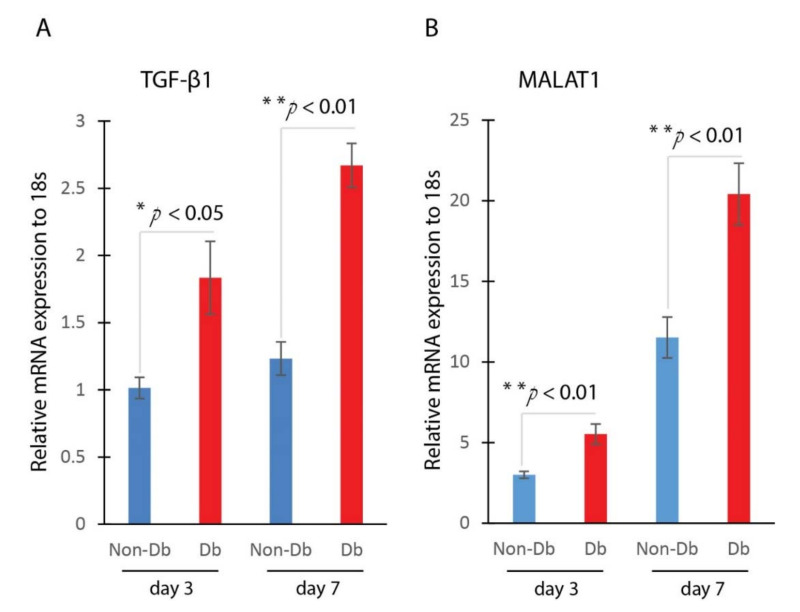
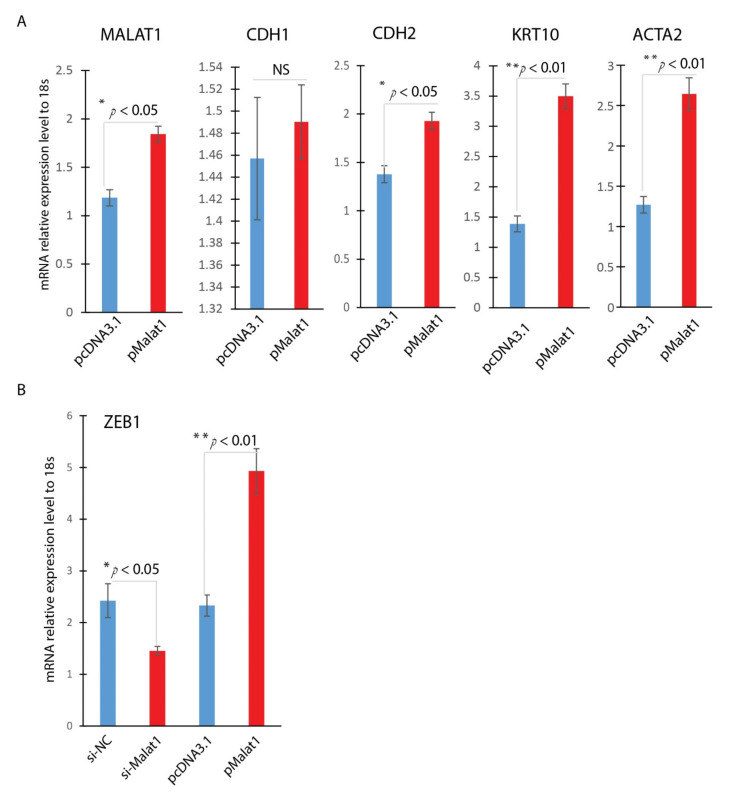
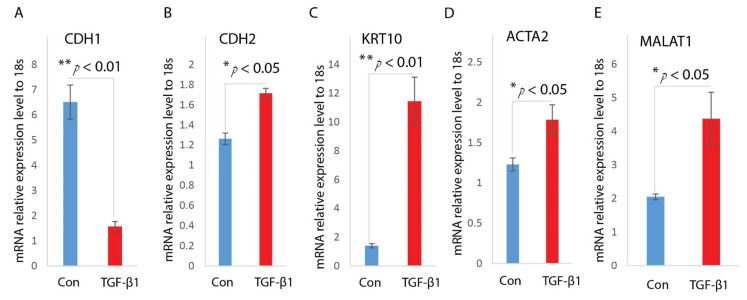
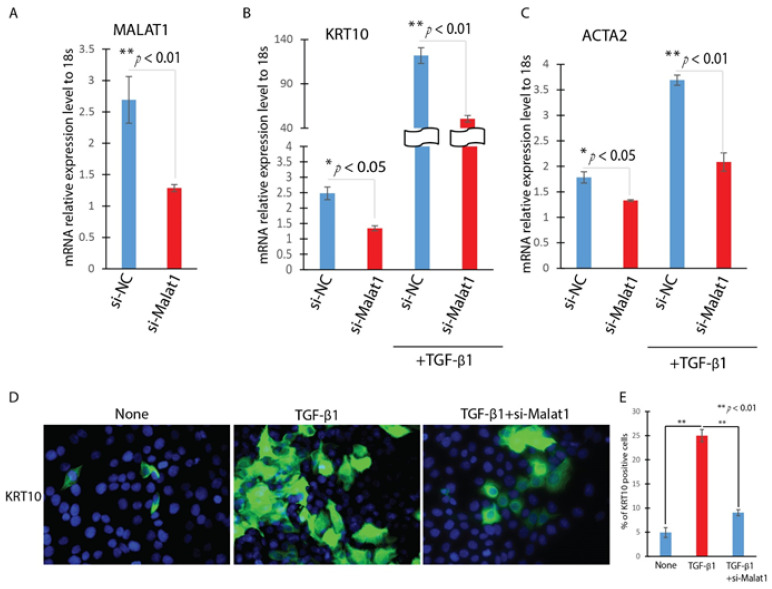
One of the major complications in diabetes is impaired wound healing. Unfortunately, effective therapies are currently lacking. Epithelial to mesenchymal transition (EMT) is a critical process involved in cutaneous wound healing. In response to injury, EMT is required to activate and mobilize stationary keratinocytes in the skin toward the wound bed, which allows for re-epithelialization. This process is stalled in diabetic wounds. In this study, we investigate the role of long non-coding RNA (lncRNA), MALAT1, in transforming growth factor beta 1(TGF-β1)-induced EMT of human keratinocyte (HaCaT) cells. Initially, we detected MALAT1 and TGF-β1 expression in non-diabetic and diabetic wounds and found that these expression are significantly up-regulated in diabetic wounds. Then, HaCaT cells were cultured and exposed to TGF-β1. The EMT of HaCaT cells were confirmed by the increased expression of CDH2, KRT10, and ACTA2, in addition to the down-regulation of CDH1. Knockdown of MALAT1 was achieved by transfecting a small interfering RNA (SiRNA). MALAT1 silencing attenuates TGFβ1-induced EMT. Mechanistically, MALAT1 is involved in TGF-β1 mediated EMT through significantly induced ZEB1 expression, a critical transcription factor for EMT. In summary, lncRNA MALAT1 is involved in TGFβ1-induced EMT of human HaCaT cells and provides new understanding for the pathogenesis of diabetic wounds.
糖尿病的主要并发症之一是伤口愈合受损。不幸的是,目前缺乏有效的治疗方法。上皮间质转化(EMT)是皮肤伤口愈合中涉及的关键过程。在受伤时,需要 EMT 来激活和动员皮肤中静止的角质形成细胞向伤口床移动,这允许再上皮化。这个过程在糖尿病伤口中停滞不前。在这项研究中,我们研究了长非编码 RNA(lncRNA),MALAT1 在转化生长因子β 1(TGF-β1)诱导的人角质形成细胞(HaCaT)细胞 EMT 中的作用。最初,我们检测了非糖尿病和糖尿病伤口中的 MALAT1 和 TGF-β1 表达,发现这些表达在糖尿病伤口中显著上调。然后,培养 HaCaT 细胞并使其暴露于 TGF-β1。通过增加 CDH2、KRT10 和 ACTA2 的表达以及下调 CDH1,证实了 HaCaT 细胞的 EMT。通过转染小干扰 RNA(SiRNA)实现 MALAT1 的敲低。MALAT1 的沉默减弱了 TGFβ1 诱导的 EMT。从机制上讲,MALAT1 通过显著诱导 EMT 的关键转录因子 ZEB1 的表达参与 TGF-β1 介导的 EMT。总之,lncRNA MALAT1 参与了 TGFβ1 诱导的人 HaCaT 细胞 EMT,并为糖尿病伤口的发病机制提供了新的认识。