Department of Global Public Health, Karolinska Institutet, 171 77 Stockholm, Sweden.
Department of Education, Umeå University, 901 87 Umeå, Sweden.
Int J Environ Res Public Health. 2021 Oct 20;18(21):11041. doi: 10.3390/ijerph182111041.
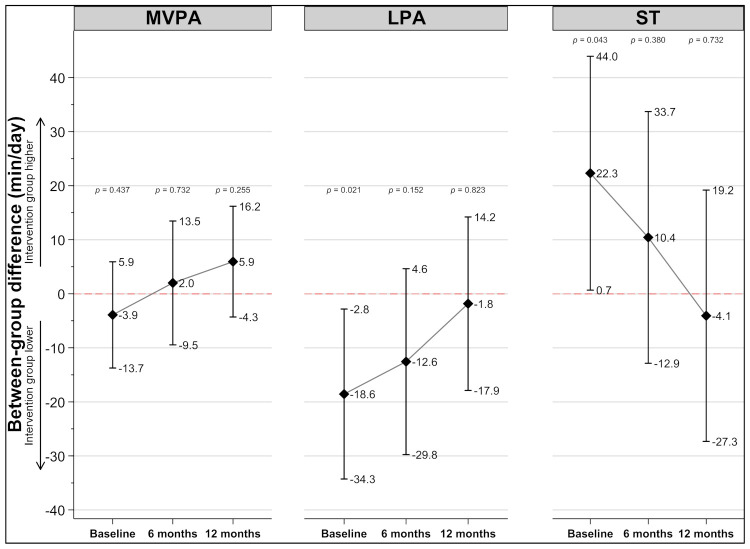
Schools are an important arena to curb the decline in physical activity (PA) in youth. School-based interventions with accelerometer-measured PA are warranted. This study aimed to increase accelerometer-measured PA in adolescents following a 12-month school-based intervention. Two school-classes of 16-18-year-old Swedish students were allocated to intervention group and control group. Accelerometer-measured PA was gathered at baseline, 6- and 12-month follow-up. Mixed-effects linear regression was used to investigate between-group and within-group differences in mean minutes per day (min/day) of moderate to vigorous PA (MVPA), light PA (LPA) and sedentary time (ST). Fifty-seven students participated (intervention group = 31, control group = 26). At 12-month follow-up, the intervention group performed 5.9 (95% CI: -4.3, 16.2) min/day more in MVPA, 1.8 (95% CI: -17.9, 14.2) min/day less in LPA, and 4.1 (95% CI: -27.3, 19.2) min/day less in ST compared to the control group. Within the intervention group, there was no significant change in PA. Within the control group, LPA decreased (95% CI: -19.6, -0.2; = 0.044) and ST increased (95% CI: 1.8, 30.8; = 0.028). Although no between-group differences in PA were statistically significant, the within-group changes may suggest a preventive impact on the decline in PA during adolescence.
学校是遏制青少年体力活动(PA)下降的重要场所。有必要对基于学校的、使用加速度计测量 PA 的干预措施进行研究。本研究旨在通过为期 12 个月的基于学校的干预措施,提高青少年的加速度计测量 PA。将两个 16-18 岁瑞典学生的班级分配到干预组和对照组。在基线、6 个月和 12 个月随访时,使用加速度计收集 PA 数据。采用混合效应线性回归分析,比较组间和组内平均每天中度到剧烈体力活动(MVPA)、轻度体力活动(LPA)和久坐时间(ST)分钟数的差异。共有 57 名学生参与(干预组 31 名,对照组 26 名)。在 12 个月的随访中,与对照组相比,干预组的 MVPA 增加了 5.9 分钟/天(95%CI:-4.3,16.2),LPA 减少了 1.8 分钟/天(95%CI:-17.9,14.2),ST 减少了 4.1 分钟/天(95%CI:-27.3,19.2)。在干预组内,PA 没有显著变化。在对照组内,LPA 减少(95%CI:-19.6,-0.2; = 0.044),ST 增加(95%CI:1.8,30.8; = 0.028)。尽管组间 PA 差异没有统计学意义,但组内变化可能表明对青少年 PA 下降具有预防作用。