School of Computer and Information, Hefei University of Technology, Hefei 230009, China.
Biomedical Device Innovation Center, Shenzhen Technology University, Shenzhen 518118, China.
Sensors (Basel). 2021 Nov 2;21(21):7304. doi: 10.3390/s21217304.
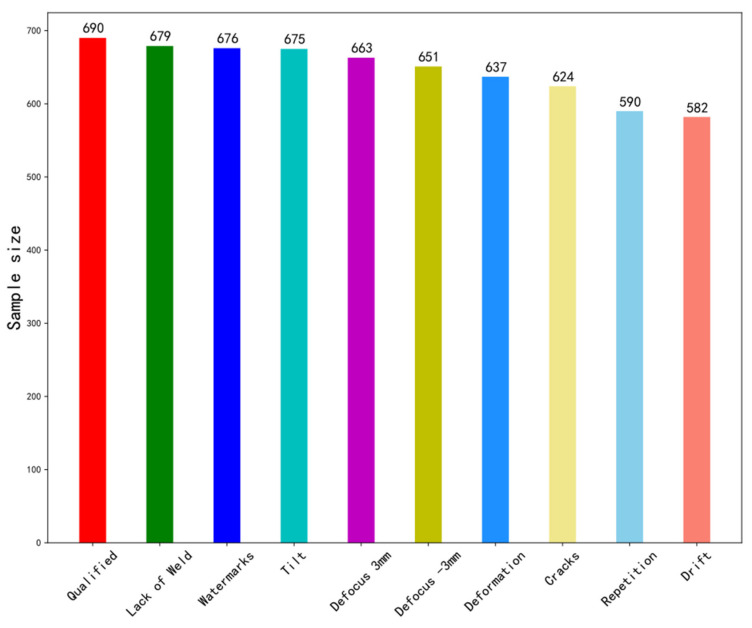
Most of the existing laser welding process monitoring technologies focus on the detection of post-engineering defects, but in the mass production of electronic equipment, such as laser welding metal plates, the real-time identification of defect detection has more important practical significance. The data set of laser welding process is often difficult to build and there is not enough experimental data, which hinder the applications of the data-driven laser welding defect detection method. In this paper, an intelligent welding defect diagnosis method based on auxiliary classifier generative adversarial networks (ACGAN) has been proposed. Firstly, a ten-class dataset consisting of 6467 samples, was constructed, which originate from the optical and thermal sensory parameters in the welding process. A new structured ACGAN network model is proposed to generate fake data similar to the true defect feature distributions. In addition, in order to make the difference between different defects categories more obvious after data expansion, a data filtering and data purification scheme was proposed based on ensemble learning and an SVM (support vector machine), which is used to filter the bad generated data. In the experiments, the classification accuracy can reach 96.83% and 85.13%, for the CNN (convolutional neural network) algorithm model and ACGAN model, respectively. However, the accuracy can further improve to 97.86% and 98.37% for the fusion models of ACGAN-CNN and ACGAN-SVM-CNN models, respectively. The results show that ACGAN can not only be used as an algorithm model for classification, but also be used to achieve superior real-time classification and recognition through data enhancement and multi-model fusion.
现有的大多数激光焊接过程监测技术都侧重于对工程后缺陷的检测,但在电子设备的批量生产中,如激光焊接金属板,实时识别缺陷检测具有更重要的实际意义。激光焊接过程数据集通常难以构建,且实验数据不足,这阻碍了基于数据驱动的激光焊接缺陷检测方法的应用。本文提出了一种基于辅助分类器生成对抗网络(ACGAN)的智能焊接缺陷诊断方法。首先,构建了一个包含 6467 个样本的十分类数据集,这些样本来源于焊接过程中的光学和热敏感参数。提出了一种新的结构化 ACGAN 网络模型,用于生成与真实缺陷特征分布相似的虚假数据。此外,为了在数据扩展后使不同缺陷类别的差异更加明显,提出了一种基于集成学习和 SVM(支持向量机)的数据过滤和数据净化方案,用于过滤不良生成的数据。在实验中,对于 CNN(卷积神经网络)算法模型和 ACGAN 模型,分类准确率分别达到 96.83%和 85.13%。然而,对于 ACGAN-CNN 和 ACGAN-SVM-CNN 模型的融合模型,准确率分别可以进一步提高到 97.86%和 98.37%。结果表明,ACGAN 不仅可以作为分类算法模型,还可以通过数据增强和多模型融合实现卓越的实时分类和识别。