MED-Mediterranean Institute for Agriculture, Environment and Development, Faculdade de Ciências e Tecnologia, Universidade do Algarve, Campus de Gambelas, 8005-139 Faro, Portugal.
Department of Food Science and Health, Andalusian Institute of Agricultural and Fisheries Research and Training (IFAPA), Avenida Menendez-Pidal, SN, 14004 Córdoba, Spain.
Molecules. 2021 Oct 25;26(21):6427. doi: 10.3390/molecules26216427.
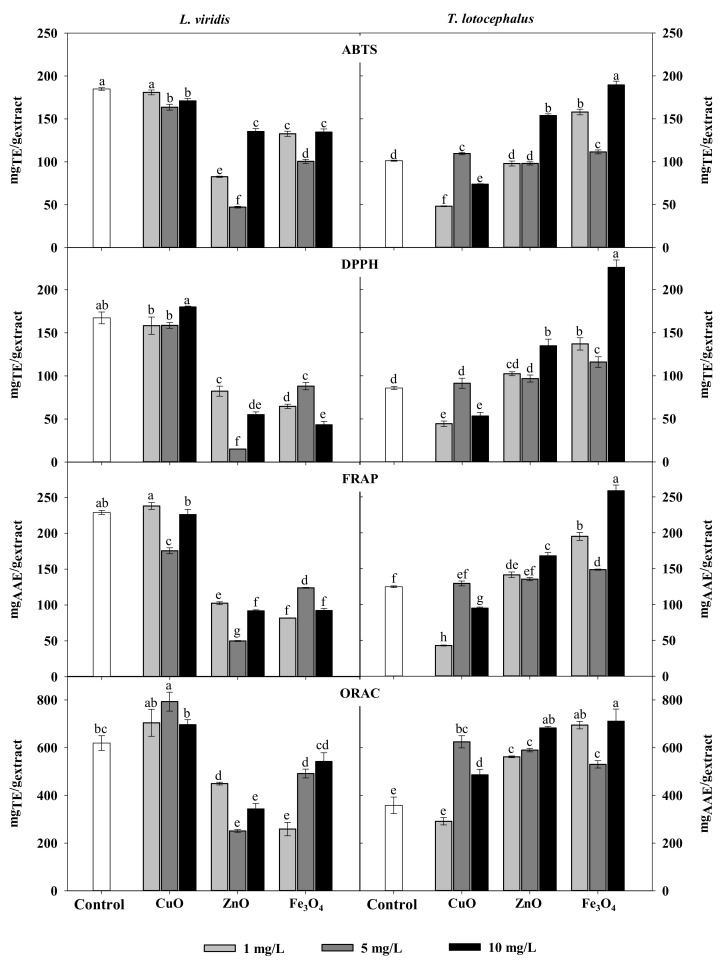
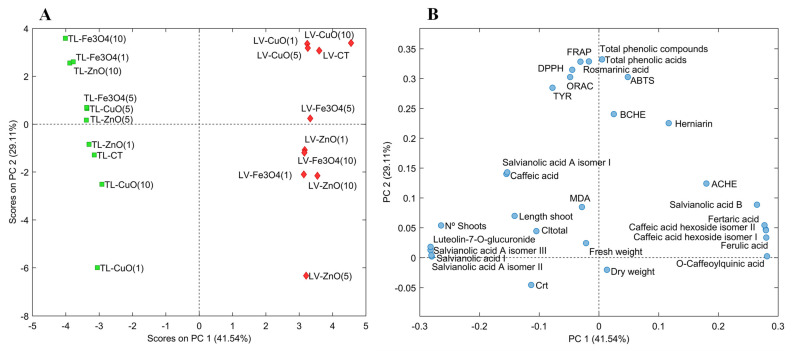
Nanoparticles (NPs) recently emerged as new chemical elicitors acting as signaling agents affecting several processes in plant metabolism. The aim of this work was to investigate the impact of the addition of copper oxide (CuO), zinc oxide (ZnO) and iron oxide (FeO) NPs (<100 nm) at different concentrations (1, 5 and 10 mg/L) to the culture media on several morphological, physiological and -biochemical parameters of in vitro shoot cultures of L'Hér and G. López and R. Morales (Lamiaceae), as well as on phenolic profile and bioactivity (antioxidant and enzyme inhibition capacities). Although some decreases in shoot number and length were observed in response to NPs, biomass production was not affected or was improved in both species. Most NPs treatments decreased total chlorophyll and carotenoid contents and increased malondialdehyde levels, an indicator of lipid peroxidation, in both species. HPLC-HR-MS analysis led to the identification of thirteen and twelve phenolic compounds, respectively, in and extracts, being rosmarinic acid the major compound found in all the extracts. ZnO and FeO NPs induced an increase in total phenolic and rosmarinic acid contents in extracts. Additionally, some NPs treatments also increased antioxidant activity in extracts from this species and the opposite was observed for . The capacity of the extracts to inhibit tyrosinase, acetylcholinesterase and butyrylcholinesterase enzymes was not considerably affected. Overall, NPs had a significant impact on different parameters of and in vitro shoot cultures, although the results varied with the species and NPs type.
纳米粒子(NPs)最近作为新的化学诱导剂出现,作为信号剂影响植物代谢的几个过程。本工作的目的是研究在不同浓度(1、5 和 10mg/L)下向培养基中添加氧化铜(CuO)、氧化锌(ZnO)和氧化铁(FeO)NPs(<100nm)对离体 L'Hér 和 G. López 和 R. Morales(唇形科)的芽培养的几种形态、生理和生化参数的影响,以及对酚类谱和生物活性(抗氧化和酶抑制能力)的影响。尽管纳米粒子处理导致芽数和长度略有减少,但在两种植物中,生物量的产生没有受到影响或得到了改善。大多数 NPs 处理降低了两种植物的总叶绿素和类胡萝卜素含量,增加了丙二醛水平,丙二醛是脂质过氧化的一个指标。HPLC-HR-MS 分析分别在 和 提取物中鉴定出 13 种和 12 种酚类化合物,迷迭香酸是所有提取物中的主要化合物。ZnO 和 FeO NPs 诱导 提取物中总酚和迷迭香酸含量增加。此外,一些 NPs 处理还增加了该物种提取物的抗氧化活性,而相反的情况则发生在 。提取物对酪氨酸酶、乙酰胆碱酯酶和丁酰胆碱酯酶的抑制能力没有受到明显影响。总的来说,纳米粒子对 和 离体芽培养的不同参数有显著影响,尽管结果因物种和 NPs 类型而异。