Institute of Chemical Engineering, Ural Federal University, 620002 Ekaterinburg, Russia.
Postovsky Institute of Organic Synthesis, Ural Branch of the Russian Academy of Sciences, 620990 Ekaterinburg, Russia.
Molecules. 2021 Oct 29;26(21):6534. doi: 10.3390/molecules26216534.
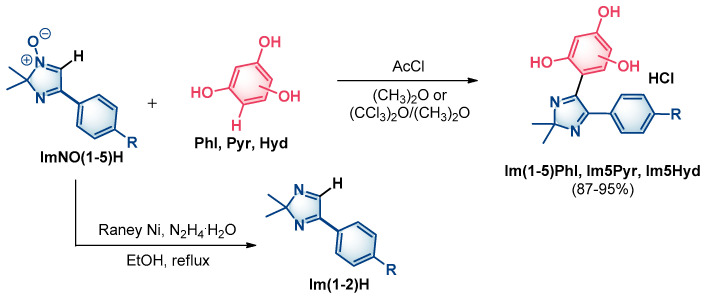
The synthesis of inhibitors for oxidative stress-associated destructive processes based on 2-imidazole-derived phenolic compounds affording the bifunctional 2-imidazole-derived phenolic compounds in good-to-excellent yields was reported. In particular, a series of bifunctional organic molecules of the 5-aryl-2-imidazole family of various architectures bearing both electron-donating and electron-withdrawing substituents in the aryl fragment along with the different arrangements of the hydroxy groups in the polyphenol moiety, namely derivatives of phloroglucinol, pyrogallol, hydroxyquinol, including previously unknown water-soluble molecules, were studied. The structural and antioxidant properties of these bifunctional 5-aryl-2-imidazoles were comprehensively studied. The redox transformations of the synthesized compounds were carried out. The integrated approach based on single and mixed mechanisms of antioxidant action, namely the AOC, ARC, Folin, and DPPH assays, were applied to estimate antioxidant activities. The relationship "structure-antioxidant properties" was established for each of the antioxidant action mechanisms. The conjugation effect was shown to result in a decrease in the mobility of the hydrogen atom, thus complicating the process of electron transfer in nearly all cases. On the contrary, the conjugation in imidazolyl substituted phloroglucinols was found to enhance their activity through the hydrogen transfer mechanism. Imidazole-derived polyphenolic compounds bearing the most electron-withdrawing functionality, namely the nitro group, were established to possess the higher values for both antioxidant and antiradical capacities. It was demonstrated that in the case of phloroglucinol derivatives, the conjugation effect resulted in a significant increase in the antiradical capacity (ARC) for a whole family of the considered 2-imidazole-derived phenolic compounds in comparison with the corresponding unsubstituted phenols. Particularly, conjugation of the polyphenolic subunit with 2,2-dimethyl-5-(4-nitrophenyl)-2-imidazol-4-yl fragment was shown to increase ARC from 2.26 to 5.16 (10 mol-eq/L). This means that the considered family of compounds is capable of exhibiting an antioxidant activity via transferring a hydrogen atom, exceeding the activity of known natural polyphenolic compounds.
基于 2-咪唑衍生的酚类化合物合成了抑制氧化应激相关破坏过程的抑制剂,以高产率得到了双功能 2-咪唑衍生的酚类化合物。特别是,报道了一系列具有不同结构的 5-芳基-2-咪唑家族的双功能有机分子,这些分子在芳基片段中带有供电子和吸电子取代基,并且多酚部分的羟基排列也不同,即没食子酚、焦没食子酚、羟基喹啉的衍生物,包括以前未知的水溶性分子。这些双功能 5-芳基-2-咪唑的结构和抗氧化性质得到了全面研究。进行了合成化合物的氧化还原转化。应用基于抗氧化活性的单一和混合机制的综合方法,即 AOC、ARC、Folin 和 DPPH 测定法,来估计抗氧化活性。针对每种抗氧化作用机制都建立了“结构-抗氧化性质”关系。共轭效应导致氢原子的迁移性降低,从而在几乎所有情况下使电子转移过程复杂化。相反,在咪唑基取代的没食子酚中,共轭作用被发现通过氢转移机制增强了它们的活性。具有最多吸电子官能团的即硝基的咪唑衍生多酚化合物被证明具有更高的抗氧化和抗自由基能力。结果表明,对于没食子酚衍生物,在整个考虑的 2-咪唑衍生的酚类化合物家族中,共轭效应导致与相应的未取代酚相比,抗自由基能力(ARC)显著增加。特别是,多酚亚基与 2,2-二甲基-5-(4-硝基苯基)-2-咪唑-4-基片段的共轭增加了 ARC 从 2.26 到 5.16(10 mol-eq/L)。这意味着所考虑的化合物家族能够通过转移氢原子来表现出抗氧化活性,超过了已知的天然多酚化合物的活性。