
用于纳米氧化铈递送的生物相容性聚乳酸基三层纳米纤维膜的研制与体外评价:糖尿病伤口愈合的新方法
Development and In Vitro Evaluation of Biocompatible PLA-Based Trilayer Nanofibrous Membranes for the Delivery of Nanoceria: A Novel Approach for Diabetic Wound Healing.
作者信息
Hussein Mohamed Ahmed Mohamady, Su Sena, Ulag Songul, Woźniak Agata, Grinholc Mariusz, Erdemir Gökce, Erdem Kuruca Serap, Gunduz Oguzhan, Muhammed Mamoun, El-Sherbiny Ibrahim M, Megahed Mosaad
机构信息
Clinic of Dermatology, University Hospital of RWTH Aachen, 52074 Aachen, Germany.
Department of Pharmacology, Medical Research Division, National Research Center, Dokki, Cairo 12622, Egypt.
出版信息
Polymers (Basel). 2021 Oct 21;13(21):3630. doi: 10.3390/polym13213630.
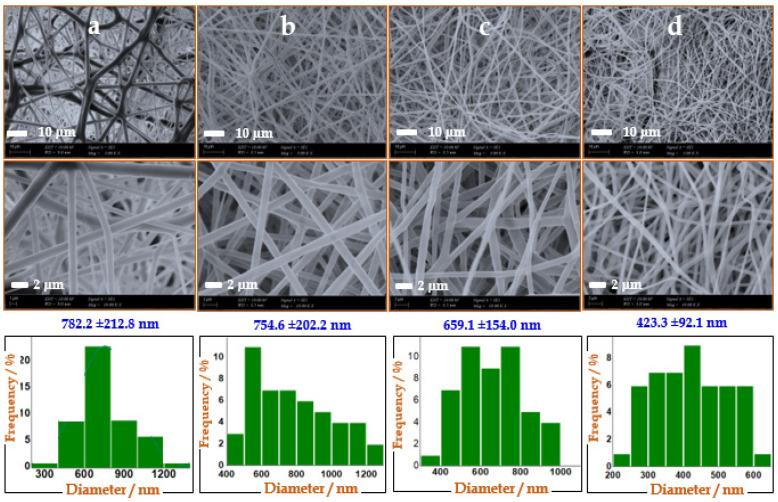
The attempts to explore and optimize the efficiency of diabetic wound healing's promotors are still in progress. Incorporation of cerium oxide nanoparticles (nCeO) in appropriate nanofibers (NFs) can prolong and maximize their promoting effect for the healing of diabetic wounds, through their sustained releases, as well as the nanofibers role in mimicking of the extra cellular matrix (ECM). The as-prepared nCeO were analyzed by using UV-Vis spectroscopy, XRD, SEM-EDX, TEM and FTIR, where TEM and SEM images of both aqueous suspension and powder showed spherical/ovoid-shaped particles. Biodegradable trilayer NFs with cytobiocompatibility were developed to sandwich nCeO in PVA NFs as a middle layer where PLA NFs were electrospun as outer bilayer. The nCeO-loaded trilayer NFs were characterized by SEM, XRD, FTIR and DSC. A two-stage release behavior was observed when the nanoceria was released from the trilayer-based nanofibers; an initial burst release took place, and then it was followed by a sustained release pattern. The mouse embryo fibroblasts, i.e., 3T3 cells, were seeded over the nCeO-loaded NFs mats to investigate their cyto-biocompatibility. The presence and sustained release of nCeO efficiently enhance the adhesion, growth and proliferation of the fibroblasts' populations. Moreover, the incorporation of nCeO with a higher amount into the designed trilayer NFs demonstrated a significant improvement in morphological, mechanical, thermal and cyto-biocompatibility properties than lower doses. Overall, the obtained results suggest that designated trilayer nanofibrous membranes would offer a specific approach for the treatment of diabetic wounds through an effective controlled release of nCeO.
探索和优化糖尿病伤口愈合促进剂效率的尝试仍在进行中。将氧化铈纳米颗粒(nCeO)掺入适当的纳米纤维(NFs)中,可以通过其持续释放以及纳米纤维在模拟细胞外基质(ECM)中的作用,延长并最大化其对糖尿病伤口愈合的促进作用。通过紫外可见光谱、X射线衍射、扫描电子显微镜-能谱分析、透射电子显微镜和傅里叶变换红外光谱对制备的nCeO进行了分析,其中水悬浮液和粉末的透射电子显微镜和扫描电子显微镜图像均显示为球形/卵形颗粒。开发了具有细胞生物相容性的可生物降解三层纳米纤维,将nCeO夹在聚乙烯醇纳米纤维中间层,聚乳酸纳米纤维作为外层双层进行电纺。通过扫描电子显微镜、X射线衍射、傅里叶变换红外光谱和差示扫描量热法对负载nCeO的三层纳米纤维进行了表征。当纳米氧化铈从基于三层的纳米纤维中释放时,观察到了两阶段释放行为;首先发生初始突释,然后是持续释放模式。将小鼠胚胎成纤维细胞,即3T3细胞,接种在负载nCeO的纳米纤维垫上,以研究其细胞生物相容性。nCeO的存在和持续释放有效地增强了成纤维细胞群体的粘附、生长和增殖。此外,与较低剂量相比,在设计的三层纳米纤维中掺入更高量的nCeO在形态、机械、热和细胞生物相容性性能方面有显著改善。总体而言,所得结果表明,指定的三层纳米纤维膜将通过有效控制nCeO的释放为糖尿病伤口的治疗提供一种特定方法。




 Zotero 插件