Clinical College, Xuzhou Medical University, Xuzhou, China.
Department of Neurology, The Affiliated Hospital of Xuzhou Medical University, Xuzhou, China.
Brain Behav. 2021 Dec;11(12):e2416. doi: 10.1002/brb3.2416. Epub 2021 Nov 13.
This study investigated the clinical epidemiological characteristics of nitrous oxide (N O) abusers in a hospital in China, which have not been systematically reported.
The characteristics of patients abusing N O who were examined and treated at the Affiliated Hospital of Xuzhou Medical University from January 2017 to December 2020 were analyzed.
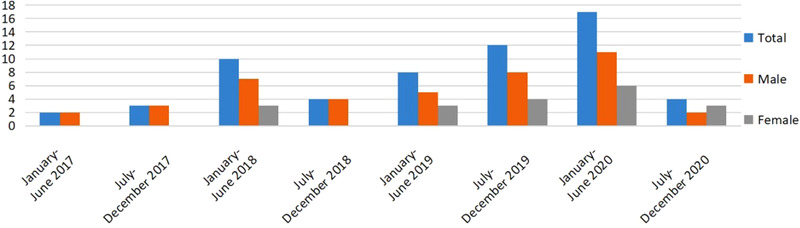
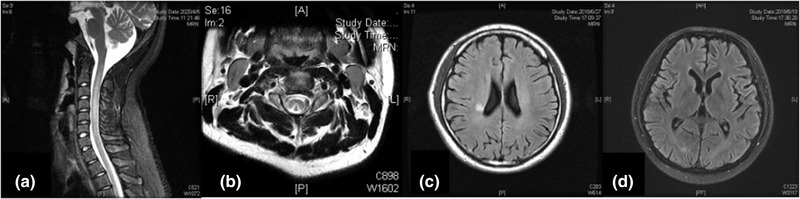
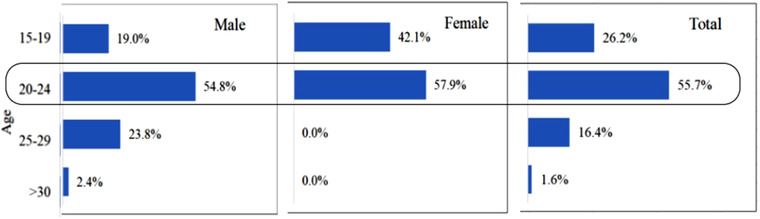
A total of 61 patients (average age: 21.7 ± 3.2 years; 42 male and 19 female) were enrolled; 60.7% of the patients had an education level of high school or lower, and most (59.0%) had no stable occupation. The mean exposure time was 8.5 ± 7.7 months (range: 1-36 months). Only 52.5% of the abusers reported the physician of the relevant exposure history at the first time of visiting the doctor. The main clinical type was mixed (49.2%). The most common clinical manifestation was distal limb numbness (80.3%). The most frequent outcome was peripheral neuropathy (59%) and subacute combined degeneration (36%). Serum homocysteine level was elevated in 67.5% (27/40) of the patients, while 44.4% (20/45) showed reduced vitamin B12. Note that 61% (22/36) showed abnormal signals in the posterior or lateral funiculus of the spinal cord, and 97% (31/32) of the patients showed peripheral nerve damage by electromyography. In all cases, symptoms were alleviated after halting N O intake and receiving nutritional neurotherapy.
N O abuse can lead to nervous system damage, especially peripheral nerve and spinal cord damage. A full understanding of its clinical epidemiological characteristics is helpful for clinicians to make a timely and clear diagnosis.
本研究调查了中国某医院一氧化二氮(N O)滥用者的临床流行病学特征,这些特征尚未得到系统报道。
分析了 2017 年 1 月至 2020 年 12 月在徐州医科大学附属医院接受检查和治疗的 N O 滥用患者的特征。
共纳入 61 例患者(平均年龄:21.7 ± 3.2 岁;42 名男性,19 名女性);60.7%的患者具有高中学历或以下学历,大多数(59.0%)没有稳定的职业。平均暴露时间为 8.5 ± 7.7 个月(范围:1-36 个月)。仅 52.5%的滥用者在首次就诊时向医生报告了相关暴露史。主要临床类型为混合性(49.2%)。最常见的临床表现是四肢远端麻木(80.3%)。最常见的结局是周围神经病(59%)和亚急性联合变性(36%)。67.5%(27/40)的患者血清同型半胱氨酸水平升高,44.4%(20/45)的患者维生素 B12 水平降低。值得注意的是,61%(22/36)的患者脊髓后或外侧索出现异常信号,97%(31/32)的患者肌电图显示周围神经损伤。在所有病例中,停止 N O 摄入并接受营养神经治疗后症状均得到缓解。
N O 滥用可导致神经系统损伤,尤其是周围神经和脊髓损伤。充分了解其临床流行病学特征有助于临床医生及时明确诊断。