Choi Hayoung, Lee Hyun, Ra Seung Won, Jang Jong Geol, Lee Ji-Ho, Jhun Byung Woo, Park Hye Yun, Jung Ji Ye, Lee Seung Jun, Jo Kyung-Wook, Rhee Chin Kook, Kim Changwhan, Lee Sei Won, Min Kyung Hoon, Kwon Yong-Soo, Kim Deog Kyeom, Lee Jin Hwa, Park Yong Bum, Chung Eun Hee, Kim Yae-Jean, Yoo Kwang Ha, Oh Yeon-Mok
Division of Pulmonary, Allergy, and Critical Care Medicine, Department of Internal Medicine, Hallym University Kangnam Sacred Heart Hospital, Hallym University College of Medicine, Seoul, Republic of Korea.
Division of Pulmonary Medicine and Allergy, Department of Internal Medicine, Hanyang University College of Medicine, Seoul, Republic of Korea.
Tuberc Respir Dis (Seoul). 2022 Jan;85(1):56-66. doi: 10.4046/trd.2021.0136. Epub 2021 Nov 15.
Because the etiologies of bronchiectasis and related diseases vary significantly among different regions and ethnicities, this study aimed to develop a diagnostic bundle for bronchiectasis in South Korea.
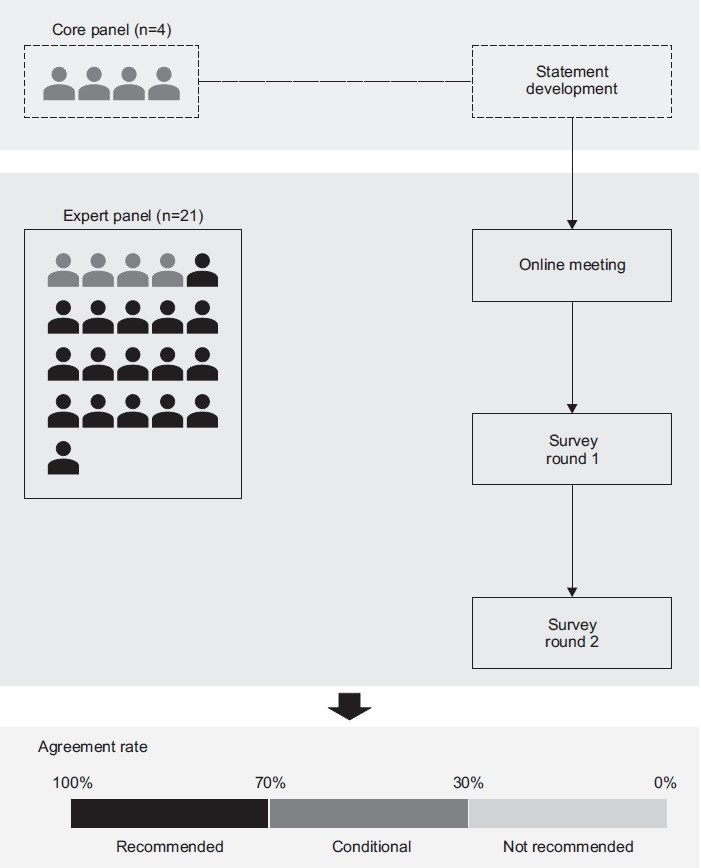
A modified Delphi method was used to develop expert consensus statements on a diagnostic bundle for bronchiectasis in South Korea. Initial statements proposed by a core panel, based on international bronchiectasis guidelines, were discussed in an online meeting and two email surveys by a panel of experts (≥70% agreement).
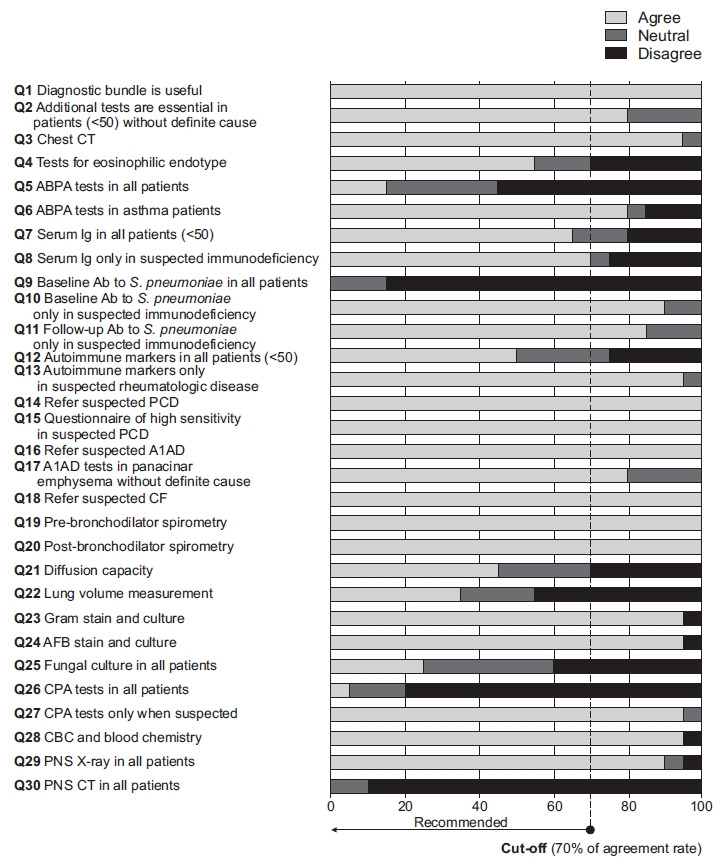
The study involved 21 expert participants, and 30 statements regarding a diagnostic bundle for bronchiectasis were classified as recommended, conditional, or not recommended. The consensus statements of the expert panel were as follows: A standardized diagnostic bundle is useful in clinical practice; diagnostic tests for specific diseases, including immunodeficiency and allergic bronchopulmonary aspergillosis, are necessary when clinically suspected; initial diagnostic tests, including sputum microbiology and spirometry, are essential in all patients with bronchiectasis, and patients suspected with rare causes such as primary ciliary dyskinesia should be referred to specialized centers.
Based on this Delphi survey, expert consensus statements were generated including specific diagnostic, laboratory, microbiological, and pulmonary function tests required to manage patients with bronchiectasis in South Korea.
由于支气管扩张及相关疾病的病因在不同地区和种族之间存在显著差异,本研究旨在制定韩国支气管扩张的诊断组合。
采用改良德尔菲法就韩国支气管扩张诊断组合制定专家共识声明。由一个核心小组根据国际支气管扩张指南提出的初始声明,在一次在线会议和两次电子邮件调查中由一组专家进行讨论(达成≥70%的共识)。
该研究有21名专家参与,关于支气管扩张诊断组合的30项声明被分类为推荐、有条件推荐或不推荐。专家小组的共识声明如下:标准化诊断组合在临床实践中有用;临床怀疑时,对包括免疫缺陷和变应性支气管肺曲霉病在内的特定疾病进行诊断检测是必要的;初始诊断检测,包括痰微生物学和肺量计检查,对所有支气管扩张患者至关重要,怀疑患有原发性纤毛运动障碍等罕见病因的患者应转诊至专科中心。
基于本次德尔菲调查,生成了专家共识声明,包括管理韩国支气管扩张患者所需的特定诊断、实验室、微生物学和肺功能检查。