Division of Population Health, Health Services Research & Primary Care, Faculty of Biology, Medicine and Health, University of Manchester, Room 2.545, Stopford Building, Oxford Road, Manchester, M13 9PT, UK.
BMC Public Health. 2021 Nov 14;21(1):2091. doi: 10.1186/s12889-021-12169-7.
Falls are a common and serious health issue facing the global population, causing an estimated 646,000 deaths per year globally. Wearable devices typically combine accelerometers, gyroscopes and even barometers; using the data collected and inputting this into an algorithm that decides whether a fall has occurred. The purpose of this umbrella review was to provide a comprehensive overview of the systematic reviews on the effectiveness of wearable electronic devices for falls detection in adults.
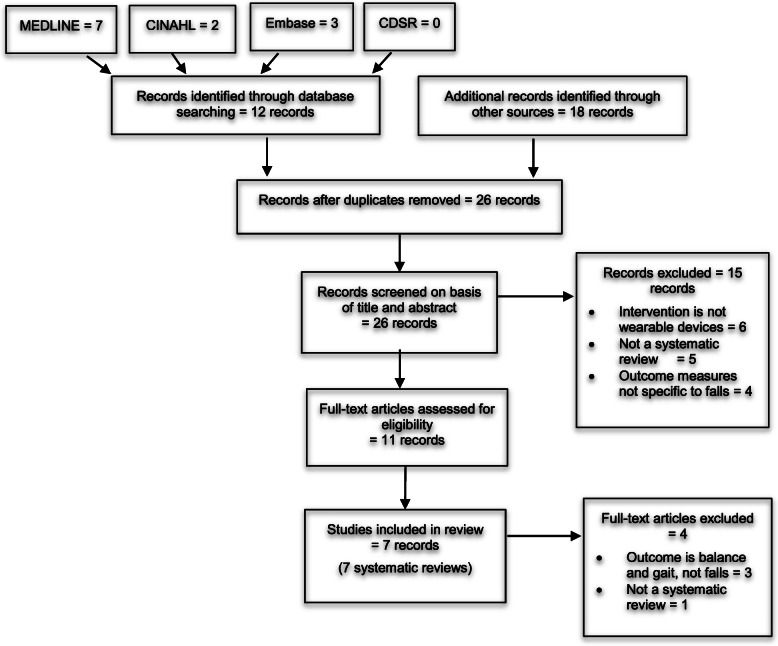
MEDLINE, Embase, Cochrane Database of Systematic Reviews (CDSR), and CINAHL, were searched from their inceptions until April 2019 for systematic reviews that assessed the accuracy of wearable technology in the detection of falls.
Seven systematic reviews were included in this review. Due to heterogeneity between the included systematic reviews in their methods and their reporting of results, a meta-analysis could not be performed. Most devices tested used accelerometers, often in combination with gyroscopes. Three systematic reviews reported an average sensitivity of 93.1% or greater and an average specificity of 86.4% or greater for the detection of falls. Placing sensors on the trunk, foot or leg appears to provide the highest accuracy for falls detection, with multiple sensors increasing the accuracy, specificity, and sensitivity of these devices.
This review demonstrated that wearable device technology offers a low-cost and accurate way to effectively detect falls and summon for help. There are significant differences in the effectiveness of these devices depending on the type of device and its placement. Further high-quality research is needed to confirm the accuracy of these devices in frail older people in real-world settings.
跌倒在全球人口中是一个常见且严重的健康问题,每年在全球造成约 646,000 人死亡。可穿戴设备通常结合使用加速度计、陀螺仪甚至气压计;使用收集的数据并将其输入到决定是否发生跌倒的算法中。本次伞式综述的目的是全面概述关于可穿戴电子设备在成人跌倒检测中有效性的系统评价。
从建库开始到 2019 年 4 月,在 MEDLINE、Embase、Cochrane 系统评价数据库(CDSR)和 CINAHL 中搜索评估可穿戴技术检测跌倒准确性的系统评价。
本综述纳入了 7 项系统评价。由于纳入的系统评价在方法和结果报告方面存在异质性,因此无法进行荟萃分析。大多数测试的设备使用加速度计,通常与陀螺仪结合使用。有 3 项系统评价报告了跌倒检测的平均敏感度为 93.1%或更高,平均特异性为 86.4%或更高。在躯干、脚或腿部放置传感器似乎可以提供最高的跌倒检测准确性,多个传感器可以提高这些设备的准确性、特异性和敏感度。
本综述表明,可穿戴设备技术提供了一种低成本且准确的方法,可以有效检测跌倒并发出求救信号。这些设备的有效性因设备类型及其放置位置而异。需要进一步进行高质量的研究,以确认这些设备在现实环境中对虚弱老年人的准确性。