Anaesthesiology and Intensive Care Department, Imam Khomeini Hospital complex, Tehran University of Medical Sciences, Tehran, Iran.
Iranian Center of Neurological Research, Neuroscience Institute, Imam Khomeini Hospital Complex, Tehran University of Medical Sciences, Tehran, Iran.
Trials. 2021 Nov 14;22(1):802. doi: 10.1186/s13063-021-05795-4.
Because of the effect of vitamins on modulating the immune system function, we have evaluated the effect of supplementation with vitamins A, B, C, D, and E in ICU-admitted patients with COVID-19.
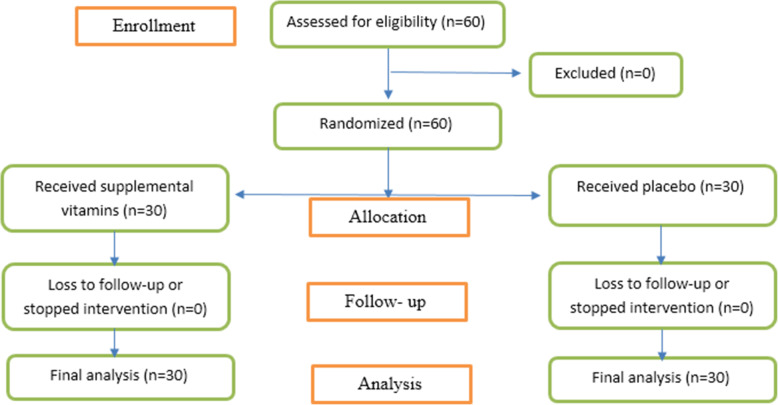
This study was a randomized and single-blinded clinical trial in which 60 subjects were randomly assigned to two groups. The intervention group (n=30) received vitamins, and the control group did not receive any vitamin or placebo. The intervention was included 25,000 IU daily of vitamins A, 600,000 IU once during the study of D, 300 IU twice daily of E, 500 mg four times daily of C, and one amp daily of B complex for 7 days. At baseline and after the 7-day intervention, the serum levels of inflammatory markers, vitamins, and the SOFA score were assessed. In addition, the mortality rate and duration of hospitalization were evaluated after the intervention (IRCT registration number: IRCT20200319046819N1/registration date: 2020-04-04, https://www.irct.ir/trial/46838 ).
Significant changes were detected in serum levels of vitamins (p < 0.001 for all vitamins), ESR (p < 0.001), CRP (p = 0.001), IL6 (p = 0.003), TNF-a (p = 0.001), and SOFA score (p < 0.001) after intervention compared with the control group. The effect of vitamins on the mortality rate was not statistically significant (p=0.112). The prolonged hospitalization rate to more than 7 days was significantly lower in the intervention group than the control group (p=0.001). Regarding the effect size, there was a significant and inverse association between receiving the intervention and prolonged hospitalization (OR = 0.135, 95% CI 0.038-0.481; p=0.002); however, after adjusting for confounders, it was not significant (OR=0.402, 95% CI 0.086-1.883; p=0.247).
Supplementation with vitamins A, B, C, D, and E could improve the inflammatory response and decrease the severity of disease in ICU-admitted patients with COVID-19.
由于维生素对调节免疫系统功能的影响,我们评估了补充维生素 A、B、C、D 和 E 对 ICU 收治的 COVID-19 患者的影响。
这是一项随机、单盲临床试验,将 60 名受试者随机分为两组。干预组(n=30)接受维生素治疗,对照组不接受任何维生素或安慰剂。干预措施包括每日 25,000 IU 维生素 A、研究期间一次 600,000 IU 维生素 D、每日两次 300 IU 维生素 E、每日四次 500 mg 维生素 C 和每日一次 B 族维生素复合物,持续 7 天。在基线和 7 天干预后,评估炎症标志物、维生素和 SOFA 评分的血清水平。此外,干预后评估死亡率和住院时间(IRCT 注册号:IRCT20200319046819N1/注册日期:2020-04-04,https://www.irct.ir/trial/46838)。
与对照组相比,干预后血清维生素水平(所有维生素均 p<0.001)、ESR(p<0.001)、CRP(p=0.001)、IL6(p=0.003)、TNF-a(p=0.001)和 SOFA 评分(p<0.001)均有显著变化。维生素对死亡率的影响无统计学意义(p=0.112)。干预组住院时间延长至 7 天以上的比例明显低于对照组(p=0.001)。关于效应大小,接受干预与延长住院时间之间存在显著的负相关(OR=0.135,95%CI 0.038-0.481;p=0.002);然而,在调整混杂因素后,相关性不显著(OR=0.402,95%CI 0.086-1.883;p=0.247)。
补充维生素 A、B、C、D 和 E 可以改善 ICU 收治的 COVID-19 患者的炎症反应,降低疾病严重程度。