Institut National de la Santé et de la Recherche Médicale (INSERM) U1262, Centre National de la Recherche Scientifique (CNRS) Unité Mixte de Recherche (UMR) 7276, Limoges University, Limoges, France.
Institut National de la Santé et de la Recherche Médicale (INSERM) U 1236, Rennes1 University, Rennes, France.
Front Immunol. 2021 Oct 28;12:737427. doi: 10.3389/fimmu.2021.737427. eCollection 2021.
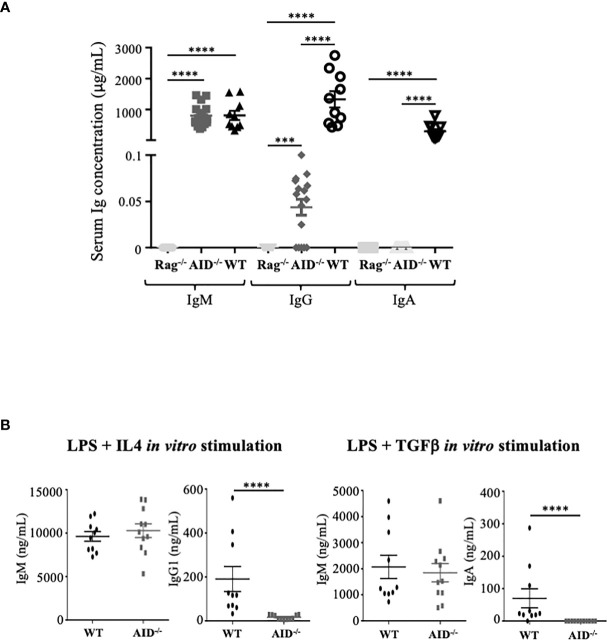
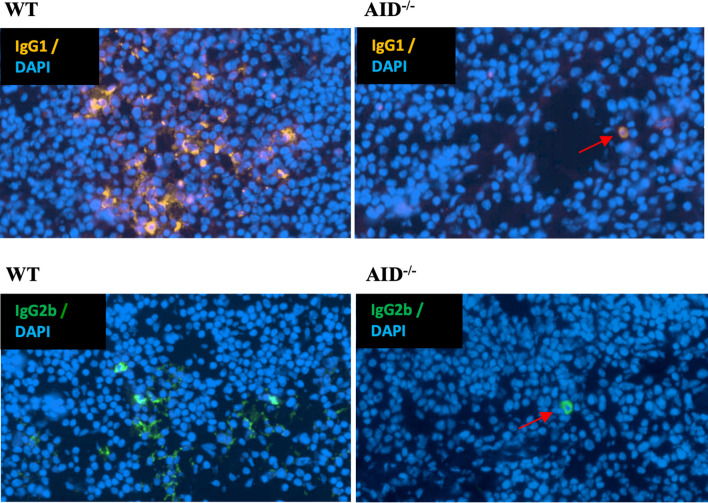
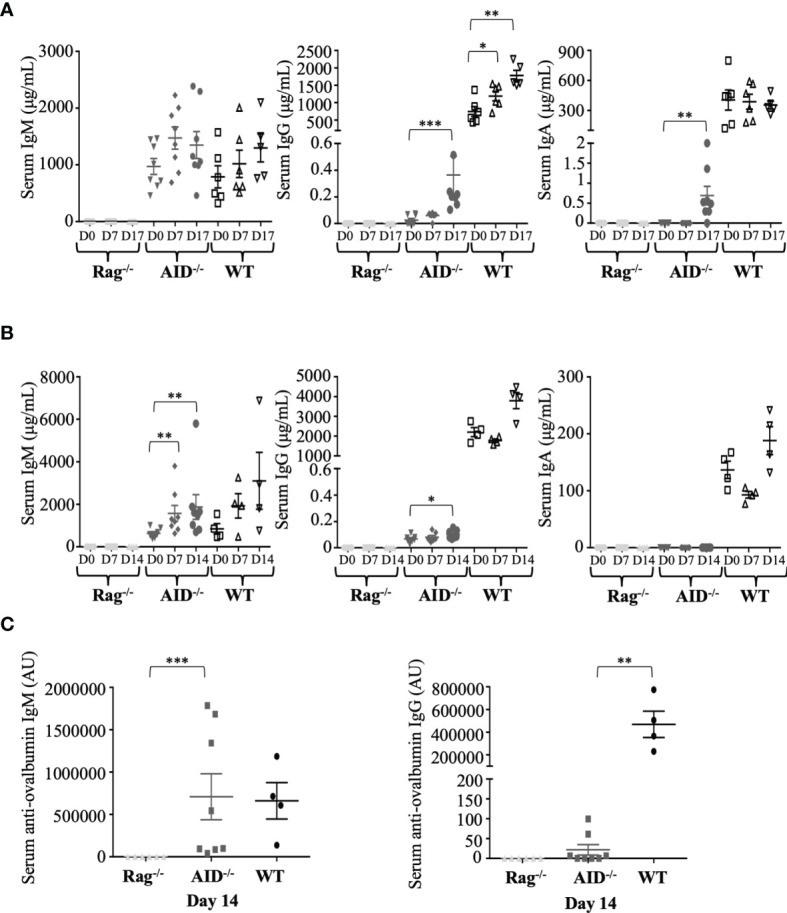
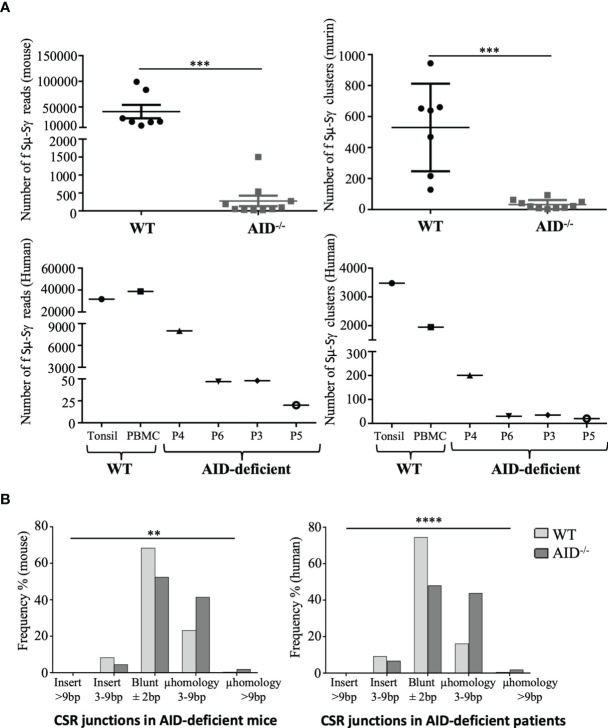
Activation-induced deaminase (AID) is the major actor of immunoglobulin (Ig) gene diversification in germinal center B-cells. From its first description, it was considered as mandatory for class switch recombination (CSR), and this discovery initiated a long quest for all of the AID-interacting factors controlling its activity. The mechanisms focusing AID-mediated DNA lesions to given target sequences remain incompletely understood with regards the detailed characterization of optimal substrates in which cytidine deamination will lead to double strand breaks (DSBs) and chromosomal cleavage. In an effort to reconsider whether such CSR breaks absolutely require AID, we herein provide evidence, based on deep-sequencing approaches, showing that this dogma is not absolute in both human and mouse B lymphocytes. In activated B-cells from either AID-deficient mice or human AID-deficient patients, we report an intrinsic ability of the locus to undergo "on-target" cleavage and subsequent synapsis of broken regions in conditions able to yield low-level CSR. DNA breaks occur in such conditions within the same repetitive S regions usually targeted by AID, but their repair follows a specific pathway with increased usage of microhomology-mediated repair. These data further demonstrate the role of AID machinery as not initiating chromosomal cleavage but rather catalyzing a process which spontaneously initiates at low levels in an appropriately conformed locus.
激活诱导的脱氨酶(AID)是生发中心 B 细胞中免疫球蛋白(Ig)基因多样化的主要作用因子。从最初的描述来看,它被认为是类别转换重组(CSR)所必需的,这一发现引发了对所有控制其活性的 AID 相互作用因子的长期探索。关于 AID 介导的 DNA 损伤在给定靶序列的聚焦机制,对于最佳底物的详细特征化,其中胞嘧啶脱氨酶将导致双链断裂(DSBs)和染色体断裂,仍然不完全理解。为了重新考虑 CSR 断裂是否绝对需要 AID,我们在此提供了基于深度测序方法的证据,表明这一教条在人和小鼠 B 淋巴细胞中并不绝对。在缺乏 AID 的小鼠或缺乏人 AID 的患者的活化 B 细胞中,我们报告了 基因座在能够产生低水平 CSR 的条件下进行“靶内”切割和随后断裂区域连接的内在能力。在这些条件下,DNA 断裂发生在通常被 AID 靶向的相同重复 S 区,但它们的修复遵循特定的途径,增加了微同源介导的修复的使用。这些数据进一步证明了 AID 机制的作用不是启动 染色体断裂,而是催化一个在适当构象的 基因座中以低水平自发启动的过程。