Department of Anesthesiology and Intensive Care Medicine, Rostock University Medical Centre, Schillingallee 35, 18057, Rostock, Germany.
Department of Nuclear Medicine, Rostock University Medical Centre, Rostock, Germany.
Mol Imaging Biol. 2022 Jun;24(3):466-478. doi: 10.1007/s11307-021-01677-y. Epub 2021 Nov 15.
The mammalian brain glucose metabolism is tightly and sensitively regulated. An ischemic brain injury caused by cardiac arrest (CA) and cardiopulmonary resuscitation (CPR) affects cerebral function and presumably also glucose metabolism. The majority of patients who survive CA suffer from cognitive deficits and physical disabilities. Toll-like receptor 2 (TLR2) plays a crucial role in inflammatory response in ischemia and reperfusion (I/R). Since deficiency of TLR2 was associated with increased survival after CA-CPR, in this study, glucose metabolism was measured using non-invasive [F]F-FDG PET-CT imaging before and early after CA-CPR in a mouse model comparing wild-type (WT) and TLR2-deficient (TLR2) mice. The investigation will evaluate whether FDG-PET could be useful as an additional methodology in assessing prognosis.
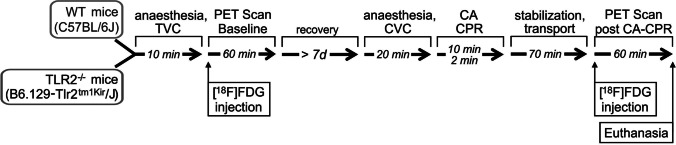
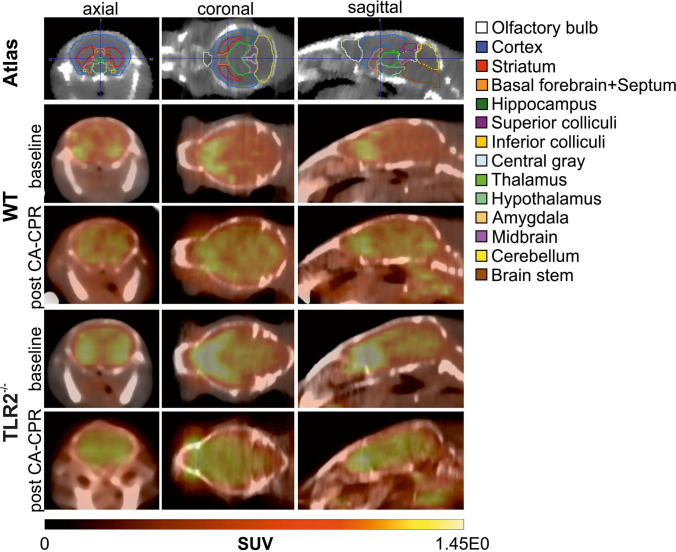
Two PET-CT scans using 2-deoxy-2-[F]fluoro-D-glucose ([F]F-FDG) tracer were carried out to measure dynamic glucose metabolism before and early after CPR. To achieve this, anesthetized and ventilated adult female WT and TLR2 mice were scanned in PET-CT. After recovery from the baseline scan, the same animals underwent 10-min KCL-induced CA followed by CPR. Approximately 90 min after CA, measurements of [F]F-FDG uptake for 60 min were started. The [F]F-FDG standardized uptake values (SUVs) were calculated using PMOD-Software on fused FDG-PET-CT images with the included 3D Mirrione-Mouse-Brain-Atlas.
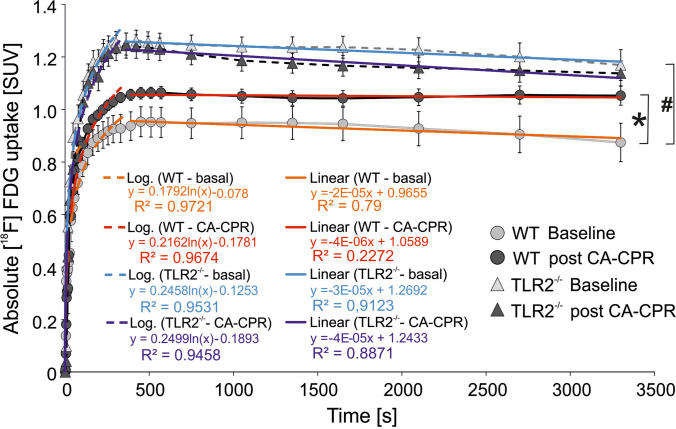
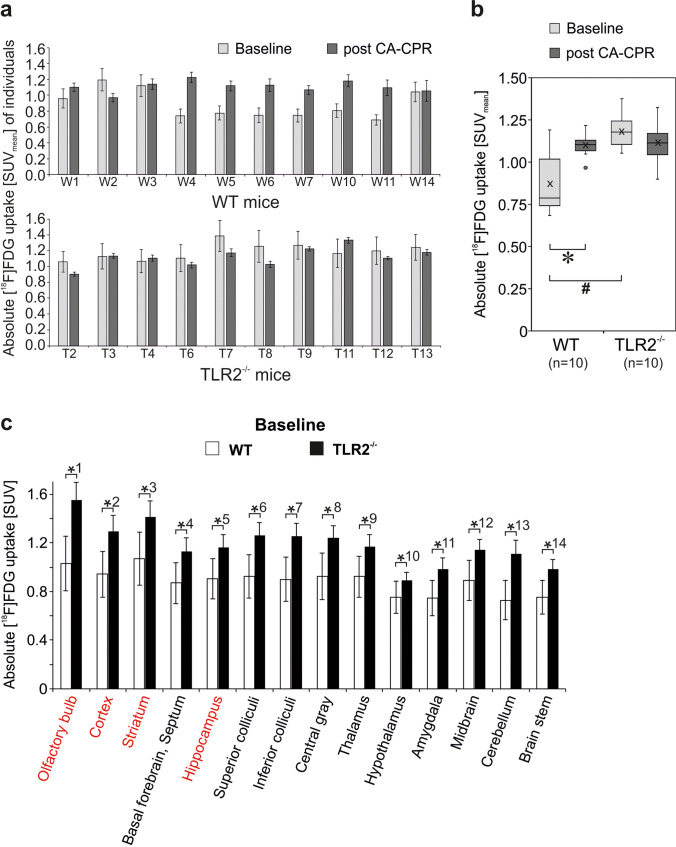
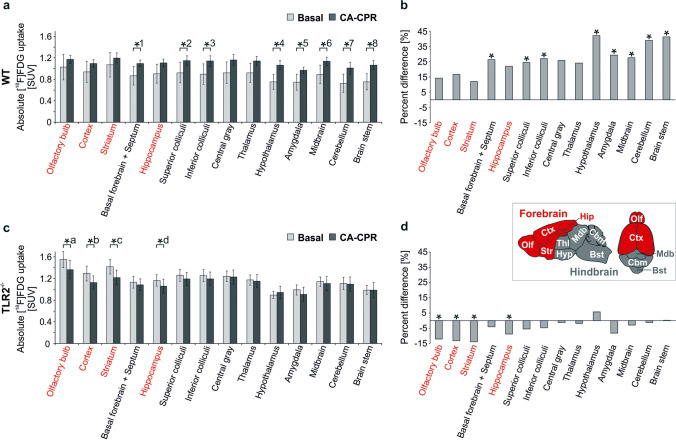
The absolute SUV of glucose in the whole brain of WT mice was increased about 25.6% after CA-CPR. In contrast, the absolute glucose SUV in the whole brain of TLR2 mice was not significantly different between baseline and measurements post CA-CPR. In comparison, baseline measurements of both mouse strains show a highly significant difference with regard to the absolute glucose SUV in the whole brain. Values of TLR2 mice revealed a 34.6% higher glucose uptake.
The altered mouse strains presented a different pattern in glucose uptake under normal and ischemic conditions, whereby the post-ischemic differences in glucose metabolism were associated with the function of key immune factor TLR2. There is evidence for using early FDG-PET-CT as an additional diagnostic tool after resuscitation. Further studies are needed to use PET-CT in predicting neurological outcomes.
哺乳动物的大脑葡萄糖代谢受到严格而敏感的调节。心脏骤停(CA)和心肺复苏(CPR)引起的缺血性脑损伤会影响大脑功能,可能还会影响葡萄糖代谢。大多数存活下来的 CA 患者都患有认知障碍和身体残疾。Toll 样受体 2(TLR2)在缺血再灌注(I/R)中的炎症反应中起着至关重要的作用。由于 TLR2 缺乏与 CA-CPR 后存活率增加有关,因此在这项研究中,我们在 WT 和 TLR2 缺陷(TLR2)小鼠模型中比较了 CA-CPR 前后使用非侵入性[F]F-FDG PET-CT 成像测量葡萄糖代谢。该研究将评估 FDG-PET 是否可作为评估预后的附加方法。
使用 2-脱氧-2-[F]氟-D-葡萄糖([F]F-FDG)示踪剂进行了两次 PET-CT 扫描,以在 CPR 前后测量动态葡萄糖代谢。为了实现这一目标,麻醉和通气的成年雌性 WT 和 TLR2 小鼠在 PET-CT 中进行了扫描。在基线扫描恢复后,相同的动物接受了 10 分钟的 KCL 诱导的 CA,然后进行了 CPR。在 CA 后约 90 分钟,开始进行 60 分钟的[F]F-FDG 摄取测量。使用 PMOD-Software 在融合的 FDG-PET-CT 图像上使用包含的 3D Mirrione-Mouse-Brain-Atlas 计算[F]F-FDG 标准化摄取值(SUV)。
WT 小鼠全脑的绝对葡萄糖 SUV 在 CA-CPR 后增加了约 25.6%。相比之下,TLR2 小鼠全脑的绝对葡萄糖 SUV 在 CA-CPR 前后测量值之间没有显著差异。相比之下,两种小鼠品系的基线测量值在全脑的绝对葡萄糖 SUV 方面存在显著差异。TLR2 小鼠的值显示葡萄糖摄取率提高了 34.6%。
改变的小鼠品系在正常和缺血条件下表现出不同的葡萄糖摄取模式,其中缺血后葡萄糖代谢的差异与关键免疫因子 TLR2 的功能有关。有证据表明,早期 FDG-PET-CT 可作为复苏后的附加诊断工具。需要进一步的研究来使用 PET-CT 预测神经结局。