Department of Radiology, Tokushima Red Cross Hospital, 103, Irinokuchi Komatsushima-cho, Komatsushima, Tokushima, 773-8502, Japan.
Department of Diagnostic Radiology, Graduate School of Health Sciences, Tokushima University, 3-18-15, Kuramoto-cho, Tokushima, Tokushima, 770-8509, Japan.
Jpn J Radiol. 2022 Apr;40(4):412-418. doi: 10.1007/s11604-021-01214-5. Epub 2021 Nov 15.
To evaluate the risk factors for unsuccessful removal of a central venous access port (CV port) implanted in the forearm of adult oncologic patients.
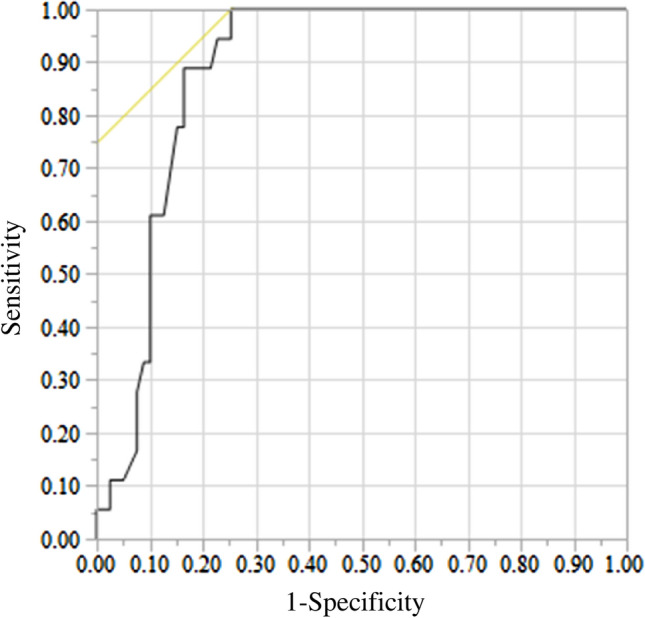
This study included 97 adult oncologic patients (51 males, 46 females; age range, 30-88 years; mean age, 63.7 years) in whom removal of a CV port implanted in the forearm was attempted at our hospital between January 2015 and May 2021. Gender, age at removal, body mass index, and diagnosis were examined as patient characteristics; and indwelling period, indwelling side, and indication for removal were examined as factors associated with removal of a CV port. These variables were compared between successful and unsuccessful cases using univariate analysis. Then, multivariate analysis was performed to identify independent risk factors for unsuccessful removal of a CV port using variables with a significant difference in the univariate analysis. A receiver-operating characteristics (ROC) curve was drawn for significant risk factors in the multivariate analysis and the Youden index was used to determine the optimum cut-off value for predicting unsuccessful removal of a CV port.
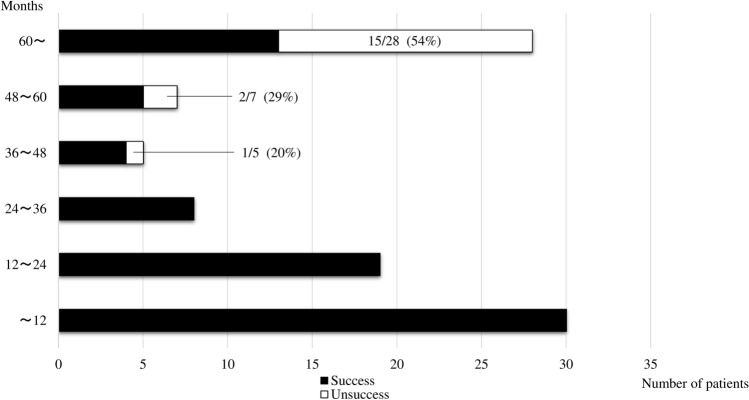
Removal of CV ports was successful in 79 cases (81.4%), but unsuccessful in 18 cases (18.6%) due to fixation of the catheter to the vessel wall. Multivariate logistic regression analysis showed that the indwelling period (odds ratio 1.048; 95% confidence interval 1.026-1.070; P < 0.0001) was a significant independent risk factor for unsuccessful removal of a CV port. ROC analysis showed that the cut-off value for successful removal was 41 months, and 54% of cases with an indwelling period > 60 months had unsuccessful removal.
The indwelling period is an independent risk factor for unsuccessful removal of a CV port implanted in the forearm of adult oncologic patients, with a cut-off of 41 months.
评估成人肿瘤科患者前臂植入中心静脉通路(CV 端口)拔除失败的危险因素。
本研究纳入 2015 年 1 月至 2021 年 5 月在我院尝试拔除前臂植入 CV 端口的 97 例成年肿瘤科患者(男 51 例,女 46 例;年龄 30-88 岁,平均 63.7 岁)。患者特征包括性别、拔除时年龄、体重指数和诊断;与 CV 端口拔除相关的因素包括留置期、留置侧和拔除指征。采用单因素分析比较成功组和失败组之间的这些变量。然后,采用多因素分析识别单因素分析中差异有统计学意义的 CV 端口拔除失败的独立危险因素。对多因素分析中的显著危险因素绘制受试者工作特征(ROC)曲线,并使用约登指数确定预测 CV 端口拔除失败的最佳截断值。
79 例(81.4%)成功拔除 CV 端口,但 18 例(18.6%)因导管与血管壁固定而失败。多因素 logistic 回归分析显示,留置时间(优势比 1.048;95%置信区间 1.026-1.070;P < 0.0001)是 CV 端口拔除失败的显著独立危险因素。ROC 分析显示,成功拔除的截断值为 41 个月,留置时间>60 个月的 54%病例拔除失败。
成人肿瘤科患者前臂植入 CV 端口的留置时间是拔除失败的独立危险因素,截断值为 41 个月。