Department of Epidemiology and Population Health, Center for Research on Population and Health, Faculty of Health Sciences, American University of Beirut, Beirut, Lebanon.
Department of Public Health, Institute of Tropical Medicine, Antwerp, Belgium.
PLoS One. 2021 Nov 16;16(11):e0259791. doi: 10.1371/journal.pone.0259791. eCollection 2021.
To examine trends and variations of caesarean section by economic status and type of healthcare facility in Arab countries in the Middle East and North Africa (MENA).
Secondary data analysis of nationally representative household surveys conducted between 2008-2020 across nine Arab countries in the MENA region. The study population was women aged 15-49 years with a live birth in the two years preceding the survey. Temporal changes in the proportion of deliveries by caesarean section in each country were calculated using generalised linear models and presented as risk differences (RD) with 95% confidence intervals (95%CI). Caesarean section was disaggregated by household wealth index and type of healthcare facility.
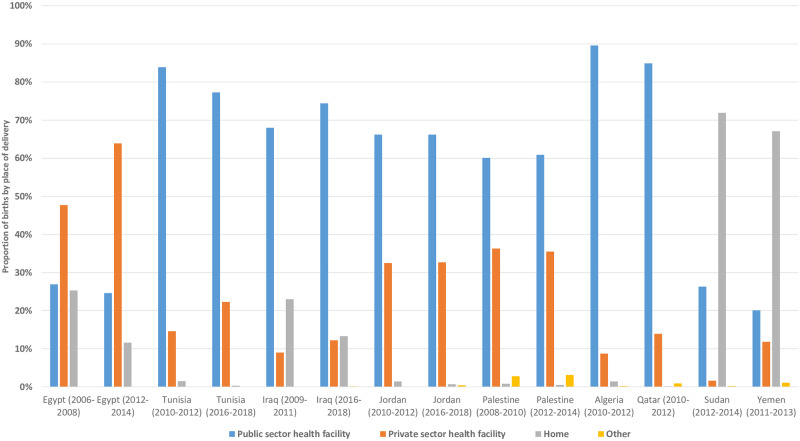
Use of caesarean section ranged from 57.3% (95%CI:55.6-59.1%) in Egypt to 5.7% of births (95%CI:4.9-6.6%) in Yemen. Overall, the use of caesarean section has increased across the MENA region, except in Jordan, where there was no evidence of change (RD -2.3 (95%CI: -6.0 ‒1.4)). Across most countries, caesarean section use was highest in the richest quintile compared to the poorest quintile, for example, 42.8% (95%CI:38.0-47.6%) vs. 22.6% (95%CI:19.6-25.9%) in Iraq, respectively. Proportion of caesarean section was higher in private sector facilities compared to public sector: 21.8% (95%CI:18.2-25.9%) vs. 15.7% (95%CI:13.3-18.4%) in Yemen, respectively.
Variations in caesarean section exist within and between Arab countries, and it was more commonly used amongst the richest quintiles and in private healthcare facilities. The private sector has a prominent role in observed trends. Urgent policies and interventions are required to address non-medically indicated intervention.
检查中东和北非(MENA)地区阿拉伯国家中按经济地位和医疗保健机构类型划分的剖宫产趋势和变化。
对 MENA 地区九个阿拉伯国家在 2008-2020 年期间进行的具有全国代表性的家庭调查进行二次数据分析。研究人群为过去两年内在调查前有活产的 15-49 岁妇女。使用广义线性模型计算每个国家剖宫产比例的时间变化,并以风险差异(RD)和 95%置信区间(95%CI)表示。按家庭财富指数和医疗保健机构类型对剖宫产进行分类。
剖宫产使用率从埃及的 57.3%(95%CI:55.6-59.1%)到也门的 5.7%(95%CI:4.9-6.6%)不等。总体而言,MENA 地区的剖宫产使用率有所增加,但在约旦没有变化的证据(RD-2.3(95%CI:-6.0-1.4))。在大多数国家,与最贫困五分位数相比,最富裕五分位数的剖宫产使用率最高,例如,在伊拉克分别为 42.8%(95%CI:38.0-47.6%)和 22.6%(95%CI:19.6-25.9%)。与公立医院相比,私立部门的剖宫产比例更高:也门分别为 21.8%(95%CI:18.2-25.9%)和 15.7%(95%CI:13.3-18.4%)。
阿拉伯国家内部和之间的剖宫产存在差异,最富裕五分位数和私立医疗机构中更为常见。私立部门在观察到的趋势中发挥了重要作用。需要采取紧急政策和干预措施来解决非医学指征的干预问题。