Bellanti Francesco, di Bello Giorgia, Tamborra Rosanna, Amatruda Marco, Lo Buglio Aurelio, Dobrakowski Michał, Kasperczyk Aleksandra, Kasperczyk Sławomir, Serviddio Gaetano, Vendemiale Gianluigi
Department of Medical and Surgical Sciences, University of Foggia, Foggia 71122, Italy.
Department of Biochemistry, Medical University of Silesia, Zabrze 41-808, Poland.
World J Stem Cells. 2021 Oct 26;13(10):1595-1609. doi: 10.4252/wjsc.v13.i10.1595.
Senescence is characterized by a decline in hepatocyte function, with impairment of metabolism and regenerative capacity. Several models that duplicate liver functions are essential tools for studying drug metabolism, liver diseases, and organ regeneration. The human HepaRG cell line represents an effective model for the study of liver metabolism and hepatic progenitors. However, the impact of senescence on HepaRG cells is not yet known.
To characterize the effects of senescence on the transdifferentiation capacity and mitochondrial metabolism of human HepaRG cells.
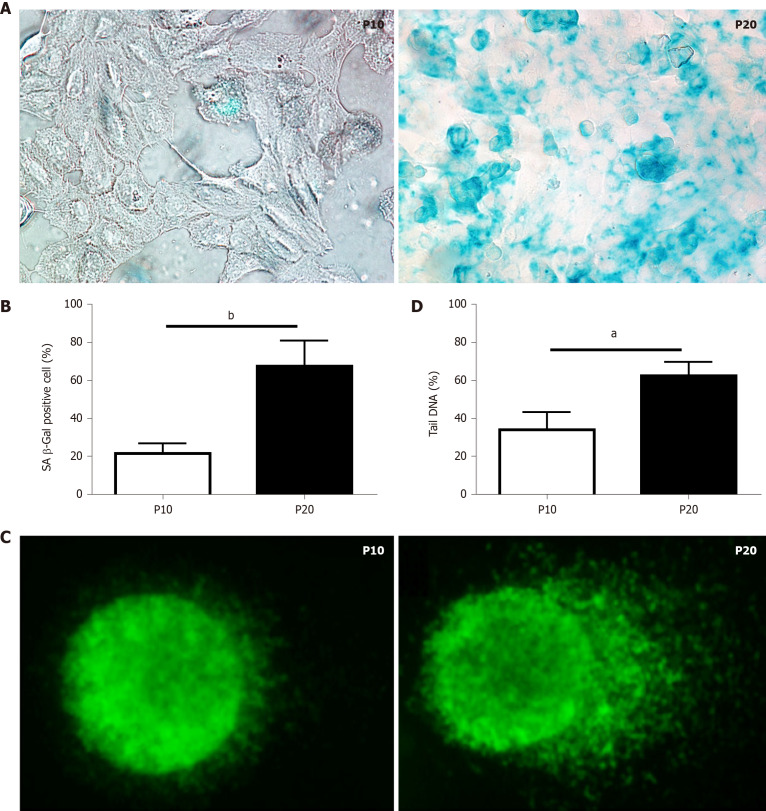
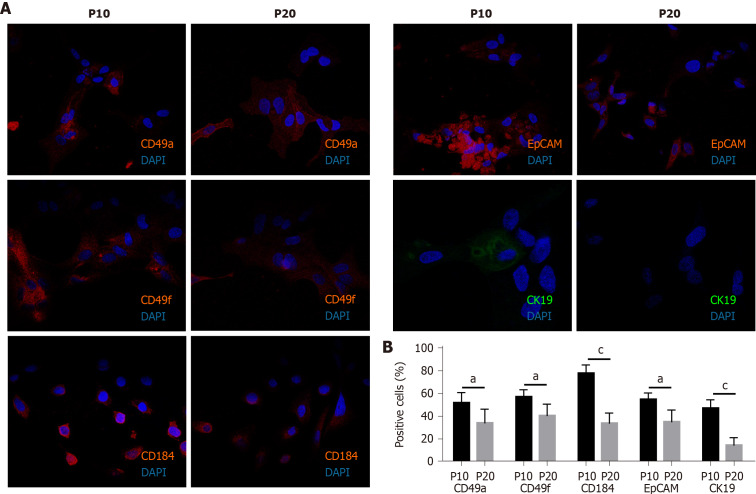
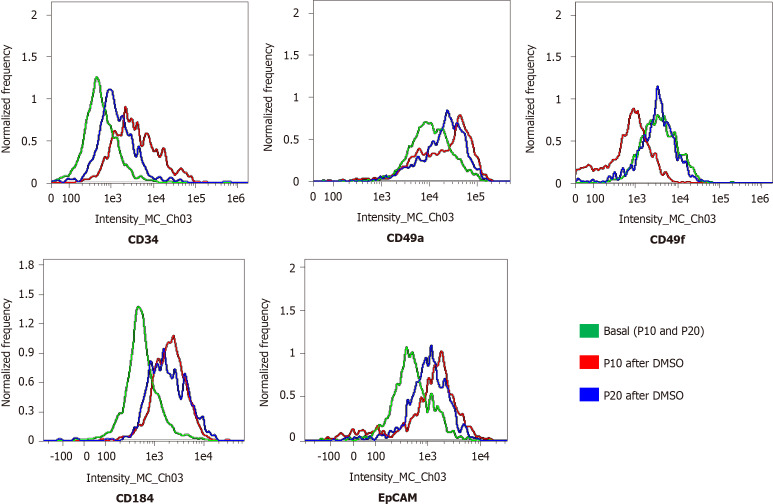
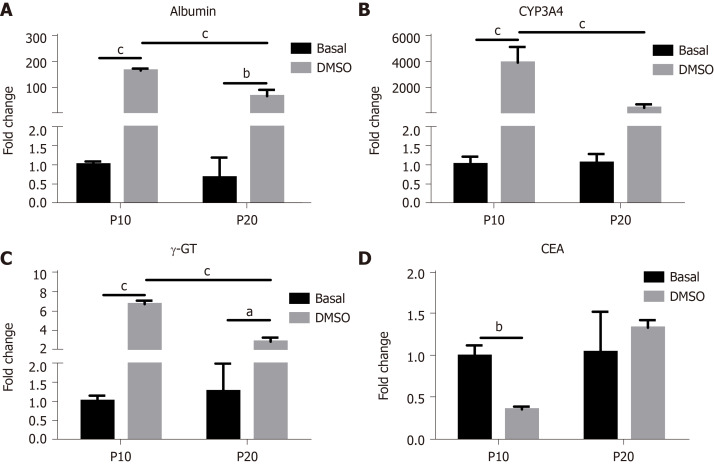
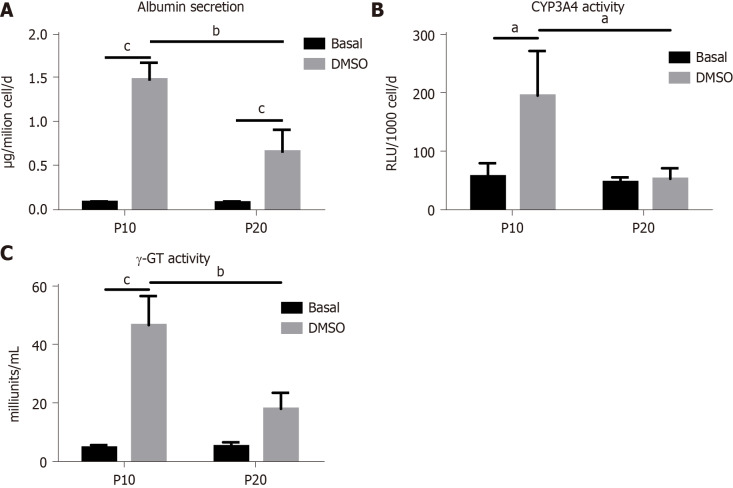
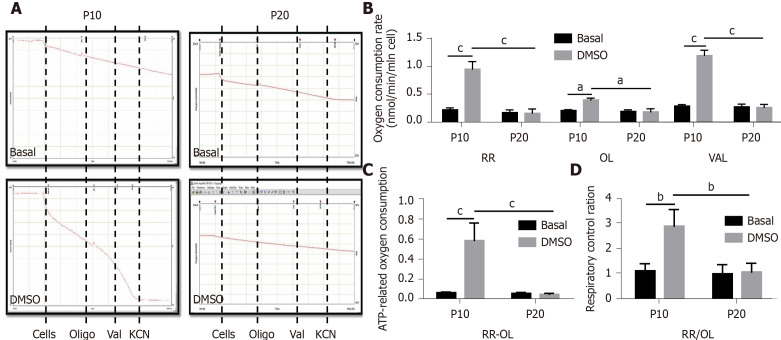
We compared the transdifferentiation capacity of cells over 10 (passage 10 [P10]) P20. Aging was evaluated by senescence-associated (SA) beta-galactosidase activity and the comet assay. HepaRG transdifferentiation was analyzed by confocal microscopy and flow cytometry (expression of cluster of differentiation 49a [CD49a], CD49f, CD184, epithelial cell adhesion molecule [EpCAM], and cytokeratin 19 [CK19]), quantitative PCR analysis (expression of albumin, cytochrome P450 3A4 [CYP3A4], γ-glutamyl transpeptidase [γ-GT], and carcinoembryonic antigen [CEA]), and functional analyses (albumin secretion, CYP3A4, and γ-GT). Mitochondrial respiration and the ATP and nicotinamide adenine dinucleotide (NAD)/NAD with hydrogen (NADH) content were also measured.
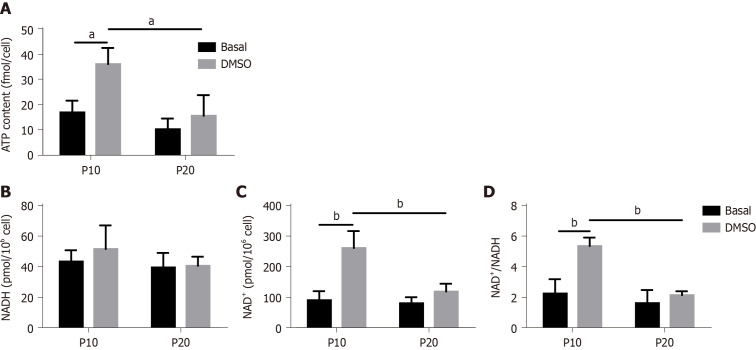
SA β-galactosidase staining was higher in P20 than P10 HepaRG cells; in parallel, the comet assay showed consistent DNA damage in P20 HepaRG cells. With respect to P10, P20 HepaRG cells exhibited a reduction of CD49a, CD49f, CD184, EpCAM, and CK19 after the induction of transdifferentiation. Furthermore, lower gene expression of albumin, CYP3A4, and γ-GT, as well as reduced albumin secretion capacity, CYP3A4, and γ-GT activity were reported in transdifferentiated P20 compared to P10 cells. By contrast, the gene expression level of CEA was not reduced by transdifferentiation in P20 cells. Of note, both cellular and mitochondrial oxygen consumption was lower in P20 than in P10 transdifferentiated cells. Finally, both ATP and NAD/NADH were depleted in P20 cells with respect to P10 cells.
SA mitochondrial dysfunction may limit the transdifferentiation potential of HepaRG cells, with consequent impairment of metabolic and regenerative properties, which may alter applications in basic studies.
衰老的特征是肝细胞功能下降,伴有代谢和再生能力受损。几种复制肝功能的模型是研究药物代谢、肝脏疾病和器官再生的重要工具。人HepaRG细胞系是研究肝脏代谢和肝祖细胞的有效模型。然而,衰老对HepaRG细胞的影响尚不清楚。
描述衰老对人HepaRG细胞转分化能力和线粒体代谢的影响。
我们比较了传代10次(第10代[P10])和第20代细胞的转分化能力。通过衰老相关(SA)β-半乳糖苷酶活性和彗星试验评估细胞衰老情况。通过共聚焦显微镜和流式细胞术(分化簇49a[CD49a]、CD49f、CD184、上皮细胞粘附分子[EpCAM]和细胞角蛋白19[CK19]的表达)、定量PCR分析(白蛋白、细胞色素P450 3A4[CYP3A4]、γ-谷氨酰转肽酶[γ-GT]和癌胚抗原[CEA]的表达)以及功能分析(白蛋白分泌、CYP3A4和γ-GT)分析HepaRG细胞的转分化情况。还测量了线粒体呼吸以及ATP和烟酰胺腺嘌呤二核苷酸(NAD)/还原型烟酰胺腺嘌呤二核苷酸(NADH)的含量。
SAβ-半乳糖苷酶染色在第20代HepaRG细胞中高于第10代;同时,彗星试验显示第20代HepaRG细胞存在一致的DNA损伤。与第10代相比,第20代HepaRG细胞在诱导转分化后,CD49a、CD49f、CD184、EpCAM和CK19的表达降低。此外,与第10代细胞相比,第20代转分化细胞中白蛋白、CYP3A4和γ-GT的基因表达较低,白蛋白分泌能力、CYP3A4和γ-GT活性也降低。相比之下,第20代细胞中转分化并未降低CEA的基因表达水平。值得注意的是,第20代转分化细胞的细胞耗氧量和线粒体耗氧量均低于第10代。最后,与第10代细胞相比,第20代细胞中的ATP和NAD/NADH均减少。
SA线粒体功能障碍可能会限制HepaRG细胞的转分化潜能,进而损害其代谢和再生特性,这可能会改变基础研究中的应用。