Department of Experimental and Clinical Medicine, MDS Unit, AOUC- University of Florence, Florence, Italy.
Department of Internal Medicine I, Medical Center, University of Freiburg, Faculty of Medicine, University of Freiburg Medical Center, Freiburg, Germany.
Adv Ther. 2022 Apr;39(4):1474-1488. doi: 10.1007/s12325-021-01948-8. Epub 2021 Nov 16.
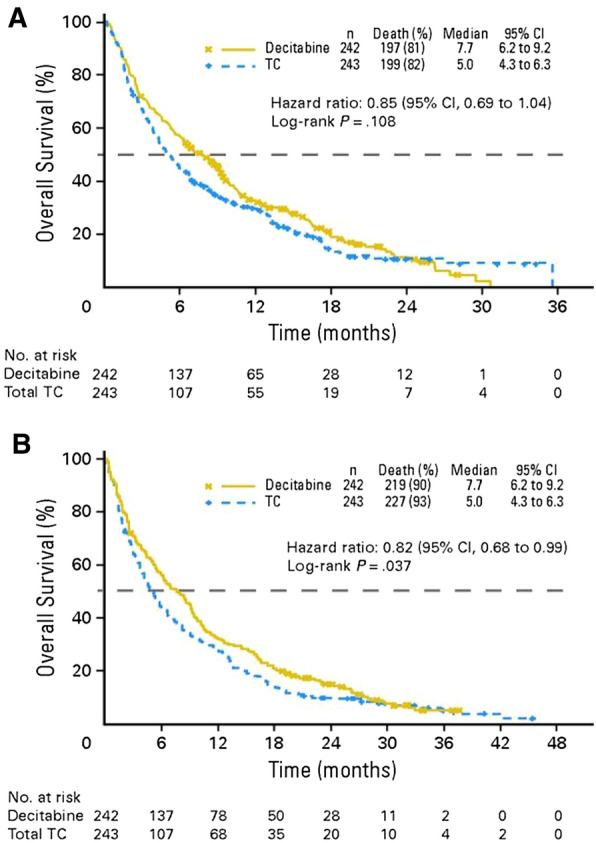
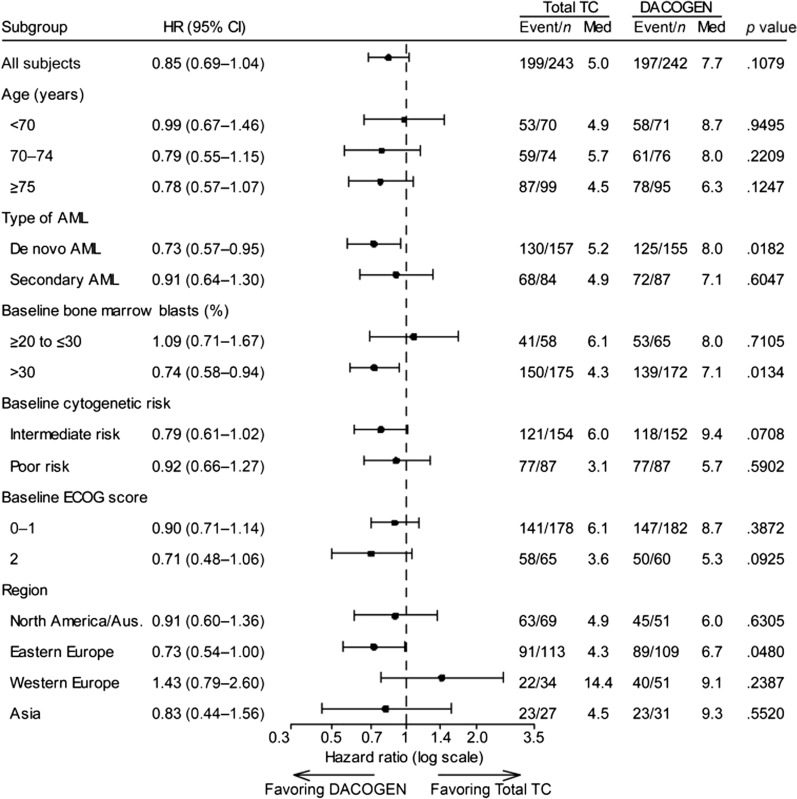
Decitabine (5-aza-2'-deoxycytidine) is a hypomethylating agent used in the treatment of acute myeloid leukemia (AML). Decitabine inhibits DNA methyltransferases, causing DNA hypomethylation, and leading amongst others to re-expression of silenced tumor suppressor genes. Decitabine is indicated for the treatment of adult patients with newly diagnosed de novo or secondary AML who are not eligible for standard induction chemotherapy. The initial authorization in 2012 was based on the results of the open-label, randomized, multicenter phase 3 DACO-016 trial, and supported by data from the supportive phase 2 open-label DACO-017 trial. Compared with standard care, decitabine significantly improved overall survival, event-free survival, progression-free survival, and response rate. Decitabine was generally well tolerated, offering a valuable treatment option in patients with AML irrespective of age, especially for patients achieving a complete response. Several observational "real-life" studies confirmed these results. In contrast to standard chemotherapy, the presence of adverse-risk karyotypes or TP53 mutations does not negatively impact sensitivity to hypomethylating therapy albeit with lower durability. Data suggest a potential positive effect of decitabine in patients with monosomal karyotype-positive AML. For the time being, decitabine is an appropriate option as monotherapy for patients with AML who are unfit to receive more intensive combination therapies, but emerging data suggest that decitabine-based doublet or triplet combinations may be future treatment options for patients with AML.
地西他滨(5-氮杂-2'-脱氧胞苷)是一种用于治疗急性髓系白血病(AML)的低甲基化剂。地西他滨抑制 DNA 甲基转移酶,导致 DNA 低甲基化,并导致沉默的肿瘤抑制基因重新表达等。地西他滨适用于治疗不符合标准诱导化疗条件的新诊断为初发或继发 AML 的成年患者。2012 年的首次批准是基于开放标签、随机、多中心的 3 期 DACO-016 试验的结果,并得到了支持性 2 期开放标签 DACO-017 试验的数据支持。与标准治疗相比,地西他滨显著改善了总生存期、无事件生存期、无进展生存期和反应率。地西他滨通常具有良好的耐受性,为 AML 患者提供了一种有价值的治疗选择,无论年龄大小,尤其是对于达到完全缓解的患者。几项观察性“真实世界”研究证实了这些结果。与标准化疗相比,不良风险核型或 TP53 突变的存在并不影响对低甲基化治疗的敏感性,尽管持久性较低。数据表明地西他滨对单体型核型阳性 AML 患者可能有潜在的积极作用。目前,地西他滨是不适合接受更强化联合治疗的 AML 患者的单药治疗的合适选择,但新出现的数据表明,地西他滨为基础的双联或三联组合可能是 AML 患者未来的治疗选择。