• 文献检索
  • 文档翻译
  • 深度研究
  • 学术资讯
  • Suppr Zotero 插件Zotero 插件
  • 邀请有礼
  • 套餐&价格
  • 历史记录
应用&插件
Suppr Zotero 插件Zotero 插件浏览器插件Mac 客户端Windows 客户端微信小程序
定价
高级版会员购买积分包购买API积分包
服务
文献检索文档翻译深度研究API 文档MCP 服务
关于我们
关于 Suppr公司介绍联系我们用户协议隐私条款
关注我们

Suppr 超能文献

核心技术专利:CN118964589B侵权必究
粤ICP备2023148730 号-1Suppr @ 2026

文献检索

告别复杂PubMed语法,用中文像聊天一样搜索,搜遍4000万医学文献。AI智能推荐,让科研检索更轻松。

立即免费搜索

文件翻译

保留排版,准确专业,支持PDF/Word/PPT等文件格式,支持 12+语言互译。

免费翻译文档

深度研究

AI帮你快速写综述,25分钟生成高质量综述,智能提取关键信息,辅助科研写作。

立即免费体验

COVID-19 疫苗犹豫的个体决定因素。

Individual determinants of COVID-19 vaccine hesitancy.

机构信息

Campbell Family Mental Health Research Institute, Centre for Addiction and Mental Health, Toronto, Ontario, Canada.

Department of Psychiatry, University of Toronto, Toronto, Ontario, Canada.

出版信息

PLoS One. 2021 Nov 17;16(11):e0258462. doi: 10.1371/journal.pone.0258462. eCollection 2021.

DOI:10.1371/journal.pone.0258462
PMID:34788308
原文链接:https://pmc.ncbi.nlm.nih.gov/articles/PMC8598046/
Abstract

BACKGROUND

Novel coronavirus disease 2019 (COVID-19) vaccine hesitancy is a barrier to achieving herd immunity, and thus, a prominent public health concern. This study aimed to identify the determinants of COVID-19 vaccine hesitancy based on the World Health Organization's '3Cs' model (i.e., confidence, complacency, and convenience) in the United States (U.S.) and Canada.

METHODS

Data from 7678 adults ages 18 or older were collected from the four most populous U.S. States, specifically New York, California, Florida, and Texas, and from English-speaking Canada at three timepoints, in May and July 2020, and March 2021 using a web-based survey (www.covid19-database.com). Sociodemographic information was collected, and comprehensive psychological assessments were administered. Univariate analyses were performed to identify the individual determinants of vaccine hesitancy, which were categorized as: 1) vaccine confidence, 2) vaccine complacency, 3) sociodemographic, and 4) other psychological factors. A series of models were computed using these categorizations.

RESULTS

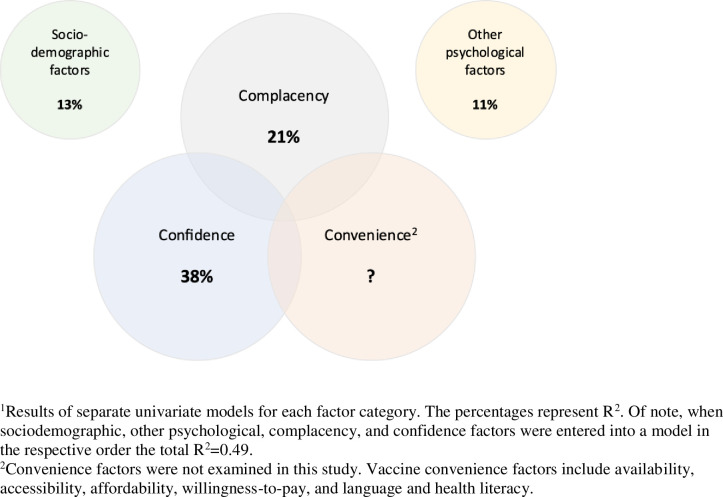
Mistrust of vaccine benefit (β(SE) = 0.67(0.01), p<0.001, partial η2 = 0.26) and lower perceived seriousness of COVID-19 (β(SE) = 0.68(0.02), p<0.001, partial η2 = 0.12) were the principal determinants of vaccine hesitancy. Right-wing political affiliation (β(SE) = 0.32(0.02), p<0.001, partial η2 = 0.03), higher risk propensity (β(SE) = 0.24(0.02), p<0.001, partial η2 = 0.03), and less negative mental health effects of the COVID-19 pandemic (β(SE) = 0.20(0.01), p<0.001, partial η2 = 0.03) were the main sociodemographic and psychological determinants. Other sociodemographic determinants included younger age, women, race, and employment status. Lack of vaccine confidence and complacency explained 38% and 21% of the variance in vaccine hesitancy, respectively; whereas, sociodemographic and psychological determinants explained 13% and 11% of the variance in vaccine hesitancy, respectively.

DISCUSSION

Targeted and tailored public health interventions that enhance the public's confidence in vaccines and emphasize the risk and seriousness of COVID-19 may address COVID-19 vaccine hesitancy. Efforts directed toward specific marginalized and underserved groups may be required to promote vaccine confidence.

摘要

背景

新型冠状病毒病 2019(COVID-19)疫苗犹豫是实现群体免疫的障碍,因此是一个突出的公共卫生问题。本研究旨在根据世界卫生组织(WHO)的“3C”模型(即信心、自满和便利),确定美国和加拿大 COVID-19 疫苗犹豫的决定因素。

方法

从美国四个人口最多的州(纽约州、加利福尼亚州、佛罗里达州和得克萨斯州)和讲英语的加拿大收集了 7678 名年龄在 18 岁或以上的成年人的数据,分别在 2020 年 5 月和 7 月以及 2021 年 3 月使用了一个基于网络的调查(www.covid19-database.com)。收集了社会人口统计学信息,并进行了全面的心理评估。进行了单变量分析,以确定疫苗犹豫的个体决定因素,这些因素分为:1)疫苗信心,2)疫苗自满,3)社会人口统计学和 4)其他心理因素。使用这些分类计算了一系列模型。

结果

对疫苗益处的不信任(β(SE)=0.67(0.01),p<0.001,部分 η2=0.26)和对 COVID-19 严重性的感知降低(β(SE)=0.68(0.02),p<0.001,部分 η2=0.12)是疫苗犹豫的主要决定因素。右翼政治派别(β(SE)=0.32(0.02),p<0.001,部分 η2=0.03)、更高的风险倾向(β(SE)=0.24(0.02),p<0.001,部分 η2=0.03)和 COVID-19 大流行对心理健康影响较小(β(SE)=0.20(0.01),p<0.001,部分 η2=0.03)是主要的社会人口统计学和心理决定因素。其他社会人口统计学决定因素包括年龄较小、女性、种族和就业状况。缺乏疫苗信心和自满分别解释了疫苗犹豫的 38%和 21%的方差;而社会人口统计学和心理决定因素分别解释了疫苗犹豫的 13%和 11%的方差。

讨论

针对增强公众对疫苗的信心并强调 COVID-19 的风险和严重性的有针对性和量身定制的公共卫生干预措施可能会解决 COVID-19 疫苗犹豫问题。可能需要针对特定的边缘化和服务不足的群体开展工作,以促进疫苗信心。
https://cdn.ncbi.nlm.nih.gov/pmc/blobs/7033/8598046/5f2dbb3db9cc/pone.0258462.g003.jpg
https://cdn.ncbi.nlm.nih.gov/pmc/blobs/7033/8598046/3ff5a9b6e99d/pone.0258462.g001.jpg
https://cdn.ncbi.nlm.nih.gov/pmc/blobs/7033/8598046/af6f76eb89cc/pone.0258462.g002.jpg
https://cdn.ncbi.nlm.nih.gov/pmc/blobs/7033/8598046/5f2dbb3db9cc/pone.0258462.g003.jpg
https://cdn.ncbi.nlm.nih.gov/pmc/blobs/7033/8598046/3ff5a9b6e99d/pone.0258462.g001.jpg
https://cdn.ncbi.nlm.nih.gov/pmc/blobs/7033/8598046/af6f76eb89cc/pone.0258462.g002.jpg
https://cdn.ncbi.nlm.nih.gov/pmc/blobs/7033/8598046/5f2dbb3db9cc/pone.0258462.g003.jpg

相似文献

1
Individual determinants of COVID-19 vaccine hesitancy.COVID-19 疫苗犹豫的个体决定因素。
PLoS One. 2021 Nov 17;16(11):e0258462. doi: 10.1371/journal.pone.0258462. eCollection 2021.
2
Determinants of social distancing adherence.社会距离遵守的决定因素。
Front Public Health. 2023 Jan 12;10:977857. doi: 10.3389/fpubh.2022.977857. eCollection 2022.
3
Changes in general and COVID-19 vaccine hesitancy among U.S. adults from 2021 to 2022.2021 年至 2022 年美国成年人对一般疫苗和 COVID-19 疫苗犹豫的变化。
Ann Med. 2024 Dec;56(1):2357230. doi: 10.1080/07853890.2024.2357230. Epub 2024 May 30.
4
Socioeconomic determinants and reasons for non-acceptance to vaccination recommendations during the 3 - 5 waves of the COVID-19 pandemic in Hungary.匈牙利 COVID-19 大流行的 3-5 波期间,疫苗接种建议的社会经济决定因素和不接受原因。
BMC Public Health. 2024 Jul 5;24(1):1796. doi: 10.1186/s12889-024-19267-2.
5
Vaccine Hesitancy Is a Barrier to Achieving Equitable Herd Immunity Among Racial Minorities.疫苗犹豫是在少数族裔中实现公平群体免疫的一个障碍。
Front Med (Lausanne). 2021 Nov 24;8:668299. doi: 10.3389/fmed.2021.668299. eCollection 2021.
6
Motivators and Demotivators for COVID-19 Vaccination Based on Co-Occurrence Networks of Verbal Reasons for Vaccination Acceptance and Resistance: Repetitive Cross-Sectional Surveys and Network Analysis.基于疫苗接种接受和抵制的口头理由共现网络的 COVID-19 疫苗接种动机和抑制因素:重复横断面调查和网络分析。
JMIR Public Health Surveill. 2024 Apr 22;10:e50958. doi: 10.2196/50958.
7
Dynamic evolution of COVID-19 vaccine hesitancy over 2021-2023 among Chinese population: Repeated nationwide cross-sectional study.2021-2023 年中国人群对 COVID-19 疫苗犹豫的动态演变:重复全国性横断面研究。
J Med Virol. 2024 Jul;96(7):e29800. doi: 10.1002/jmv.29800.
8
COVID-19 vaccine hesitancy among adults in India: A primary study based on health behavior theories and 5C psychological antecedents model.印度成年人对 COVID-19 疫苗的犹豫:基于健康行为理论和 5C 心理前因模型的初步研究。
PLoS One. 2024 May 9;19(5):e0294480. doi: 10.1371/journal.pone.0294480. eCollection 2024.
9
COVID-19 Vaccine Hesitancy Among Chinese Population: A Large-Scale National Study.中国民众对 COVID-19 疫苗的犹豫:一项大规模的全国性研究。
Front Immunol. 2021 Nov 29;12:781161. doi: 10.3389/fimmu.2021.781161. eCollection 2021.
10
COVID-19 Vaccine Hesitancy Among Adolescent and Young Adult Cancer Survivors.青少年和青年癌症幸存者对 COVID-19 疫苗的犹豫。
JNCI Cancer Spectr. 2021 Jun 29;5(3):Pkab049. doi: 10.1093/jncics/pkab049. eCollection 2021 Jun.

引用本文的文献

1
Attitudes Toward COVID-19 and Seasonal Influenza Vaccines in the Post-COVID Era: A Cross-Sectional Study Among Adults in Malta.新冠疫情后时代对新冠病毒和季节性流感疫苗的态度:马耳他成年人的横断面研究
Pharmacy (Basel). 2025 Jul 29;13(4):102. doi: 10.3390/pharmacy13040102.
2
Vaccine hesitancy and decision regret among nurses in oncology settings in Italy: a cluster-based profile analysis.意大利肿瘤科室护士的疫苗犹豫和决策后悔:基于聚类的概况分析
Sci Rep. 2025 Aug 21;15(1):30813. doi: 10.1038/s41598-025-16759-y.
3
Prevalence of COVID-19 vaccine hesitancy in Brazil: a systematic review and meta-analysis.

本文引用的文献

1
Factors Associated With US Adults' Likelihood of Accepting COVID-19 Vaccination.与美国成年人接受 COVID-19 疫苗意愿相关的因素。
JAMA Netw Open. 2020 Oct 1;3(10):e2025594. doi: 10.1001/jamanetworkopen.2020.25594.
2
COVID-19 vaccine trials should seek worthwhile efficacy.新冠病毒疫苗试验应追求有价值的疗效。
Lancet. 2020 Sep 12;396(10253):741-743. doi: 10.1016/S0140-6736(20)31821-3. Epub 2020 Aug 27.
3
A future vaccination campaign against COVID-19 at risk of vaccine hesitancy and politicisation.未来针对新冠病毒的疫苗接种运动面临疫苗犹豫和政治化的风险。
巴西新冠疫苗犹豫的流行情况:一项系统评价与荟萃分析
Front Public Health. 2025 Aug 4;13:1622247. doi: 10.3389/fpubh.2025.1622247. eCollection 2025.
4
The Influence of the Coronavirus Disease 2019 Pandemic on Influenza Vaccination Refusal and Patient Satisfaction.2019年冠状病毒病大流行对流感疫苗接种拒绝率及患者满意度的影响
Open Forum Infect Dis. 2025 Jun 18;12(7):ofaf351. doi: 10.1093/ofid/ofaf351. eCollection 2025 Jul.
5
Use of complementary medicine and uptake of COVID-19 vaccination among US adults.美国成年人使用补充医学与接种新冠疫苗情况
Front Med (Lausanne). 2025 Jun 11;12:1474914. doi: 10.3389/fmed.2025.1474914. eCollection 2025.
6
COVID-19 vaccine hesitancy among Italian university students: Insights from history to shape the future.意大利大学生对新冠疫苗的犹豫态度:从历史中汲取经验以塑造未来
Hum Vaccin Immunother. 2025 Dec;21(1):2506307. doi: 10.1080/21645515.2025.2506307. Epub 2025 Jun 18.
7
Factors associated with parental hesitancy towards the human papillomavirus vaccine: a cross-sectional study.与父母对人乳头瘤病毒疫苗犹豫相关的因素:一项横断面研究。
Sci Rep. 2025 May 26;15(1):18284. doi: 10.1038/s41598-025-94067-1.
8
Vaccination, Public Health and Health Communication: A Network of Connections to Tackle Global Challenges.疫苗接种、公共卫生与健康传播:应对全球挑战的联系网络
Vaccines (Basel). 2025 Feb 27;13(3):245. doi: 10.3390/vaccines13030245.
9
Spatial multilevel analysis of individual, household, and community factors associated with COVID-19 vaccine hesitancy in the Dominican Republic.多米尼加共和国与新冠疫苗犹豫相关的个人、家庭和社区因素的空间多层次分析。
Sci Rep. 2025 Apr 2;15(1):11203. doi: 10.1038/s41598-025-94653-3.
10
Rural community pharmacists' willingness to receive, administer, and recommend COVID-19 vaccines after the First U.S. vaccine rollout.美国首次推出新冠疫苗后农村社区药剂师接受、接种和推荐新冠疫苗的意愿。
Explor Res Clin Soc Pharm. 2024 Oct 5;16:100520. doi: 10.1016/j.rcsop.2024.100520. eCollection 2024 Dec.
Lancet Infect Dis. 2020 Jul;20(7):769-770. doi: 10.1016/S1473-3099(20)30426-6. Epub 2020 May 20.
4
Herd Immunity: Understanding COVID-19.群体免疫:了解 COVID-19。
Immunity. 2020 May 19;52(5):737-741. doi: 10.1016/j.immuni.2020.04.012.
5
An interactive web-based dashboard to track COVID-19 in real time.一个基于网络的交互式仪表盘,用于实时追踪新冠病毒。
Lancet Infect Dis. 2020 May;20(5):533-534. doi: 10.1016/S1473-3099(20)30120-1. Epub 2020 Feb 19.
6
Understanding the Dimensions of Anti-Vaccination Attitudes: the Vaccination Attitudes Examination (VAX) Scale.理解反疫苗态度的维度:疫苗接种态度测验(VAX)量表
Ann Behav Med. 2017 Oct;51(5):652-660. doi: 10.1007/s12160-017-9888-y.
7
Barriers of Influenza Vaccination Intention and Behavior - A Systematic Review of Influenza Vaccine Hesitancy, 2005 - 2016.流感疫苗接种意愿与行为的障碍——2005 - 2016年流感疫苗犹豫情况的系统评价
PLoS One. 2017 Jan 26;12(1):e0170550. doi: 10.1371/journal.pone.0170550. eCollection 2017.
8
Vaccine hesitancy: Definition, scope and determinants.疫苗犹豫:定义、范围及决定因素
Vaccine. 2015 Aug 14;33(34):4161-4. doi: 10.1016/j.vaccine.2015.04.036. Epub 2015 Apr 17.
9
Understanding vaccine hesitancy around vaccines and vaccination from a global perspective: a systematic review of published literature, 2007-2012.从全球视角理解疫苗犹豫和疫苗接种:对 2007-2012 年已发表文献的系统综述。
Vaccine. 2014 Apr 17;32(19):2150-9. doi: 10.1016/j.vaccine.2014.01.081. Epub 2014 Mar 2.
10
Socially desirable responding on the web: investigating the candor hypothesis.网络上的社会期望性回应:探究坦诚假设。
J Pers Assess. 2006 Dec;87(3):269-76. doi: 10.1207/s15327752jpa8703_08.