Gerretsen Philip, Kim Julia, Quilty Lena, Wells Samantha, Brown Eric E, Agic Branka, Pollock Bruce G, Graff-Guerrero Ariel
Centre for Addiction and Mental Health (CAMH) and Department of Psychiatry, Campbell Family Mental Health Research Institute, University of Toronto, Toronto, ON, Canada.
Institute of Medical Science, School of Graduate Studies, University of Toronto, Toronto, ON, Canada.
Front Med (Lausanne). 2021 Nov 24;8:668299. doi: 10.3389/fmed.2021.668299. eCollection 2021.
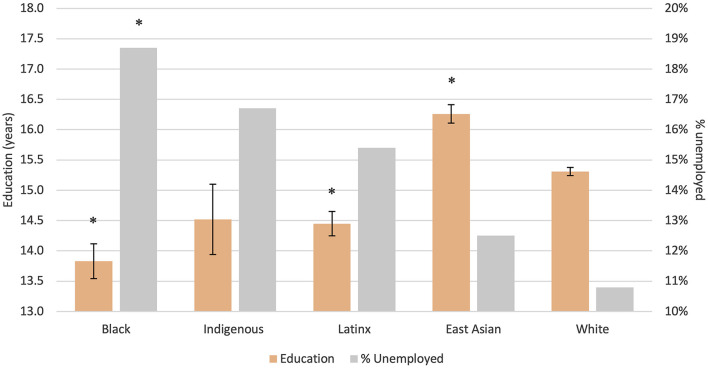
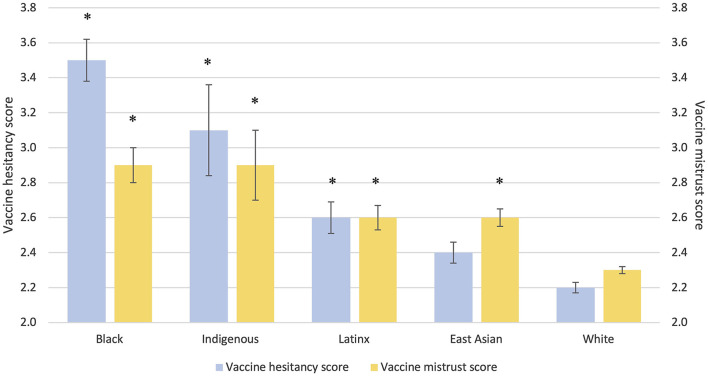
Racial minority groups have been disproportionately affected by the 2019 novel coronavirus disease (COVID-19). Vaccine hesitancy may be a major barrier to achieving equitable herd immunity and must be addressed to reduce the excess morbidity and mortality of COVID-19 in disproportionately affected communities. This study aimed to determine if COVID-19 vaccine hesitancy, and its factors vaccine complacency and confidence, are more prominent among disproportionately affected racial minority groups. We collected data from participants aged 18 years or older from the four most populous U.S. states, including New York, California, Florida, and Texas, and Canada. Data were collected using a web-based survey platform. Data are available at http://www.covid19-database.com. Data from 4,434 participants were included [mean (SD) age = 48.7 (17.2) and 50.4% women]. Vaccine hesitancy was higher in Black, Indigenous (Native American and Indigenous People of Canada, including First Nations, Inuit and Métis), and Latinx compared to White participants, while no difference was found between East Asian and White participants. The group differences in vaccine hesitancy for Indigenous and Black compared to White participants remained after controlling for sociodemographic factors. Determinants of vaccine complacency were equivalent between disproportionately affected racial groups and white participants. Vaccine confidence (i.e., trust in vaccine benefit) was generally lower in all racial groups compared to White participants. Differences in vaccine mistrust comparing Black and East Asian to White participants remained after controlling for sociodemographic factors. Disproportionately affected racial minorities may have higher vaccine hesitancy and lower confidence in COVID-19 vaccines. Public health and other relevant government services should address vaccine hesitancy among racial minorities using a culturally sensitive, community-centered approach to attain equitable herd immunity.
少数种族群体受2019年新型冠状病毒病(COVID-19)的影响尤为严重。疫苗犹豫可能是实现公平群体免疫的主要障碍,必须加以解决,以降低受影响尤为严重社区中COVID-19的额外发病率和死亡率。本研究旨在确定COVID-19疫苗犹豫及其相关因素——疫苗自满和信心,在受影响尤为严重的少数种族群体中是否更为突出。我们从美国人口最多的四个州(包括纽约州、加利福尼亚州、佛罗里达州和得克萨斯州)以及加拿大的18岁及以上参与者中收集数据。数据通过基于网络的调查平台收集。数据可在http://www.covid19-database.com获取。纳入了4434名参与者的数据[平均(标准差)年龄 = 48.7(17.2)岁,女性占50.4%]。与白人参与者相比,黑人、原住民(美国原住民和加拿大原住民,包括第一民族、因纽特人和梅蒂斯人)以及拉丁裔的疫苗犹豫程度更高,而东亚人和白人参与者之间未发现差异。在控制了社会人口学因素后,原住民和黑人与白人参与者在疫苗犹豫方面的群体差异依然存在。受影响尤为严重的种族群体和白人参与者在疫苗自满的决定因素方面相当。与白人参与者相比,所有种族群体的疫苗信心(即对疫苗益处的信任)普遍较低。在控制了社会人口学因素后,黑人与东亚人和白人参与者在疫苗不信任方面的差异依然存在。受影响尤为严重的少数种族群体可能对COVID-19疫苗有更高的犹豫程度和更低的信心。公共卫生及其他相关政府部门应采用具有文化敏感性、以社区为中心的方法来解决少数种族群体中的疫苗犹豫问题,以实现公平的群体免疫。