• 文献检索
  • 文档翻译
  • 深度研究
  • 学术资讯
  • Suppr Zotero 插件Zotero 插件
  • 邀请有礼
  • 套餐&价格
  • 历史记录
应用&插件
Suppr Zotero 插件Zotero 插件浏览器插件Mac 客户端Windows 客户端微信小程序
定价
高级版会员购买积分包购买API积分包
服务
文献检索文档翻译深度研究API 文档MCP 服务
关于我们
关于 Suppr公司介绍联系我们用户协议隐私条款
关注我们

Suppr 超能文献

核心技术专利:CN118964589B侵权必究
粤ICP备2023148730 号-1Suppr @ 2026

文献检索

告别复杂PubMed语法,用中文像聊天一样搜索,搜遍4000万医学文献。AI智能推荐,让科研检索更轻松。

立即免费搜索

文件翻译

保留排版,准确专业,支持PDF/Word/PPT等文件格式,支持 12+语言互译。

免费翻译文档

深度研究

AI帮你快速写综述,25分钟生成高质量综述,智能提取关键信息,辅助科研写作。

立即免费体验

UFold:使用深度学习进行快速准确的 RNA 二级结构预测。

UFold: fast and accurate RNA secondary structure prediction with deep learning.

机构信息

Systems Engineering Institute, School of Electronic and Information Engineering, Xi'an Jiaotong University, Xi'an, Shaanxi 710049, China.

Department of Computer Science, University of California, Irvine, CA 92697, USA.

出版信息

Nucleic Acids Res. 2022 Feb 22;50(3):e14. doi: 10.1093/nar/gkab1074.

DOI:10.1093/nar/gkab1074
PMID:34792173
原文链接:https://pmc.ncbi.nlm.nih.gov/articles/PMC8860580/
Abstract

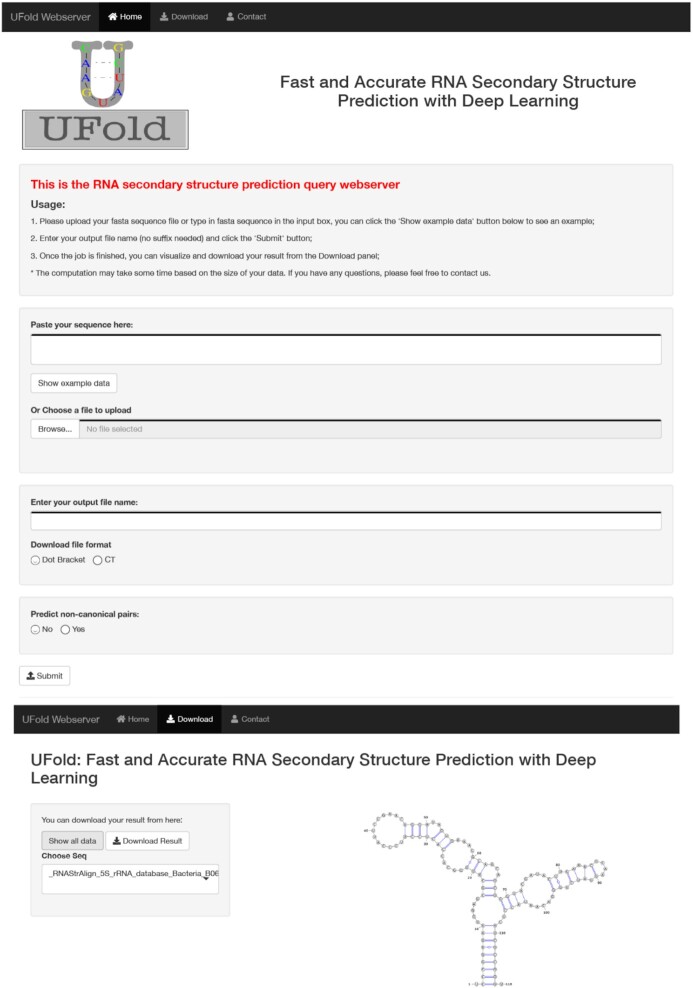
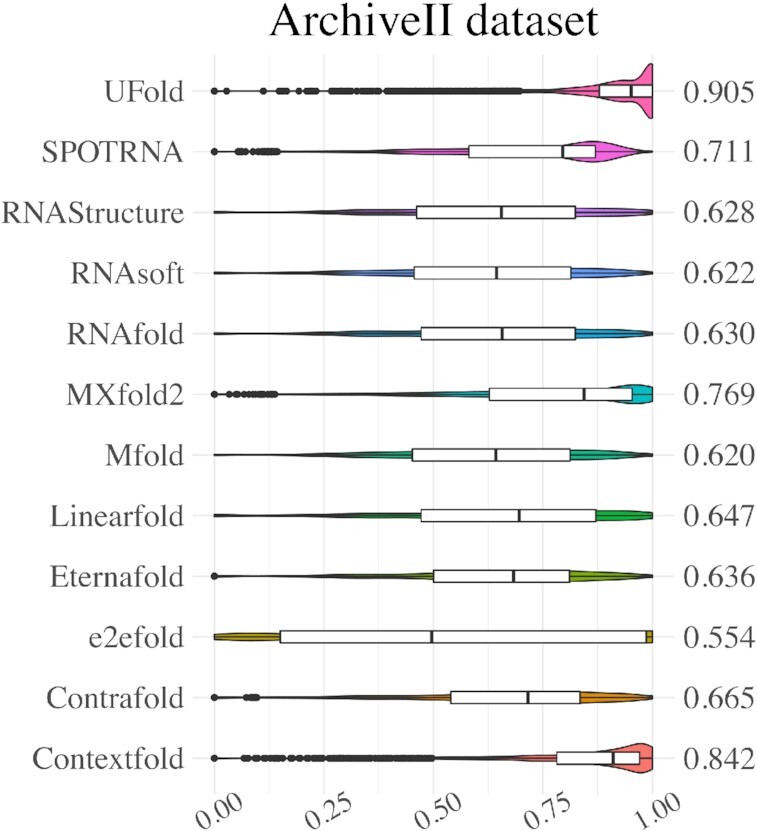
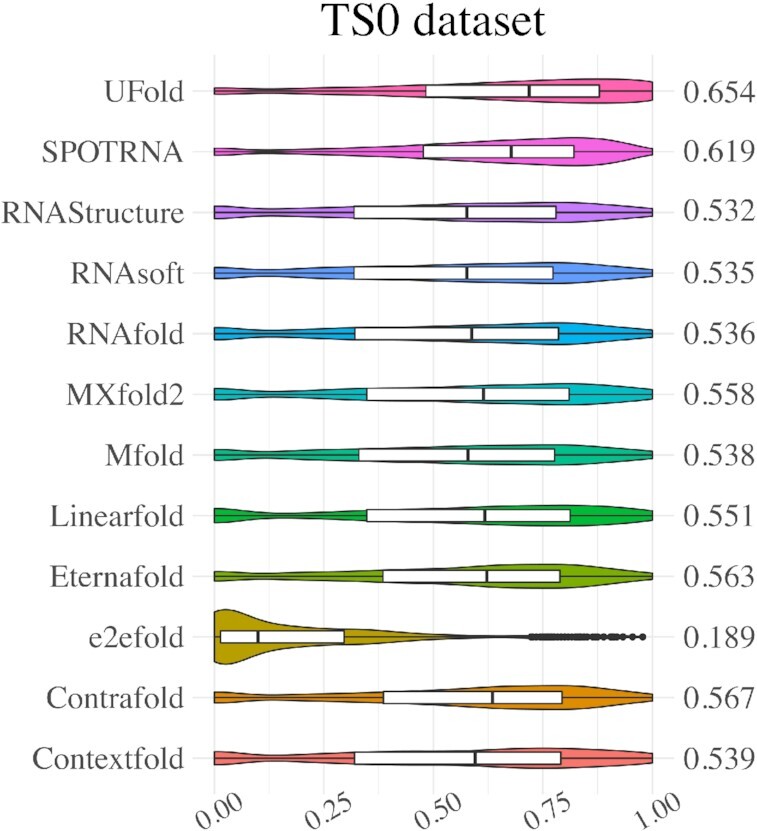
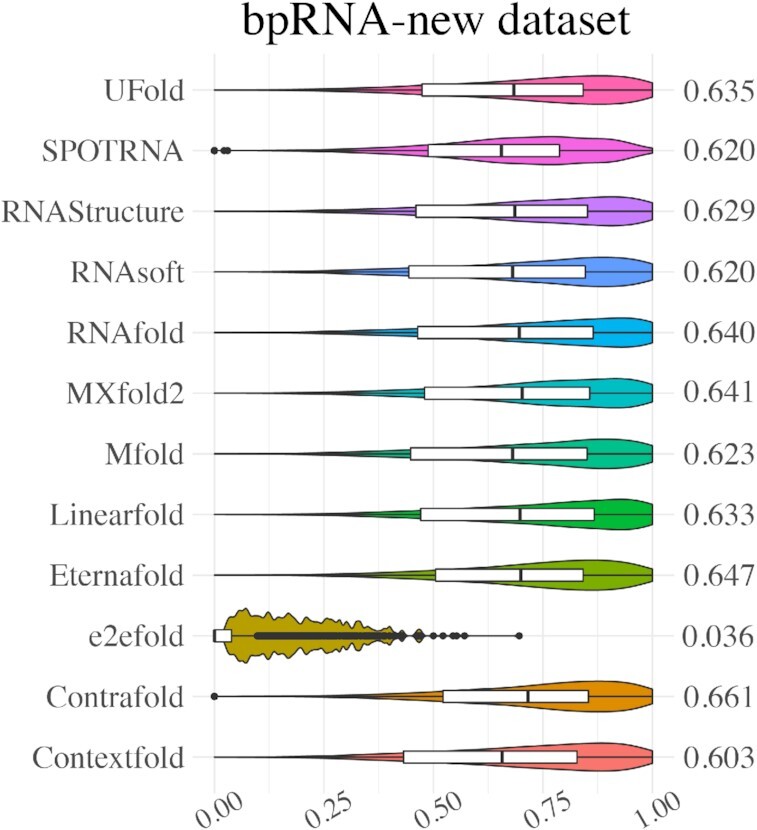
For many RNA molecules, the secondary structure is essential for the correct function of the RNA. Predicting RNA secondary structure from nucleotide sequences is a long-standing problem in genomics, but the prediction performance has reached a plateau over time. Traditional RNA secondary structure prediction algorithms are primarily based on thermodynamic models through free energy minimization, which imposes strong prior assumptions and is slow to run. Here, we propose a deep learning-based method, called UFold, for RNA secondary structure prediction, trained directly on annotated data and base-pairing rules. UFold proposes a novel image-like representation of RNA sequences, which can be efficiently processed by Fully Convolutional Networks (FCNs). We benchmark the performance of UFold on both within- and cross-family RNA datasets. It significantly outperforms previous methods on within-family datasets, while achieving a similar performance as the traditional methods when trained and tested on distinct RNA families. UFold is also able to predict pseudoknots accurately. Its prediction is fast with an inference time of about 160 ms per sequence up to 1500 bp in length. An online web server running UFold is available at https://ufold.ics.uci.edu. Code is available at https://github.com/uci-cbcl/UFold.

摘要

对于许多 RNA 分子来说,二级结构对于 RNA 的正确功能至关重要。从核苷酸序列预测 RNA 二级结构是基因组学中长期存在的问题,但随着时间的推移,预测性能已经达到了一个瓶颈。传统的 RNA 二级结构预测算法主要基于通过自由能最小化的热力学模型,这强加了很强的先验假设,并且运行速度较慢。在这里,我们提出了一种基于深度学习的方法,称为 UFold,用于 RNA 二级结构预测,它直接在注释数据和碱基配对规则上进行训练。UFold 提出了一种新的 RNA 序列图像式表示,可以通过全卷积网络(FCN)高效处理。我们在家族内和跨家族 RNA 数据集上对 UFold 的性能进行了基准测试。它在家族内数据集上的表现明显优于以前的方法,而在训练和测试不同的 RNA 家族时,其性能与传统方法相当。UFold 还能够准确地预测假结。它的预测速度很快,对于长度可达 1500bp 的序列,推断时间约为 160ms。一个运行 UFold 的在线网络服务器可在 https://ufold.ics.uci.edu 上访问。代码可在 https://github.com/uci-cbcl/UFold 上获得。
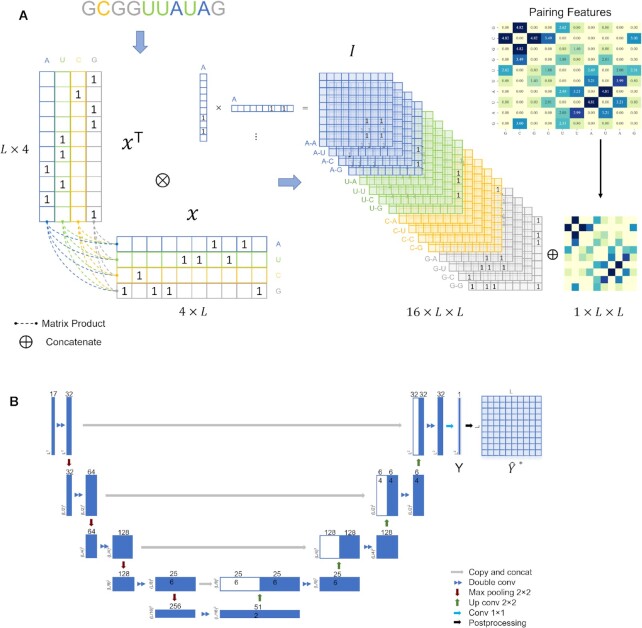
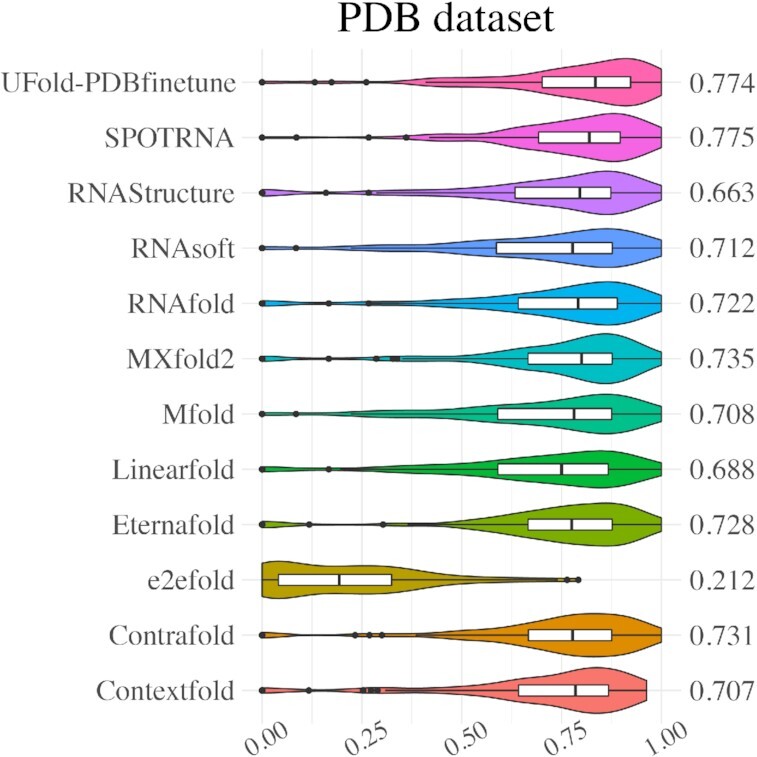
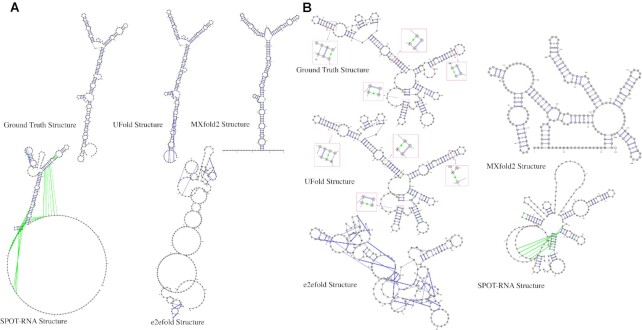
https://cdn.ncbi.nlm.nih.gov/pmc/blobs/37cc/8860580/c67fa8a2f350/gkab1074fig7.jpg
https://cdn.ncbi.nlm.nih.gov/pmc/blobs/37cc/8860580/ec0ed97d8003/gkab1074fig1.jpg
https://cdn.ncbi.nlm.nih.gov/pmc/blobs/37cc/8860580/c836d5628c74/gkab1074fig2.jpg
https://cdn.ncbi.nlm.nih.gov/pmc/blobs/37cc/8860580/bff613920e6b/gkab1074fig3.jpg
https://cdn.ncbi.nlm.nih.gov/pmc/blobs/37cc/8860580/8c29996902c9/gkab1074fig4.jpg
https://cdn.ncbi.nlm.nih.gov/pmc/blobs/37cc/8860580/13f70f2517a0/gkab1074fig5.jpg
https://cdn.ncbi.nlm.nih.gov/pmc/blobs/37cc/8860580/89c6b360db2b/gkab1074fig6.jpg
https://cdn.ncbi.nlm.nih.gov/pmc/blobs/37cc/8860580/c67fa8a2f350/gkab1074fig7.jpg
https://cdn.ncbi.nlm.nih.gov/pmc/blobs/37cc/8860580/ec0ed97d8003/gkab1074fig1.jpg
https://cdn.ncbi.nlm.nih.gov/pmc/blobs/37cc/8860580/c836d5628c74/gkab1074fig2.jpg
https://cdn.ncbi.nlm.nih.gov/pmc/blobs/37cc/8860580/bff613920e6b/gkab1074fig3.jpg
https://cdn.ncbi.nlm.nih.gov/pmc/blobs/37cc/8860580/8c29996902c9/gkab1074fig4.jpg
https://cdn.ncbi.nlm.nih.gov/pmc/blobs/37cc/8860580/13f70f2517a0/gkab1074fig5.jpg
https://cdn.ncbi.nlm.nih.gov/pmc/blobs/37cc/8860580/89c6b360db2b/gkab1074fig6.jpg
https://cdn.ncbi.nlm.nih.gov/pmc/blobs/37cc/8860580/c67fa8a2f350/gkab1074fig7.jpg

相似文献

1
UFold: fast and accurate RNA secondary structure prediction with deep learning.UFold:使用深度学习进行快速准确的 RNA 二级结构预测。
Nucleic Acids Res. 2022 Feb 22;50(3):e14. doi: 10.1093/nar/gkab1074.
2
AliNA - a deep learning program for RNA secondary structure prediction.AliNA——一个用于RNA二级结构预测的深度学习程序。
Mol Inform. 2023 Dec;42(12):e202300113. doi: 10.1002/minf.202300113. Epub 2023 Nov 2.
3
TurboFold: iterative probabilistic estimation of secondary structures for multiple RNA sequences.TurboFold:用于多个 RNA 序列的二级结构的迭代概率估计。
BMC Bioinformatics. 2011 Apr 20;12:108. doi: 10.1186/1471-2105-12-108.
4
sincFold: end-to-end learning of short- and long-range interactions in RNA secondary structure.sincFold:RNA 二级结构中短程和远程相互作用的端到端学习。
Brief Bioinform. 2024 May 23;25(4). doi: 10.1093/bib/bbae271.
5
Direct Inference of Base-Pairing Probabilities with Neural Networks Improves Prediction of RNA Secondary Structures with Pseudoknots.利用神经网络直接推断碱基配对概率可提高具有假结的 RNA 二级结构预测。
Genes (Basel). 2022 Nov 18;13(11):2155. doi: 10.3390/genes13112155.
6
Comparative Study of Single-stranded Oligonucleotides Secondary Structure Prediction Tools.单链寡核苷酸二级结构预测工具的比较研究。
BMC Bioinformatics. 2023 Nov 8;24(1):422. doi: 10.1186/s12859-023-05532-5.
7
MSFF-CDCGAN: A novel method to predict RNA secondary structure based on Generative Adversarial Network.MSFF-CDCGAN:一种基于生成对抗网络预测 RNA 二级结构的新方法。
Methods. 2022 Aug;204:368-375. doi: 10.1016/j.ymeth.2022.04.004. Epub 2022 Apr 28.
8
RNA independent fragment partition method based on deep learning for RNA secondary structure prediction.基于深度学习的 RNA 二级结构预测的 RNA 无依赖片段划分方法。
Sci Rep. 2023 Feb 17;13(1):2861. doi: 10.1038/s41598-023-30124-x.
9
TransUFold: Unlocking the structural complexity of short and long RNA with pseudoknots.TransUFold:利用假结解锁短链和长链 RNA 的结构复杂性。
Math Biosci Eng. 2023 Oct 17;20(11):19320-19340. doi: 10.3934/mbe.2023854.
10
Machine learning for RNA 2D structure prediction benchmarked on experimental data.基于实验数据的 RNA 2D 结构预测的机器学习基准测试
Brief Bioinform. 2023 May 19;24(3). doi: 10.1093/bib/bbad153.

引用本文的文献

1
Enhanced Generalizability of RNA Secondary Structure Prediction via Convolutional Block Attention Network and Ensemble Learning.通过卷积块注意力网络和集成学习提高RNA二级结构预测的泛化能力
Molecules. 2025 Aug 21;30(16):3447. doi: 10.3390/molecules30163447.
2
Discovery of RNA-Targeting Small Molecules: Challenges and Future Directions.RNA靶向小分子的发现:挑战与未来方向
MedComm (2020). 2025 Aug 24;6(9):e70342. doi: 10.1002/mco2.70342. eCollection 2025 Sep.
3
ECSFinder: optimized prediction of evolutionarily conserved RNA secondary structures from genome sequences.

本文引用的文献

1
RNA secondary structure packages evaluated and improved by high-throughput experiments.通过高通量实验评估和改进的 RNA 二级结构包。
Nat Methods. 2022 Oct;19(10):1234-1242. doi: 10.1038/s41592-022-01605-0. Epub 2022 Oct 3.
2
Improved RNA secondary structure and tertiary base-pairing prediction using evolutionary profile, mutational coupling and two-dimensional transfer learning.利用进化谱、突变耦合和二维迁移学习改进RNA二级结构和三级碱基配对预测。
Bioinformatics. 2021 Sep 9;37(17):2589-2600. doi: 10.1093/bioinformatics/btab165.
3
RNA secondary structure prediction using deep learning with thermodynamic integration.
ECSFinder:从基因组序列中对进化保守RNA二级结构进行优化预测。
Nucleic Acids Res. 2025 Aug 11;53(15). doi: 10.1093/nar/gkaf780.
4
Graph-CRISPR: a gene editing efficiency prediction model based on graph neural network with integrated sequence and secondary structure feature extraction.Graph-CRISPR:一种基于具有整合序列和二级结构特征提取功能的图神经网络的基因编辑效率预测模型。
Brief Bioinform. 2025 Jul 2;26(4). doi: 10.1093/bib/bbaf410.
5
What does it take to learn the rules of RNA base pairing? A lot less than you may think.学习RNA碱基配对规则需要什么?比你想象的要少得多。
bioRxiv. 2025 Aug 2:2025.07.31.668042. doi: 10.1101/2025.07.31.668042.
6
How large is the universe of RNA-like motifs? A clustering analysis of RNA graph motifs using topological descriptors.类RNA基序的范围有多大?使用拓扑描述符对RNA图形基序进行聚类分析。
PLoS Comput Biol. 2025 Jul 15;21(7):e1013230. doi: 10.1371/journal.pcbi.1013230. eCollection 2025 Jul.
7
Improving RNA Secondary Structure Prediction Through Expanded Training Data.通过扩展训练数据改进RNA二级结构预测
bioRxiv. 2025 May 3:2025.05.03.652028. doi: 10.1101/2025.05.03.652028.
8
Direct Modeling of DNA and RNA Aptamers with AlphaFold 3: A Promising Tool for Predicting Aptamer Structures and Aptamer-Target Interactions.使用AlphaFold 3对DNA和RNA适配体进行直接建模:预测适配体结构和适配体-靶标相互作用的有前景工具。
ACS Synth Biol. 2025 Jul 3. doi: 10.1021/acssynbio.5c00196.
9
Predicting RNA Structure Utilizing Attention from Pretrained Language Models.利用预训练语言模型的注意力预测RNA结构
J Chem Inf Model. 2025 Jul 14;65(13):6483-6498. doi: 10.1021/acs.jcim.4c02094. Epub 2025 Jul 2.
10
Comprehensive datasets for RNA design, machine learning, and beyond.用于RNA设计、机器学习及其他领域的综合数据集。
Sci Rep. 2025 Jul 1;15(1):21417. doi: 10.1038/s41598-025-07041-2.
使用热力学积分的深度学习进行 RNA 二级结构预测。
Nat Commun. 2021 Feb 11;12(1):941. doi: 10.1038/s41467-021-21194-4.
4
Rfam 14: expanded coverage of metagenomic, viral and microRNA families.Rfam 14:扩展了对宏基因组、病毒和 miRNA 家族的覆盖范围。
Nucleic Acids Res. 2021 Jan 8;49(D1):D192-D200. doi: 10.1093/nar/gkaa1047.
5
RNA secondary structure prediction using an ensemble of two-dimensional deep neural networks and transfer learning.使用二维深度神经网络集成和迁移学习进行 RNA 二级结构预测。
Nat Commun. 2019 Nov 27;10(1):5407. doi: 10.1038/s41467-019-13395-9.
6
LinearFold: linear-time approximate RNA folding by 5'-to-3' dynamic programming and beam search.LinearFold:通过 5'-to-3' 动态规划和束搜索进行线性时间近似 RNA 折叠。
Bioinformatics. 2019 Jul 15;35(14):i295-i304. doi: 10.1093/bioinformatics/btz375.
7
A New Method of RNA Secondary Structure Prediction Based on Convolutional Neural Network and Dynamic Programming.一种基于卷积神经网络和动态规划的RNA二级结构预测新方法。
Front Genet. 2019 May 22;10:467. doi: 10.3389/fgene.2019.00467. eCollection 2019.
8
DMfold: A Novel Method to Predict RNA Secondary Structure With Pseudoknots Based on Deep Learning and Improved Base Pair Maximization Principle.DMfold:一种基于深度学习和改进碱基对最大化原则预测含假结RNA二级结构的新方法。
Front Genet. 2019 Mar 4;10:143. doi: 10.3389/fgene.2019.00143. eCollection 2019.
9
Regulation of microRNA function in animals.动物中 microRNA 功能的调控。
Nat Rev Mol Cell Biol. 2019 Jan;20(1):21-37. doi: 10.1038/s41580-018-0045-7.
10
High-throughput determination of RNA structures.高通量 RNA 结构测定。
Nat Rev Genet. 2018 Oct;19(10):615-634. doi: 10.1038/s41576-018-0034-x.