Institute of Neuroanatomy, RWTH Aachen University, Aachen, Germany.
Department of Child and Adolescent Psychiatry, Psychosomatics and Psychotherapy, RWTH Aachen University, Aachen, Germany.
Clin Transl Sci. 2022 Apr;15(4):889-898. doi: 10.1111/cts.13196. Epub 2021 Nov 25.
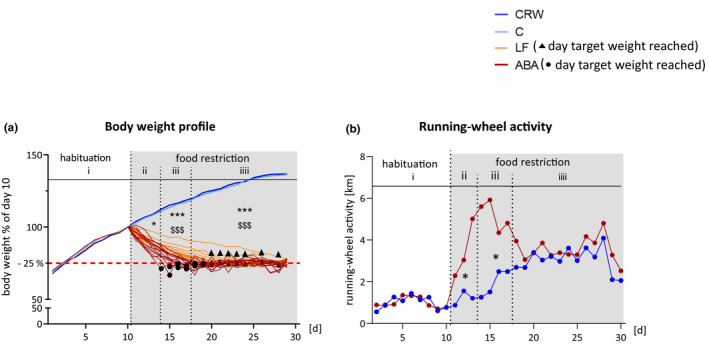
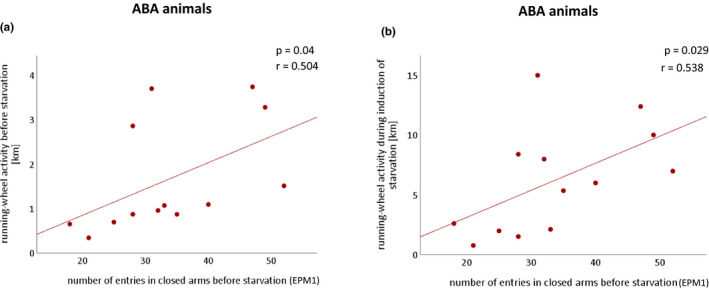
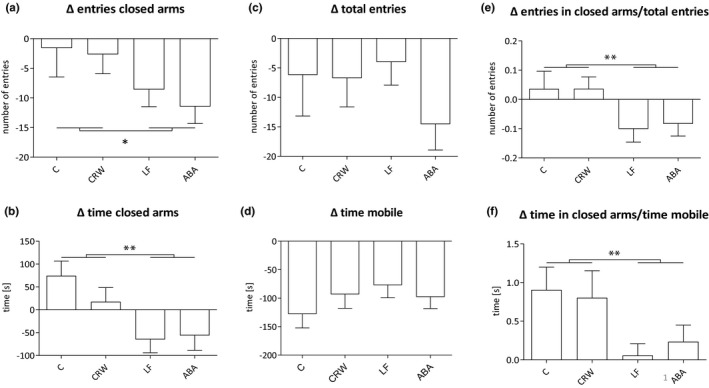
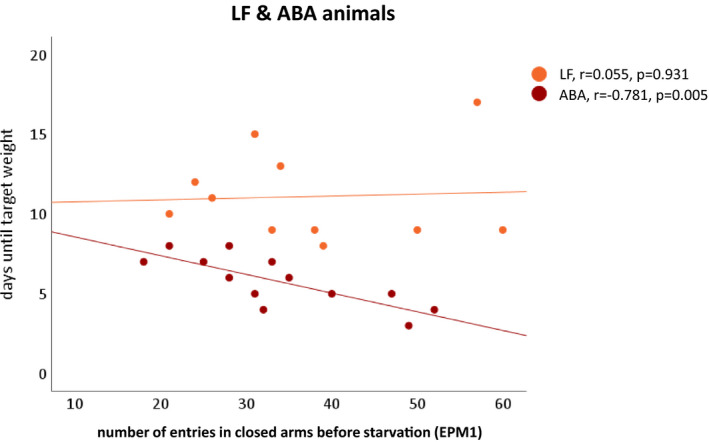
Anorexia nervosa (AN) is a severe psychiatric disorder characterized by energy restriction, low body weight, a fear of gaining weight, and often excessive physical activity. Anxiety disorders appear to constitute a major risk factor for developing AN and are the most frequent comorbidity. Here, the influence of anxiety-like behavior prior to food restriction on increased physical activity, leading to greater susceptibility to weight loss, was tested in rats. Furthermore, the possible anxiolytic effect of starvation itself was analyzed. A chronic starvation model activity-based anorexia (ABA) was applied to mimic physiological and behavioral characteristics of AN. During the induction of starvation and acute starvation, food intake was reduced by 70% and the rats lost 25% of their body weight, which was kept stable to imitate chronic starvation. Anxiety-like behavior was quantified before and after chronic starvation using the elevated plus maze, based on rodents' aversion to open spaces. Anxiety-related behavior before food restriction was associated with increased running-wheel activity during habituation and during the induction of starvation, and predicted faster weight loss in ABA rats. Additionally, food-restricted animals showed less anxiety-like behavior after chronic starvation. Animals showing more anxiety-like behavior appear to be more susceptible to weight loss, partially mediated by increased physical activity. Anxiety-related behavior was associated with increased physical activity, which in turn was associated with more rapid weight loss. Our data let us assume that food restriction has an anxiolytic effect. These findings demonstrate the importance of considering anxiety disorders in patients with AN.
神经性厌食症(AN)是一种严重的精神疾病,其特征为能量限制、低体重、对体重增加的恐惧以及经常过度的体力活动。焦虑症似乎是导致 AN 的主要危险因素,也是最常见的合并症。在这里,研究人员测试了在限制食物之前,类似焦虑的行为对增加体力活动、导致更大的体重减轻易感性的影响,而体力活动增加是导致体重减轻易感性的主要原因。此外,还分析了饥饿本身可能产生的抗焦虑作用。采用慢性饥饿模型——基于活动的厌食症(ABA)来模拟 AN 的生理和行为特征。在饥饿诱导和急性饥饿期间,食物摄入量减少了 70%,大鼠体重减轻了 25%,以模拟慢性饥饿。在慢性饥饿之前和之后,使用基于啮齿动物对开阔空间的厌恶的高架十字迷宫来量化类似焦虑的行为。在习惯形成和饥饿诱导期间,限制食物之前的焦虑相关行为与跑步轮活动增加有关,并且预测 ABA 大鼠更快的体重减轻。此外,在慢性饥饿后,限制食物的动物表现出较少的焦虑样行为。表现出更多焦虑样行为的动物似乎更容易出现体重减轻,这部分是通过增加体力活动来介导的。焦虑相关行为与增加的体力活动有关,而体力活动又与更快的体重减轻有关。我们的数据让我们假设,食物限制具有抗焦虑作用。这些发现表明,在 AN 患者中,考虑焦虑症是很重要的。