Ding Yuanyuan, Yin Ruihua, Zhang Shuai, Xiao Qi, Zhao Hongqin, Pan Xudong, Zhu Xiaoyan
Department of Neurology, The Affiliated Hospital of Qingdao University, Qingdao, China.
Department of Critical Care Medicine, The Affiliated Hospital of Qingdao University, Qingdao, China.
Front Cardiovasc Med. 2021 Nov 2;8:731958. doi: 10.3389/fcvm.2021.731958. eCollection 2021.
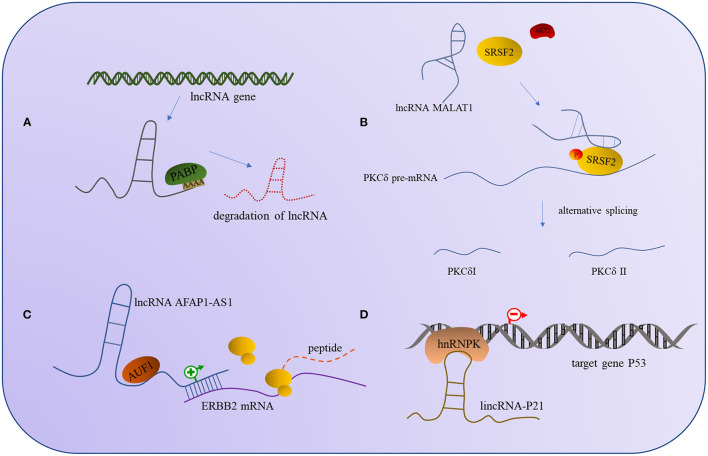
Atherosclerosis is a complex disease closely related to the function of endothelial cells (ECs), monocytes/macrophages, and vascular smooth muscle cells (VSMCs). Despite a good understanding of the pathogenesis of atherosclerosis, the underlying molecular mechanisms are still only poorly understood. Therefore, atherosclerosis continues to be an important clinical issue worthy of further research. Recent evidence has shown that long non-coding RNAs (lncRNAs) and RNA-binding proteins (RBPs) can serve as important regulators of cellular function in atherosclerosis. Besides, several studies have shown that lncRNAs are partly dependent on the specific interaction with RBPs to exert their function. This review summarizes the important contributions of lncRNAs and RBPs in atherosclerosis and provides novel and comprehensible interaction models of lncRNAs and RBPs.
动脉粥样硬化是一种与内皮细胞(ECs)、单核细胞/巨噬细胞和血管平滑肌细胞(VSMCs)功能密切相关的复杂疾病。尽管对动脉粥样硬化的发病机制有了较好的理解,但其潜在的分子机制仍知之甚少。因此,动脉粥样硬化仍然是一个值得进一步研究的重要临床问题。最近的证据表明,长链非编码RNA(lncRNAs)和RNA结合蛋白(RBPs)可作为动脉粥样硬化中细胞功能的重要调节因子。此外,多项研究表明,lncRNAs部分依赖于与RBPs的特异性相互作用来发挥其功能。本综述总结了lncRNAs和RBPs在动脉粥样硬化中的重要作用,并提供了lncRNAs和RBPs新颖且易于理解的相互作用模型。