Ear Institute, University College London, London WC1X 8EE, UK.
Ear Institute, University College London, London WC1X 8EE, UK.
Trends Neurosci. 2022 Jan;45(1):64-77. doi: 10.1016/j.tins.2021.10.005. Epub 2021 Nov 16.
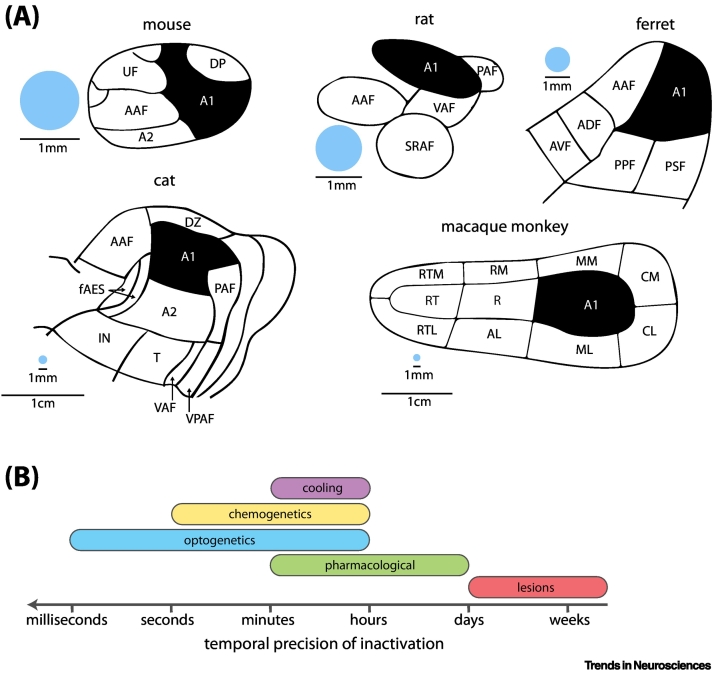
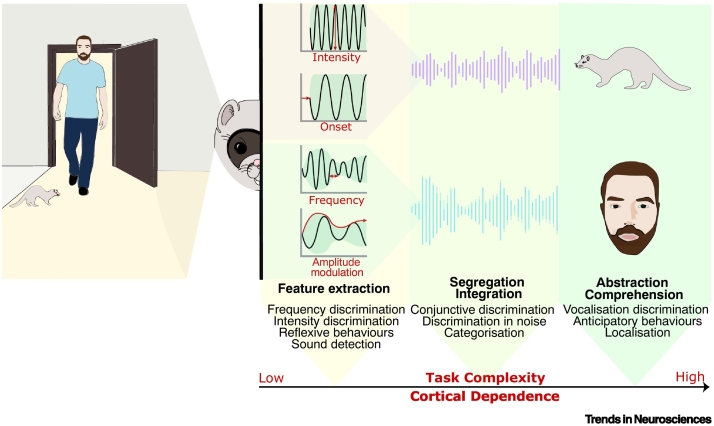
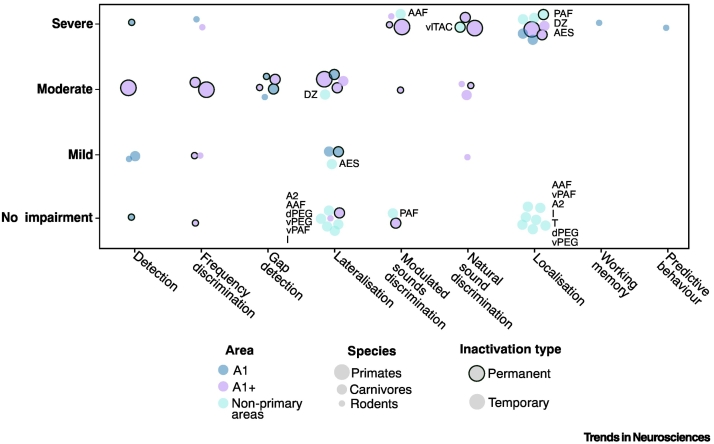
Inactivation experiments in auditory cortex (AC) produce widely varying results that complicate interpretations regarding the precise role of AC in auditory perception and ensuing behaviour. The advent of optogenetic methods in neuroscience offers previously unachievable insight into the mechanisms transforming brain activity into behaviour. With a view to aiding the design and interpretation of future studies in and outside AC, here we discuss the methodological challenges faced in manipulating neural activity. While considering AC's role in auditory behaviour through the prism of inactivation experiments, we consider the factors that confound the interpretation of the effects of inactivation on behaviour, including the species, the type of inactivation, the behavioural task employed, and the exact location of the inactivation.
在听觉皮层(AC)中进行失活实验产生了广泛的不同结果,这使得关于 AC 在听觉感知和随后的行为中的精确作用的解释变得复杂。神经科学中光遗传学方法的出现为将大脑活动转化为行为的机制提供了以前无法实现的深入了解。为了帮助设计和解释未来在 AC 内外进行的研究,我们在这里讨论了在操纵神经活动时面临的方法学挑战。在通过失活实验来考虑 AC 在听觉行为中的作用的同时,我们还考虑了混淆失活对行为的影响的解释的因素,包括物种、失活的类型、所采用的行为任务以及失活的确切位置。