Curtin Health Innovation Research Institute, Curtin University, Bentley, WA 6102, Australia.
Perron Institute for Neurological and Translational Science, Sarich Neuroscience Research Institute Building, 8 Verdun St, Nedlands, WA, 6009, Australia.
Sci Rep. 2021 Nov 19;11(1):22594. doi: 10.1038/s41598-021-01963-3.
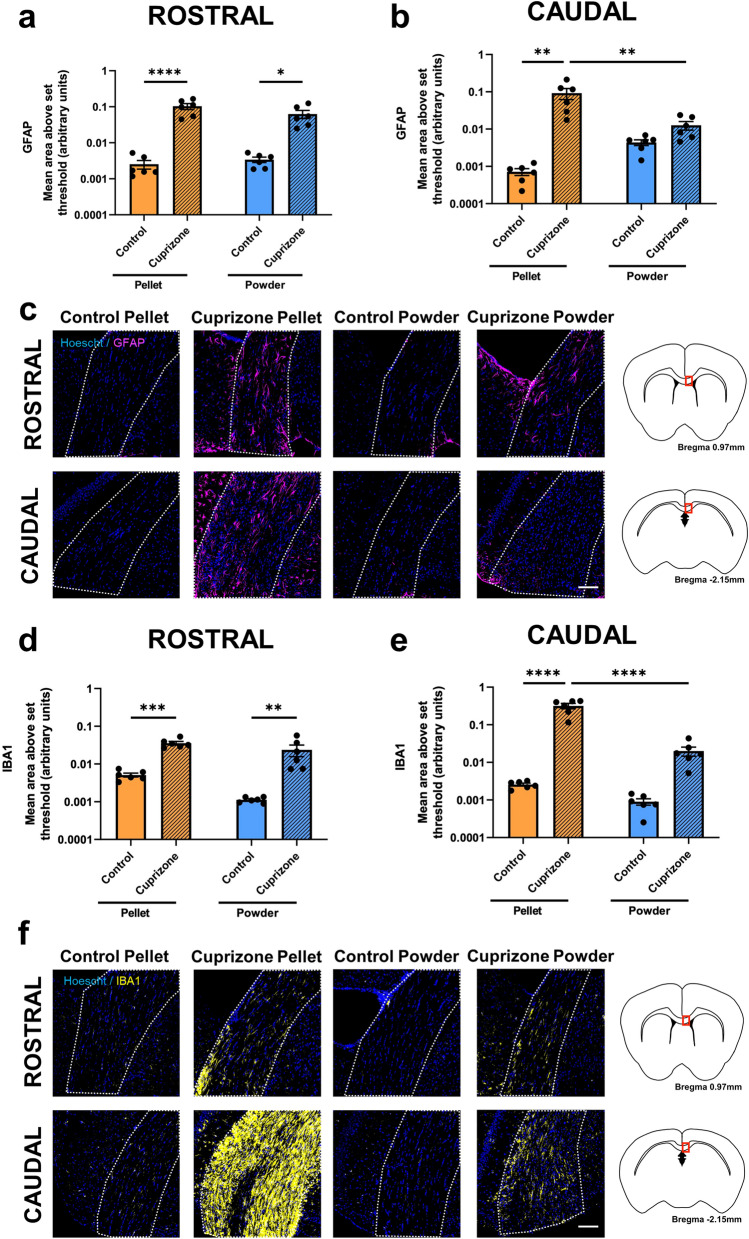
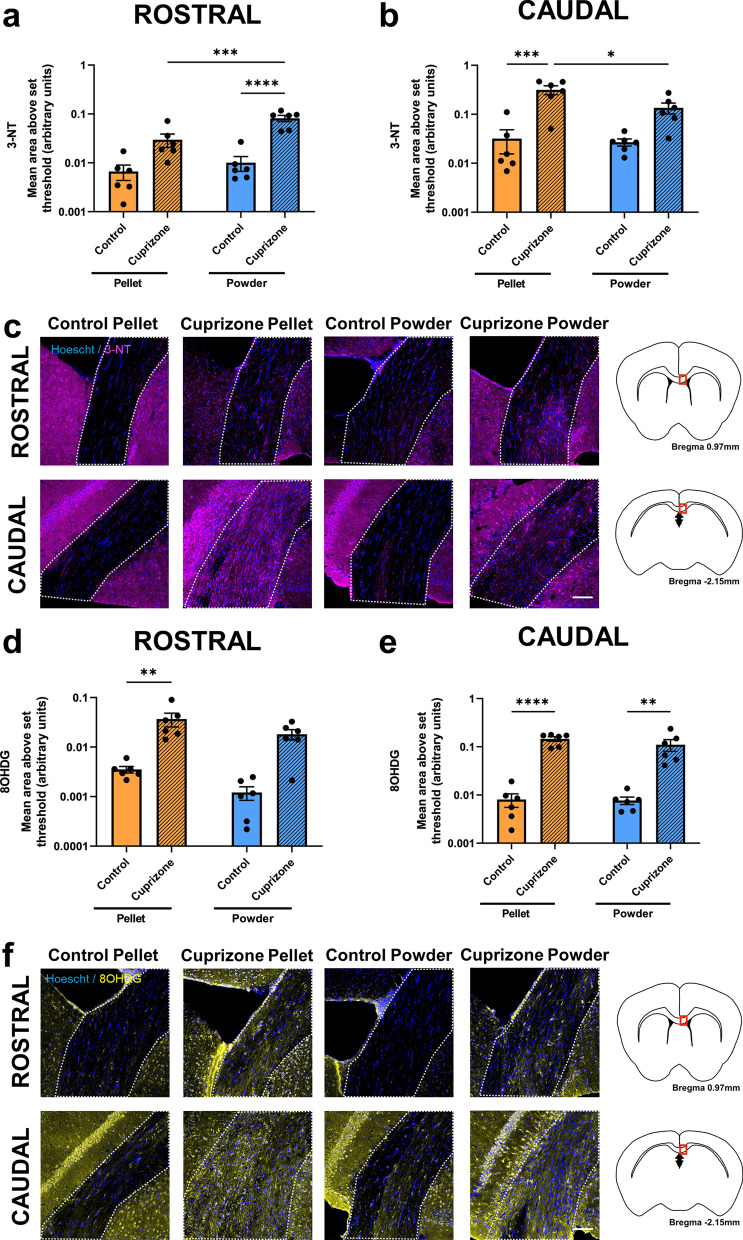
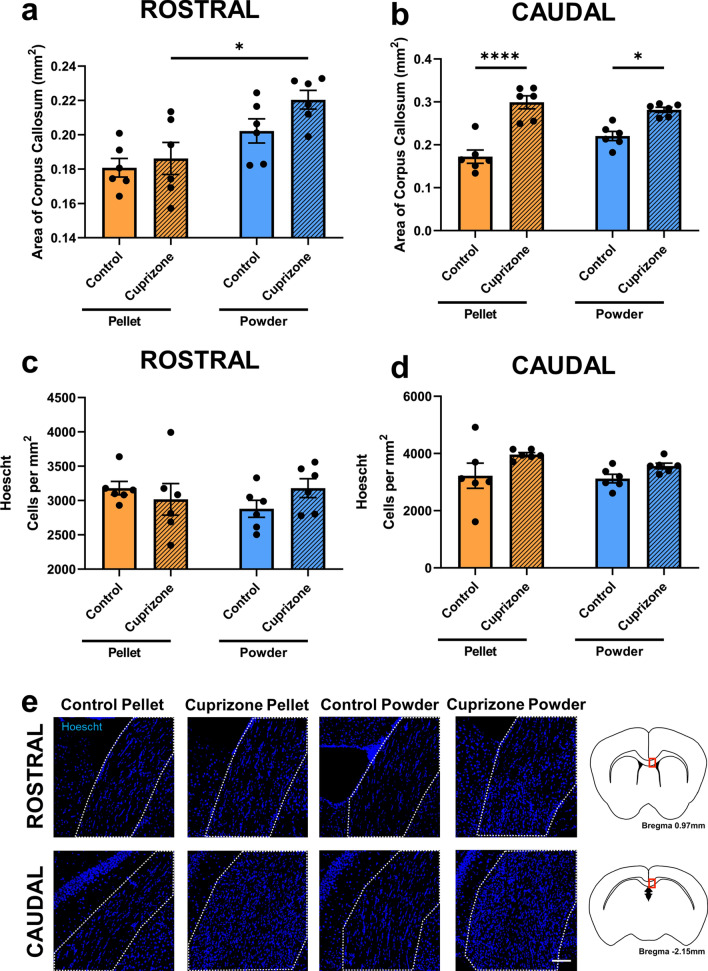
Cuprizone is a copper-chelating agent that induces pathology similar to that within some multiple sclerosis (MS) lesions. The reliability and reproducibility of cuprizone for inducing demyelinating disease pathology depends on the animals ingesting consistent doses of cuprizone. Cuprizone-containing pelleted feed is a convenient way of delivering cuprizone, but the efficacy of these pellets at inducing demyelination has been questioned. This study compared the degree of demyelinating disease pathology between mice fed cuprizone delivered in pellets to mice fed a powdered cuprizone formulation at an early 3 week demyelinating timepoint. Within rostral corpus callosum, cuprizone pellets were more effective than cuprizone powder at increasing astrogliosis, microglial activation, DNA damage, and decreasing the density of mature oligodendrocytes. However, cuprizone powder demonstrated greater protein nitration relative to controls. Furthermore, mice fed control powder had significantly fewer mature oligodendrocytes than those fed control pellets. In caudal corpus callosum, cuprizone pellets performed better than cuprizone powder relative to controls at increasing astrogliosis, microglial activation, protein nitration, DNA damage, tissue swelling, and reducing the density of mature oligodendrocytes. Importantly, only cuprizone pellets induced detectable demyelination compared to controls. The two feeds had similar effects on oligodendrocyte precursor cell (OPC) dynamics. Taken together, these data suggest that demyelinating disease pathology is modelled more effectively with cuprizone pellets than powder at 3 weeks. Combined with the added convenience, cuprizone pellets are a suitable choice for inducing early demyelinating disease pathology.
铜螯合剂 cuprizone 可诱导类似于多发性硬化症(MS)病变的病理学变化。 cuprizone 诱导脱髓鞘疾病病理学的可靠性和可重复性取决于动物摄入一致剂量的 cuprizone。含 cuprizone 的颗粒饲料是一种方便的 cuprizone 给药方式,但这些颗粒在诱导脱髓鞘方面的功效一直受到质疑。本研究比较了在脱髓鞘早期(3 周)以颗粒形式给予 cuprizone 的小鼠与以粉末形式给予 cuprizone 配方的小鼠之间脱髓鞘疾病病理学的严重程度。在胼胝体前部,与 cuprizone 粉末相比,cuprizone 颗粒更能增加星形胶质细胞增生、小胶质细胞活化、DNA 损伤,并降低成熟少突胶质细胞的密度。然而,与对照相比,cuprizone 粉末显示出更大的蛋白质硝化。此外,与给予对照颗粒的小鼠相比,给予对照粉末的小鼠成熟少突胶质细胞数量明显减少。在胼胝体后部,与 cuprizone 粉末相比,cuprizone 颗粒在增加星形胶质细胞增生、小胶质细胞活化、蛋白质硝化、DNA 损伤、组织肿胀和降低成熟少突胶质细胞密度方面的效果优于对照组。重要的是,只有 cuprizone 颗粒与对照组相比可诱导出可检测到的脱髓鞘。这两种饲料对少突胶质细胞前体细胞(OPC)动力学的影响相似。总之,这些数据表明,与 cuprizone 粉末相比,cuprizone 颗粒在 3 周时更能有效地模拟脱髓鞘疾病病理学。加上方便性,cuprizone 颗粒是诱导早期脱髓鞘疾病病理学的合适选择。