Ibis Reproductive Health, Oakland, CA, USA.
Ibis Reproductive Health, Oakland, CA, USA.
Lancet Glob Health. 2022 Jan;10(1):e105-e113. doi: 10.1016/S2214-109X(21)00461-7. Epub 2021 Nov 18.
Clinical trials have established the high effectiveness and safety of medication abortion in clinical settings. However, barriers to clinical abortion care have shifted most medication abortion use to out-of-clinic settings, especially in the context of the COVID-19 pandemic. Given this shift, we aimed to estimate the effectiveness of self-managed medication abortion (medication abortion without clinical support), and to compare it to effectiveness of clinician-managed medication abortion.
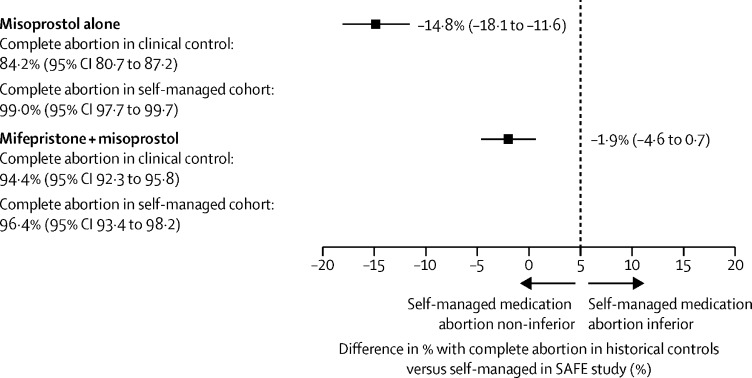
For this prospective, observational cohort study, we recruited callers from two safe abortion accompaniment groups in Argentina and Nigeria who requested information on self-managed medication abortion. Before using one of two medication regimens (misoprostol alone or in combination with mifepristone), participants completed a baseline survey, and then two follow-up phone surveys at 1 week and 3 weeks after taking pills. The primary outcome was the proportion of participants reporting a complete abortion without surgical intervention. Legal restrictions precluded enrolment of a concurrent clinical control group; thus, a non-inferiority analysis compared abortion completion among those in our self-managed medication abortion cohort with abortion completion reported in historical clinical trials using the same medication regimens, restricted to participants with pregnancies of less than 9 weeks' gestation. This study was registered with ISCRTN, ISRCTN95769543.
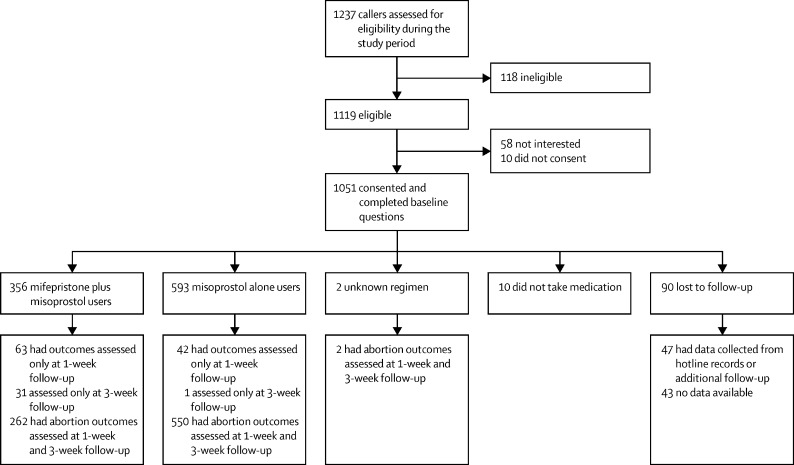
Between July 31, 2019, and April 27, 2020, we enrolled 1051 participants. We analysed abortion outcomes for 961 participants, with an additional 47 participants reached after the study period. Most pregnancies were less than 12 weeks' duration. Participants in follow-up self-managed their abortions using misoprostol alone (593 participants) or the combined regimen of misoprostol plus mifepristone (356 participants). At last follow-up, 586 (99%) misoprostol alone users and 334 (94%) combined regimen users had a complete abortion without surgical intervention. For those with pregnancies of less than 9 weeks' gestation, both regimens were non-inferior to medication abortion effectiveness in clinical settings.
Findings from this prospective cohort study show that self-managed medication abortion with accompaniment group support is highly effective and, for those with pregnancies of less than 9 weeks' gestation, non-inferior to the effectiveness of clinician-managed medication abortion administered in a clinical setting. These findings support the use of remote self-managed models of early abortion care, as well as telemedicine, as is being considered in several countries because of the COVID-19 pandemic.
David and Lucile Packard Foundation.
For the Arabic, French, Bahasa Indonesian, Spanish and Yoruba translations of the Article see Supplementary Materials section.
临床试验已经证实药物流产在临床环境中的高效性和安全性。然而,临床堕胎护理的障碍已经将大多数药物流产的使用转移到了诊所外的环境中,尤其是在 COVID-19 大流行的背景下。鉴于这种转变,我们旨在评估自我管理药物流产(没有临床支持的药物流产)的有效性,并将其与临床医生管理药物流产的有效性进行比较。
在这项前瞻性观察性队列研究中,我们招募了来自阿根廷和尼日利亚两个安全堕胎陪同小组的来电者,他们要求了解自我管理药物流产的信息。在使用两种药物方案之一(单独使用米索前列醇或与米非司酮联合使用)之前,参与者完成了基线调查,然后在服药后 1 周和 3 周进行了两次随访电话调查。主要结局是报告未经手术干预完全流产的参与者比例。法律限制排除了同时招募临床对照组;因此,通过将我们的自我管理药物流产队列中的流产完成情况与使用相同药物方案的历史临床研究中的流产完成情况进行非劣效性分析,将妊娠不到 9 周的参与者纳入其中。这项研究在 ISCRTN 和 ISRCTN95769543 注册。
在 2019 年 7 月 31 日至 2020 年 4 月 27 日期间,我们共招募了 1051 名参与者。我们分析了 961 名参与者的流产结局,另有 47 名参与者在研究结束后加入。大多数妊娠持续时间不到 12 周。在随访中,参与者自行管理米非司酮单独使用(593 名参与者)或米非司酮联合米索前列醇联合使用(356 名参与者)的流产。最后一次随访时,单独使用米索前列醇的 586 名(99%)和联合使用的 334 名(94%)参与者均未经手术干预完全流产。对于妊娠不到 9 周的参与者,两种方案在有效性方面均不劣于临床环境中的药物流产。
这项前瞻性队列研究的结果表明,在堕胎陪同小组的支持下进行自我管理的药物流产非常有效,对于妊娠不到 9 周的参与者来说,与在临床环境中由临床医生管理的药物流产的有效性相当。这些发现支持在几个国家正在考虑的远程自我管理早期堕胎护理模式和远程医疗的使用,这是由于 COVID-19 大流行。
大卫和露西尔·派克德基金会。