School of Public Health (Shenzhen), Sun Yat-sen University, Shenzhen, China.
JC School of Public Health and Primary Care, Faculty of Medicine, The Chinese University of Hong Kong, Hong Kong SAR, China.
Sleep Med. 2022 Mar;91:273-281. doi: 10.1016/j.sleep.2021.10.020. Epub 2021 Oct 21.
Many COVID-19 survivors reported stigmatization after recovery. This study investigated the association between stigma (discrimination experiences, self-stigma and perceived affiliate stigma) and sleep quality among COVID-19 survivors six months after hospital discharge.
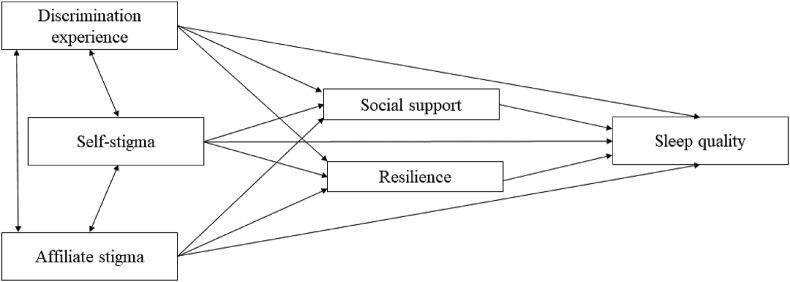
Participants were recovered adult COVID-19 survivors discharged between February 1 and April 30, 2020. Medical staff of five participating hospitals approached all discharged COVID-19 period during this period. A total of 199 participants completed the telephone interview during July to September, 2020. Structural equation modeling was performed to test the hypothesize that resilience and social support would mediate the associations between stigma and sleep quality.
The results showed that 10.1% of the participants reported terrible/poor sleep quality, 26.1% reported worse sleep quality in the past week when comparing their current status versus the time before COVID-19. After adjusting for significant background characteristics, participants who had higher number of discrimination experience, perceived stronger self-stigma and stronger perceived affiliate stigma reported poorer sleep quality. Resilience and social support were positively and significantly associated with sleep quality. The indirect effect of self-stigma on sleep quality through social support and resilience was significant and negative. Perceived affiliate stigma also had a significant and negative indirect effect on sleep quality through social support and resilience.
Various types of stigma after recovery were associated with poor sleep quality among COVID-19 survivors, while social support and resilience were protective factors. Resilience and social support mediated the associations between self-stigma/perceived affiliate stigma and sleep quality.
许多 COVID-19 幸存者在康复后报告受到歧视。本研究调查了 COVID-19 幸存者在出院后六个月时,耻辱感(歧视经历、自我耻辱感和感知的附属耻辱感)与睡眠质量之间的关系。
参与者为 2020 年 2 月 1 日至 4 月 30 日期间出院的成年 COVID-19 康复者。五家参与医院的医务人员在这段时间内接触所有出院的 COVID-19 患者。共有 199 名参与者在 2020 年 7 月至 9 月期间完成了电话访谈。结构方程模型用于检验假设,即韧性和社会支持将在耻辱感和睡眠质量之间的关系中起中介作用。
结果显示,10.1%的参与者报告睡眠质量极差/差,26.1%的参与者在与 COVID-19 前相比,过去一周的睡眠质量更差。在调整了显著的背景特征后,经历更多歧视的参与者、感知到更强的自我耻辱感和更强的感知附属耻辱感的参与者报告睡眠质量更差。韧性和社会支持与睡眠质量呈正相关且显著。自我耻辱感通过社会支持和韧性对睡眠质量的间接影响具有统计学意义且为负。感知的附属耻辱感也通过社会支持和韧性对睡眠质量产生显著的负间接影响。
康复后各种类型的耻辱感与 COVID-19 幸存者的睡眠质量差有关,而社会支持和韧性是保护因素。韧性和社会支持中介了自我耻辱感/感知的附属耻辱感与睡眠质量之间的关系。