Soy Mehmet, Keser Gökhan, Atagündüz Pamir
Division of Rheumatology, Department of Internal Medicine, Faculty of Medicine, Altınbaş University, Bahçelievler Medical Park Hospital, İstanbul Turkey.
Division of Rheumatology, Department of Internal Medicine, Faculty of Medicine, Ege University, İzmir Turkey.
Turk J Biol. 2021 Aug 30;45(4):372-389. doi: 10.3906/biy-2105-37. eCollection 2021.
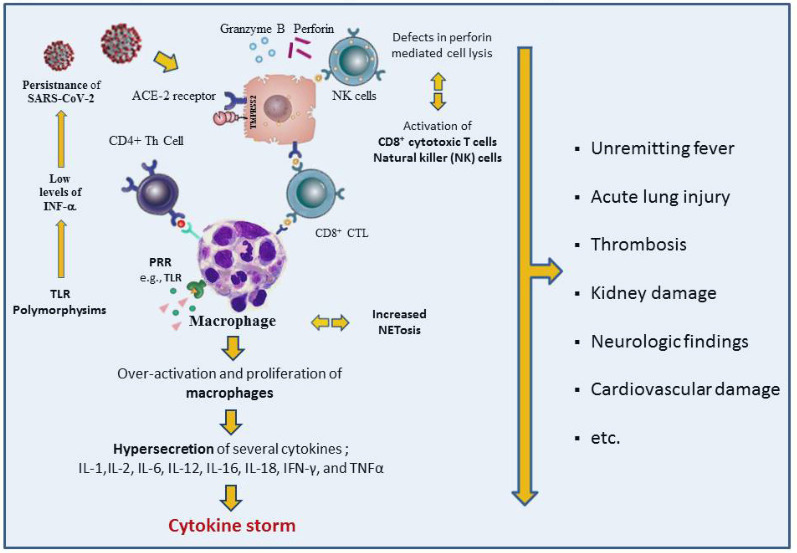
COVID-19 is a viral infection caused by the severe acute respiratory syndrome coronavirus 2 (SARS-CoV-2) that killed a large number of patients around the world. A hyperinflammatory state resulting in a cytokine storm and adult respiratory distress syndrome seems to be the major cause of the death. Many mechanisms have been suggested in the pathogenesis of COVID-19 associated cytokine storm (COVID-CS). Insufficient viral clearance and persistence of a strong cytokine response despite inadequate antiviral immunity seem to be the main mechanisms underlying the pathogenesis. The diagnosis of COVID-19 is based on relatively constant clinical symptoms, clinical findings, laboratory tests, and imaging techniques, while the diagnosis of COVID-CS is a rather dynamic process, based on evolving or newly emerging findings during the clinical course. Management of COVID-19 consists of using antiviral agents to inhibit SARS-CoV-2 replication and treating potential complications including the cytokine storm together with general supportive measures. COVID-CS may be treated using appropriate immunosuppressive and immunomodulatory drugs that reduce the level of inappropriate systemic inflammation, which has the potential to cause organ damage. Currently corticosteroids, IL-6 blockers, or IL-1 blockers are most widely used for treating COVID-CS.
新型冠状病毒肺炎(COVID-19)是由严重急性呼吸综合征冠状病毒2(SARS-CoV-2)引起的一种病毒感染,在全球造成大量患者死亡。导致细胞因子风暴和成人呼吸窘迫综合征的过度炎症状态似乎是死亡的主要原因。在新型冠状病毒肺炎相关细胞因子风暴(COVID-CS)的发病机制中,已提出多种机制。尽管抗病毒免疫力不足,但病毒清除不足和强烈的细胞因子反应持续存在似乎是发病机制的主要原因。COVID-19的诊断基于相对恒定的临床症状、临床发现、实验室检查和影像学技术,而COVID-CS的诊断是一个相当动态的过程,基于临床过程中不断演变或新出现的发现。COVID-19的治疗包括使用抗病毒药物抑制SARS-CoV-2复制,并治疗包括细胞因子风暴在内的潜在并发症以及一般支持措施。COVID-CS可使用适当的免疫抑制和免疫调节药物进行治疗,这些药物可降低不适当的全身炎症水平,而这种炎症可能导致器官损伤。目前,皮质类固醇、白细胞介素-6阻滞剂或白细胞介素-1阻滞剂最广泛用于治疗COVID-CS。