• 文献检索
  • 文档翻译
  • 深度研究
  • 学术资讯
  • Suppr Zotero 插件Zotero 插件
  • 邀请有礼
  • 套餐&价格
  • 历史记录
应用&插件
Suppr Zotero 插件Zotero 插件浏览器插件Mac 客户端Windows 客户端微信小程序
定价
高级版会员购买积分包购买API积分包
服务
文献检索文档翻译深度研究API 文档MCP 服务
关于我们
关于 Suppr公司介绍联系我们用户协议隐私条款
关注我们

Suppr 超能文献

核心技术专利:CN118964589B侵权必究
粤ICP备2023148730 号-1Suppr @ 2026

文献检索

告别复杂PubMed语法,用中文像聊天一样搜索,搜遍4000万医学文献。AI智能推荐,让科研检索更轻松。

立即免费搜索

文件翻译

保留排版,准确专业,支持PDF/Word/PPT等文件格式,支持 12+语言互译。

免费翻译文档

深度研究

AI帮你快速写综述,25分钟生成高质量综述,智能提取关键信息,辅助科研写作。

立即免费体验

针对听力障碍儿童的情感机器人助手的经验。

Experience with an Affective Robot Assistant for Children with Hearing Disabilities.

作者信息

Uluer Pinar, Kose Hatice, Gumuslu Elif, Barkana Duygun Erol

机构信息

Department of Computer Engineering, Galatasaray University, Istanbul, Turkey.

Department of AI and Data Engineering, Istanbul Technical University, Istanbul, Turkey.

出版信息

Int J Soc Robot. 2023;15(4):643-660. doi: 10.1007/s12369-021-00830-5. Epub 2021 Nov 16.

DOI:10.1007/s12369-021-00830-5
PMID:34804256
原文链接:https://pmc.ncbi.nlm.nih.gov/articles/PMC8594648/
Abstract

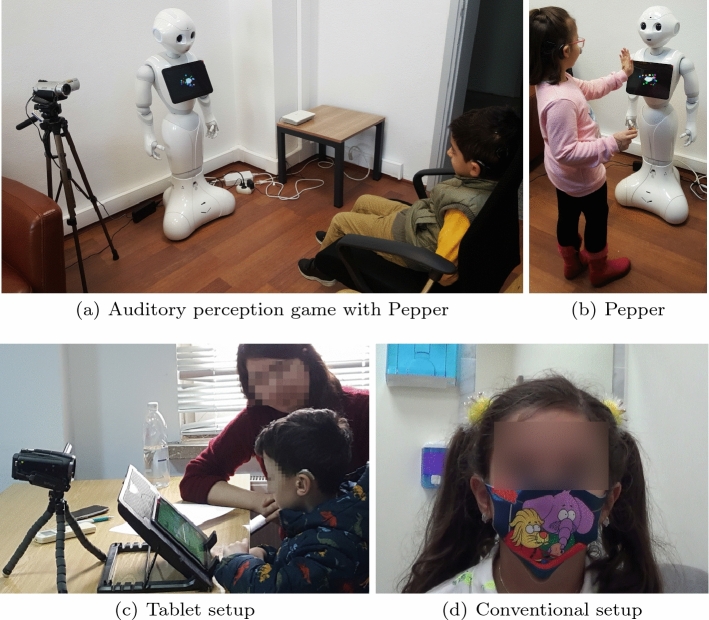
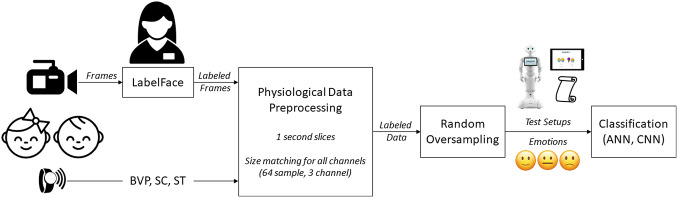
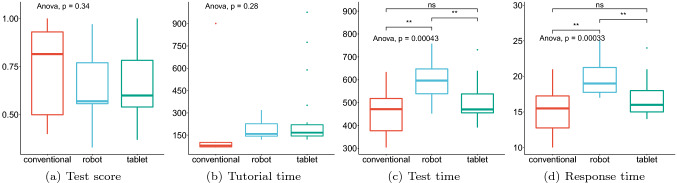
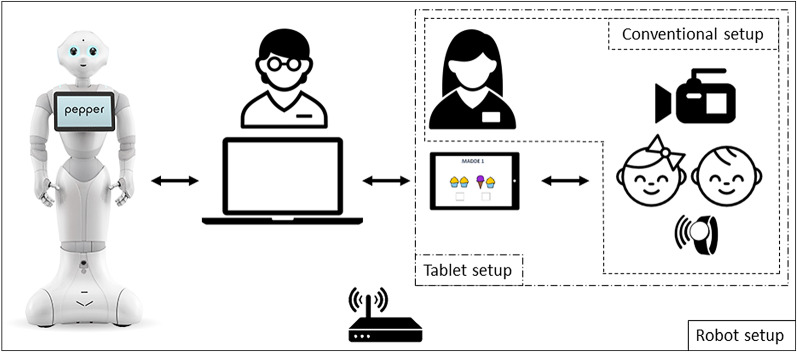
This study presents an assistive robotic system enhanced with emotion recognition capabilities for children with hearing disabilities. The system is designed and developed for the audiometry tests and rehabilitation of children in a clinical setting and includes a social humanoid robot (Pepper), an interactive interface, gamified audiometry tests, sensory setup and a machine/deep learning based emotion recognition module. Three scenarios involving conventional setup, tablet setup and setup with the robot+tablet are evaluated with 16 children having cochlear implant or hearing aid. Several machine learning techniques and deep learning models are used for the classification of the three test setups and for the classification of the emotions (pleasant, neutral, unpleasant) of children using the recorded physiological signals by E4 wristband. The results show that the collected signals during the tests can be separated successfully and the positive and negative emotions of children can be better distinguished when they interact with the robot than in the other two setups. In addition, the children's objective and subjective evaluations as well as their impressions about the robot and its emotional behaviors are analyzed and discussed extensively.

摘要

本研究提出了一种为听障儿童增强了情感识别能力的辅助机器人系统。该系统是为临床环境中儿童的听力测试和康复而设计和开发的,包括一个社交人形机器人(Pepper)、一个交互式界面、游戏化听力测试、传感装置以及一个基于机器学习/深度学习的情感识别模块。对16名佩戴人工耳蜗或助听器的儿童进行了三种场景的评估,分别是传统设置、平板电脑设置以及机器人+平板电脑设置。使用了几种机器学习技术和深度学习模型对这三种测试设置进行分类,并使用E4腕带记录的生理信号对儿童的情绪(愉悦、中性、不愉快)进行分类。结果表明,测试过程中收集到的信号能够成功分离,并且与其他两种设置相比,儿童在与机器人互动时,其积极和消极情绪能够得到更好的区分。此外,还对儿童的客观和主观评价以及他们对机器人及其情感行为的印象进行了广泛的分析和讨论。
https://cdn.ncbi.nlm.nih.gov/pmc/blobs/54f3/8594648/5500d0b5e443/12369_2021_830_Fig7_HTML.jpg
https://cdn.ncbi.nlm.nih.gov/pmc/blobs/54f3/8594648/4e0bcc3bffe6/12369_2021_830_Fig1_HTML.jpg
https://cdn.ncbi.nlm.nih.gov/pmc/blobs/54f3/8594648/8cbca923fc37/12369_2021_830_Fig2_HTML.jpg
https://cdn.ncbi.nlm.nih.gov/pmc/blobs/54f3/8594648/24c7b842df50/12369_2021_830_Fig3_HTML.jpg
https://cdn.ncbi.nlm.nih.gov/pmc/blobs/54f3/8594648/184112b4ee48/12369_2021_830_Fig4_HTML.jpg
https://cdn.ncbi.nlm.nih.gov/pmc/blobs/54f3/8594648/0c44b92322be/12369_2021_830_Fig5_HTML.jpg
https://cdn.ncbi.nlm.nih.gov/pmc/blobs/54f3/8594648/50c8482efb8b/12369_2021_830_Fig6_HTML.jpg
https://cdn.ncbi.nlm.nih.gov/pmc/blobs/54f3/8594648/5500d0b5e443/12369_2021_830_Fig7_HTML.jpg
https://cdn.ncbi.nlm.nih.gov/pmc/blobs/54f3/8594648/4e0bcc3bffe6/12369_2021_830_Fig1_HTML.jpg
https://cdn.ncbi.nlm.nih.gov/pmc/blobs/54f3/8594648/8cbca923fc37/12369_2021_830_Fig2_HTML.jpg
https://cdn.ncbi.nlm.nih.gov/pmc/blobs/54f3/8594648/24c7b842df50/12369_2021_830_Fig3_HTML.jpg
https://cdn.ncbi.nlm.nih.gov/pmc/blobs/54f3/8594648/184112b4ee48/12369_2021_830_Fig4_HTML.jpg
https://cdn.ncbi.nlm.nih.gov/pmc/blobs/54f3/8594648/0c44b92322be/12369_2021_830_Fig5_HTML.jpg
https://cdn.ncbi.nlm.nih.gov/pmc/blobs/54f3/8594648/50c8482efb8b/12369_2021_830_Fig6_HTML.jpg
https://cdn.ncbi.nlm.nih.gov/pmc/blobs/54f3/8594648/5500d0b5e443/12369_2021_830_Fig7_HTML.jpg

相似文献

1
Experience with an Affective Robot Assistant for Children with Hearing Disabilities.针对听力障碍儿童的情感机器人助手的经验。
Int J Soc Robot. 2023;15(4):643-660. doi: 10.1007/s12369-021-00830-5. Epub 2021 Nov 16.
2
Emotion Recognizing by a Robotic Solution Initiative (EMOTIVE Project).情感识别的机器人解决方案倡议(EMOTIVE 项目)。
Sensors (Basel). 2022 Apr 8;22(8):2861. doi: 10.3390/s22082861.
3
Classifying human emotions in HRI: applying global optimization model to EEG brain signals.人机交互中人类情绪的分类:将全局优化模型应用于脑电图脑信号
Front Neurorobot. 2023 Oct 10;17:1191127. doi: 10.3389/fnbot.2023.1191127. eCollection 2023.
4
Exploring the Effects of a Social Robot's Speech Entrainment and Backstory on Young Children's Emotion, Rapport, Relationship, and Learning.探究社交机器人的言语同步及背景故事对幼儿情绪、融洽度、人际关系和学习的影响。
Front Robot AI. 2019 Jul 9;6:54. doi: 10.3389/frobt.2019.00054. eCollection 2019.
5
Improving Human-Robot Interaction by Enhancing NAO Robot Awareness of Human Facial Expression.通过增强 NAO 机器人对人类面部表情的感知来改善人机交互。
Sensors (Basel). 2021 Sep 27;21(19):6438. doi: 10.3390/s21196438.
6
A Music-Therapy Robotic Platform for Children With Autism: A Pilot Study.一个用于自闭症儿童的音乐治疗机器人平台:一项试点研究。
Front Robot AI. 2022 May 23;9:855819. doi: 10.3389/frobt.2022.855819. eCollection 2022.
7
Humanoid robots versus humans: How is emotional valence of facial expressions recognized by individuals with schizophrenia? An exploratory study.类人机器人与人类:精神分裂症患者如何识别面部表情的情感效价?一项探索性研究。
Schizophr Res. 2016 Oct;176(2-3):506-513. doi: 10.1016/j.schres.2016.06.001. Epub 2016 Jun 10.
8
Learning to teleoperate an upper-limb assistive humanoid robot for bimanual daily-living tasks.学习远程操控上肢辅助仿人机器人完成双手日常生活任务。
Biomed Phys Eng Express. 2021 Dec 16;8(1). doi: 10.1088/2057-1976/ac3881.
9
Promoting Interactions Between Humans and Robots Using Robotic Emotional Behavior.利用机器人情感行为促进人机交互。
IEEE Trans Cybern. 2016 Dec;46(12):2911-2923. doi: 10.1109/TCYB.2015.2492999. Epub 2015 Nov 2.
10
Assessing Feasibility of Cognitive Impairment Testing Using Social Robotic Technology Augmented with Affective Computing and Emotional State Detection Systems.评估使用融合情感计算和情绪状态检测系统的社交机器人技术进行认知障碍测试的可行性。
Biomimetics (Basel). 2023 Oct 6;8(6):475. doi: 10.3390/biomimetics8060475.

引用本文的文献

1
Care provided by humanoid robots: a scoping review.人形机器人提供的护理:一项范围综述。
Invest Educ Enferm. 2025 Apr;43(1). doi: 10.17533/udea.iee.v43n1e11.
2
CARE: towards customized assistive robot-based education.关爱:迈向基于定制辅助机器人的教育
Front Robot AI. 2025 Feb 21;12:1474741. doi: 10.3389/frobt.2025.1474741. eCollection 2025.
3
Biosignal-integrated robotic systems with emerging trends in visual interfaces: A systematic review.具有视觉界面新趋势的生物信号集成机器人系统:一项系统综述。

本文引用的文献

1
What Makes a Robot Social? A Review of Social Robots from Science Fiction to a Home or Hospital Near You.是什么让机器人具有社交性?从科幻小说到你身边的家庭或医院的社交机器人综述。
Curr Robot Rep. 2021;2(1):9-19. doi: 10.1007/s43154-020-00035-0. Epub 2021 Feb 4.
2
Emotion Recognition for Human-Robot Interaction: Recent Advances and Future Perspectives.用于人机交互的情感识别:最新进展与未来展望。
Front Robot AI. 2020 Dec 21;7:532279. doi: 10.3389/frobt.2020.532279. eCollection 2020.
3
Social robots and therapeutic adherence: A new challenge in pediatric asthma?
Biophys Rev (Melville). 2024 Feb 21;5(1):011301. doi: 10.1063/5.0185568. eCollection 2024 Mar.
4
Evaluating speech-in-speech perception via a humanoid robot.通过人形机器人评估语音中语音的感知。
Front Neurosci. 2024 Feb 9;18:1293120. doi: 10.3389/fnins.2024.1293120. eCollection 2024.
5
Innovative protocol of an exploratory study evaluating the acceptability of a humanoid robot at home of deaf children with cochlear implants.评估可接受性的探索性研究的创新方案:在有助听器植入的聋童家中使用人形机器人。
PLoS One. 2023 Jun 16;18(6):e0285927. doi: 10.1371/journal.pone.0285927. eCollection 2023.
6
A physiological signal database of children with different special needs for stress recognition.具有不同应激识别特殊需求的儿童的生理信号数据库。
Sci Data. 2023 Jun 14;10(1):382. doi: 10.1038/s41597-023-02272-2.
7
Information Security in Medical Robotics: A Survey on the Level of Training, Awareness and Use of the Physiotherapist.医疗机器人中的信息安全:关于物理治疗师培训水平、意识及使用情况的调查
Healthcare (Basel). 2022 Jan 14;10(1):159. doi: 10.3390/healthcare10010159.
社交机器人与治疗依从性:儿科哮喘的新挑战?
Paediatr Respir Rev. 2021 Dec;40:46-51. doi: 10.1016/j.prrv.2020.11.001. Epub 2020 Dec 5.
4
Using social robot PLEO to enhance the well-being of hospitalised children.使用社交机器人 PLEO 来提升住院儿童的幸福感。
J Child Health Care. 2021 Sep;25(3):412-426. doi: 10.1177/1367493520947503. Epub 2020 Aug 25.
5
Deep Learning in Physiological Signal Data: A Survey.深度学习在生理信号数据中的应用:综述。
Sensors (Basel). 2020 Feb 11;20(4):969. doi: 10.3390/s20040969.
6
Human Emotion Recognition: Review of Sensors and Methods.人类情感识别:传感器与方法综述。
Sensors (Basel). 2020 Jan 21;20(3):592. doi: 10.3390/s20030592.
7
An Ensemble Learning Approach for Electrocardiogram Sensor Based Human Emotion Recognition.基于心电图传感器的人体情绪识别的集成学习方法。
Sensors (Basel). 2019 Oct 16;19(20):4495. doi: 10.3390/s19204495.
8
Stressing the accuracy: Wrist-worn wearable sensor validation over different conditions.强调准确性:不同条件下腕戴可穿戴传感器的验证。
Psychophysiology. 2019 Nov;56(11):e13441. doi: 10.1111/psyp.13441. Epub 2019 Jul 23.
9
Social Robots for Hospitalized Children.社交机器人在住院儿童中的应用。
Pediatrics. 2019 Jul;144(1). doi: 10.1542/peds.2018-1511.
10
Psychosocial Health Interventions by Social Robots: Systematic Review of Randomized Controlled Trials.社交机器人的心理社会健康干预:随机对照试验的系统评价
J Med Internet Res. 2019 May 10;21(5):e13203. doi: 10.2196/13203.