
建立埃及伊蚊幼虫环境对成虫出蛹时体质量影响的模型。
Modeling the effects of Aedes aegypti's larval environment on adult body mass at emergence.
机构信息
Department of Mathematics, Virginia Tech, Blacksburg, Virginia, United States of America.
Current address: Laboratory for Systems Medicine, University of Florida Health, Gainesville, Florida, United States of America.
出版信息
PLoS Comput Biol. 2021 Nov 22;17(11):e1009102. doi: 10.1371/journal.pcbi.1009102. eCollection 2021 Nov.
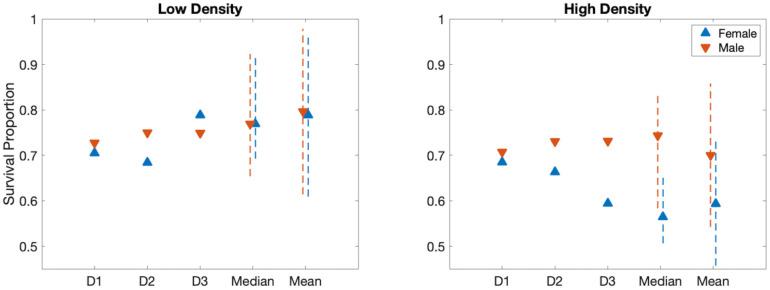
Mosquitoes vector harmful pathogens that infect millions of people every year, and developing approaches to effectively control mosquitoes is a topic of great interest. However, the success of many control measures is highly dependent upon ecological, physiological, and life history traits of mosquito species. The behavior of mosquitoes and their potential to vector pathogens can also be impacted by these traits. One trait of interest is mosquito body mass, which depends upon many factors associated with the environment in which juvenile mosquitoes develop. Our experiments examined the impact of larval density on the body mass of Aedes aegypti mosquitoes, which are important vectors of dengue, Zika, yellow fever, and other pathogens. To investigate the interactions between the larval environment and mosquito body mass, we built a discrete time mathematical model that incorporates body mass, larval density, and food availability and fit the model to our experimental data. We considered three categories of model complexity informed by data, and selected the best model within each category using Akaike's Information Criterion. We found that the larval environment is an important determinant of the body mass of mosquitoes upon emergence. Furthermore, we found that larval density has greater impact on body mass of adults at emergence than on development time, and that inclusion of density dependence in the survival of female aquatic stages in models is important. We discuss the implications of our results for the control of Aedes mosquitoes and on their potential to spread disease.
蚊子传播有害病原体,每年感染数百万人,因此开发有效控制蚊子的方法是一个非常关注的话题。然而,许多控制措施的成功高度依赖于蚊子种类的生态、生理和生活史特征。蚊子的行为及其传播病原体的潜力也会受到这些特征的影响。一个有趣的特征是蚊子的体重,它取决于与幼蚊发育环境相关的许多因素。我们的实验研究了幼虫密度对埃及伊蚊体重的影响,埃及伊蚊是登革热、寨卡病毒、黄热病和其他病原体的重要传播媒介。为了研究幼虫环境与蚊子体重之间的相互作用,我们构建了一个离散时间的数学模型,该模型结合了体重、幼虫密度、食物供应,并将模型拟合到我们的实验数据中。我们根据数据考虑了三种模型复杂性类别,并在每个类别中使用赤池信息量准则选择最佳模型。我们发现幼虫环境是蚊子出蛹时体重的重要决定因素。此外,我们发现幼虫密度对成虫出蛹时的体重影响大于对发育时间的影响,并且在模型中包含雌性水生阶段的密度依赖性对其生存很重要。我们讨论了我们的研究结果对控制埃及伊蚊及其传播疾病潜力的影响。



 Zotero 插件