University of California, Riverside School of Medicine, Department of Social Medicine, Population, and Public Health, 900 University Ave, Riverside, CA, 92521, USA.
University of California, Riverside School of Public Policy, 900 University Ave, Riverside, CA, 92521, USA.
Soc Sci Med. 2022 Jan;292:114574. doi: 10.1016/j.socscimed.2021.114574. Epub 2021 Nov 17.
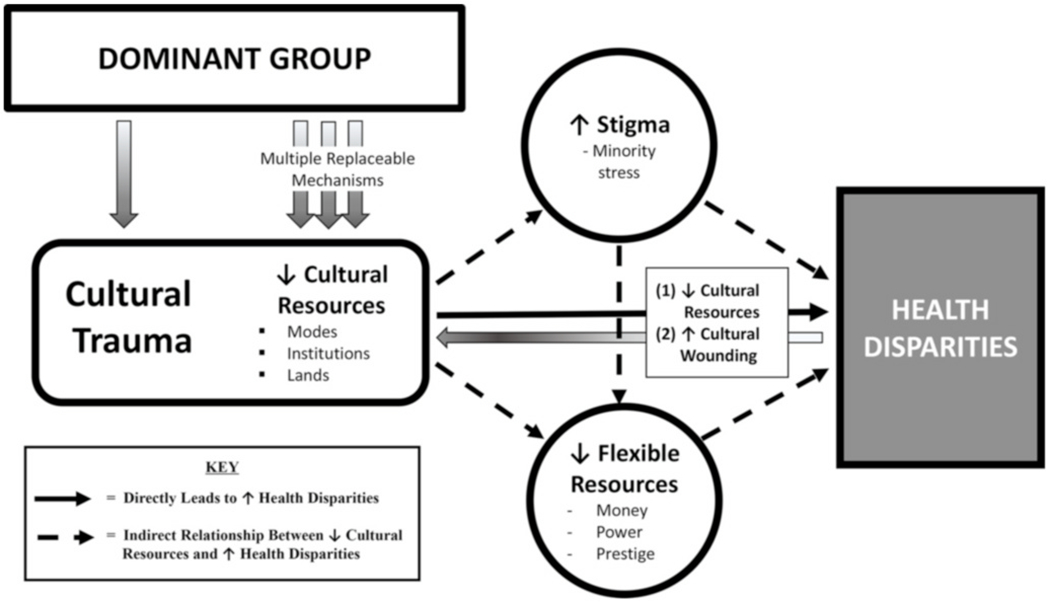
Health disparities disproportionately affect minority cultural groups (e.g., Indigenous, immigrant, refugee) worldwide; enduring across time, disease states, and risk factors despite co-occurring advancements in health and medicine. Fundamental cause theory holds that important social factors (e.g., socioeconomic status, stigma, racism) produce health disparities by restricting equitable access to health-protective resources. Yet, extant literature has not utilized fundamental cause theory to describe the health disparities impact of cultural trauma: an overwhelming, often ongoing physical or psychological assault by an oppressive dominant group on another group's cultural resources through force, threats of force, or oppressive policies. This paper presents a novel conceptual model detailing cultural trauma and the mechanisms through which it may disrupt health and create disparities by damaging three health-protective cultural resources: cultural modes, institutions, and lands. Following cultural trauma, we propose affected groups are socially disadvantaged and exposed to pervasive stress, stigma, and diminished resources, perpetuating health disparities across generations. Consequently, cultural trauma may represent an unrecognized fundamental cause of health disparities, offering potential avenues for promoting health equity through targeted research, interventions, and policies.
健康差异不成比例地影响着世界各地的少数族裔文化群体(如土著、移民、难民);尽管在健康和医学方面同时存在进步,但这些差异仍然存在于不同的时间、疾病状态和风险因素中。基本原因理论认为,重要的社会因素(如社会经济地位、耻辱感、种族主义)通过限制获得健康保护资源,从而导致健康差异。然而,现有文献尚未利用基本原因理论来描述文化创伤造成的健康差异影响:一个占主导地位的压迫性群体通过武力、武力威胁或压迫性政策,对另一个群体的文化资源进行压倒性的、常常是持续的身体或心理攻击。本文提出了一个新的概念模型,详细描述了文化创伤以及它可能通过破坏三种健康保护文化资源(文化模式、制度和土地)来破坏健康并造成差异的机制:文化模式、制度和土地。在经历文化创伤之后,我们假设受影响的群体在社会上面临劣势,并且面临普遍的压力、耻辱感和资源减少,从而使代际之间的健康差异持续存在。因此,文化创伤可能代表健康差异的一个未被认识到的根本原因,为通过有针对性的研究、干预和政策来促进健康公平提供了潜在途径。