Cabiyo Bodie, Fried Jeremy S, Collins Brandon M, Stewart William, Wong Jun, Sanchez Daniel L
Energy and Resources Group, University of California, Berkeley, CA 94720.
Pacific Northwest Research Station, US Department of Agriculture Forest Service, Portland, OR 97205.
Proc Natl Acad Sci U S A. 2021 Dec 7;118(49). doi: 10.1073/pnas.2019073118.
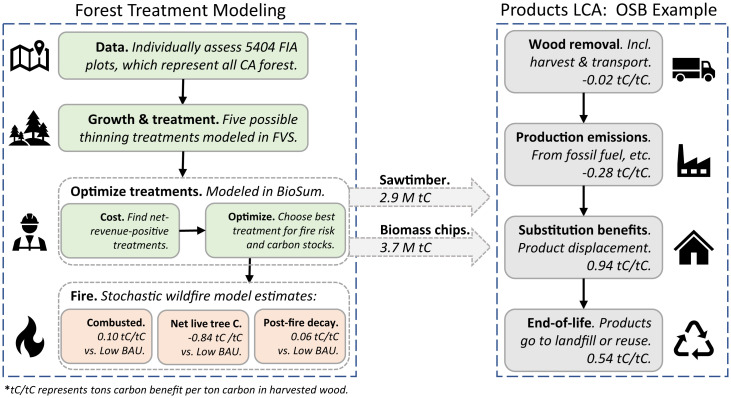
Responsible stewardship of temperate forests can address key challenges posed by climate change through sequestering carbon, producing low-carbon products, and mitigating climate risks. Forest thinning and fuel reduction can mitigate climate-related risks like catastrophic wildfire. These treatments are often cost prohibitive, though, in part because of low demand for low-value wood "residues." Where treatment occurs, this low-value wood is often burned or left to decay, releasing carbon. In this study, we demonstrate that innovative use of low-value wood, with improved potential revenues and carbon benefits, can support economical, carbon-beneficial forest management outcomes in California. With increased demand for wood residues, forest health-oriented thinning could produce up to 7.3 million (M) oven-dry tonnes of forest residues per year, an eightfold increase over current levels. Increased management and wood use could yield net climate benefits between 6.4 and 16.9 million tonnes of carbon dioxide equivalent (M tCO) per year when considering impacts from management, wildfire, carbon storage in products, and displacement of fossil carbon-intensive alternatives over a 40-y period. We find that products with durable carbon storage confer the greatest benefits, as well as products that reduce emissions in hard-to-decarbonize sectors like industrial heat. Concurrently, treatment could reduce wildfire hazard on 4.9 M ha (12.1 M ac), a quarter of which could experience stand-replacing effects without treatment. Our results suggest that innovative wood use can support widespread fire hazard mitigation and reduce net CO emissions in California.
对温带森林进行负责任的管理,可以通过碳封存、生产低碳产品和降低气候风险,应对气候变化带来的关键挑战。森林疏伐和减少燃料可以降低与气候相关的风险,如灾难性野火。然而,这些措施往往成本过高,部分原因是对低价值木材“残留物”的需求较低。在进行处理的地方,这种低价值木材通常被焚烧或任其腐烂,从而释放碳。在本研究中,我们证明,对低价值木材进行创新利用,提高潜在收入和碳效益,可以支持加利福尼亚州经济上可行且有利于碳的森林管理成果。随着对木材残留物需求的增加,以森林健康为导向的疏伐每年可产生多达730万吨绝干森林残留物,比目前水平增加八倍。在考虑40年期间管理、野火、产品中的碳储存以及化石碳密集型替代品替代等影响时,增加管理和木材使用每年可产生640万至1690万吨二氧化碳当量的净气候效益。我们发现,具有持久碳储存的产品以及减少工业供热等难以脱碳部门排放的产品带来的效益最大。同时,处理可以降低490万公顷(1210万英亩)的野火风险,其中四分之一在不进行处理的情况下可能会经历林分更替效应。我们的结果表明,创新的木材利用可以支持在加利福尼亚州广泛减轻火灾风险并减少净二氧化碳排放。