Natural Resource Ecology Laboratory, Colorado State University, Fort Collins, CO 80523;
Department of Agricultural and Biological Engineering, The Pennsylvania State University, University Park, PA 16802.
Proc Natl Acad Sci U S A. 2020 Sep 8;117(36):21968-21977. doi: 10.1073/pnas.1920877117. Epub 2020 Aug 24.
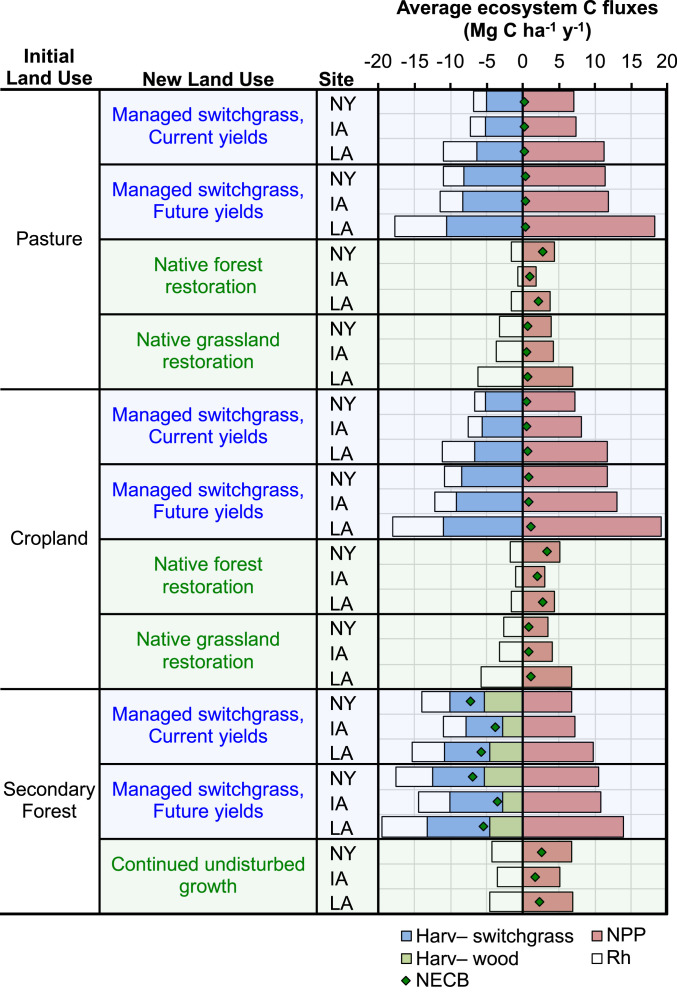
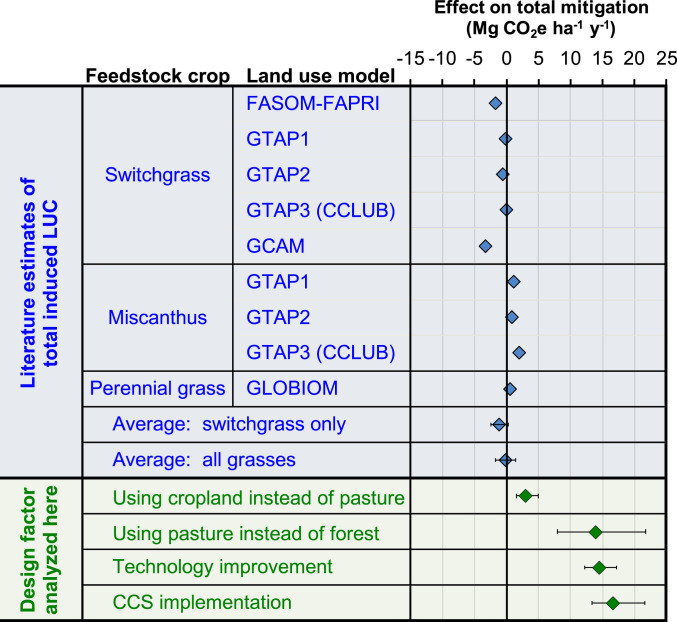
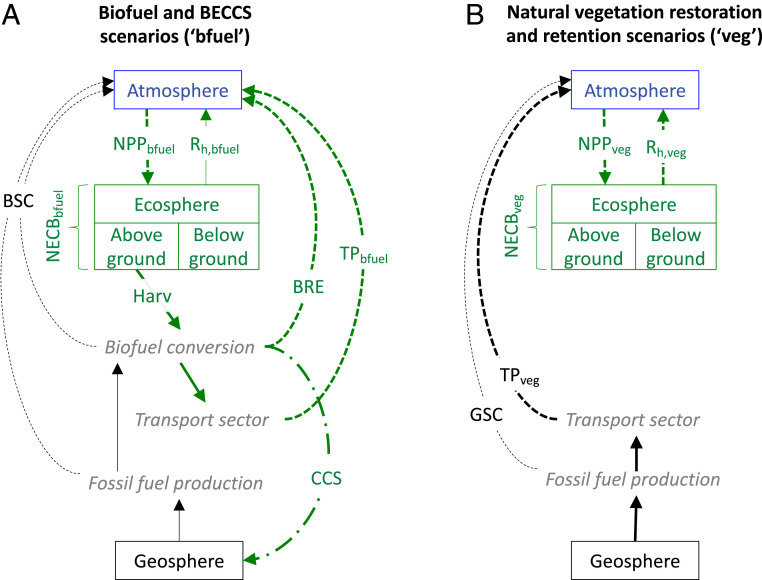
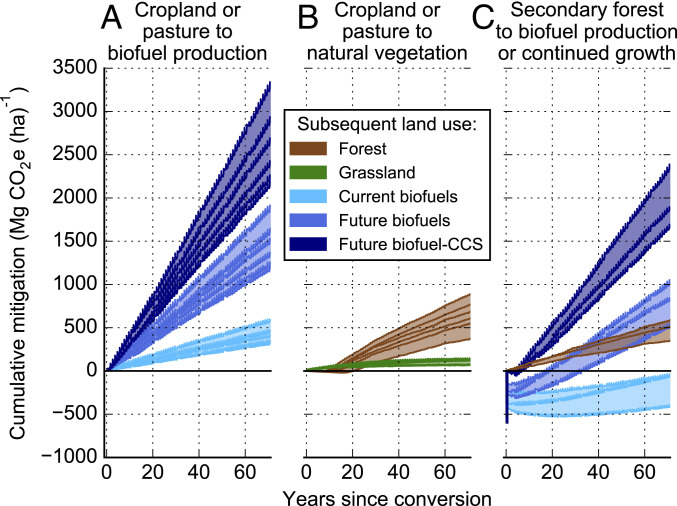
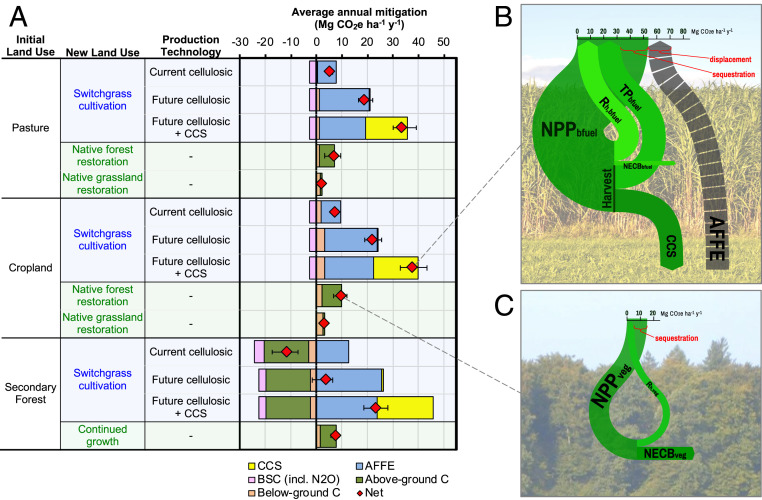
Biofuel and bioenergy systems are integral to most climate stabilization scenarios for displacement of transport sector fossil fuel use and for producing negative emissions via carbon capture and storage (CCS). However, the net greenhouse gas mitigation benefit of such pathways is controversial due to concerns around ecosystem carbon losses from land use change and foregone sequestration benefits from alternative land uses. Here, we couple bottom-up ecosystem simulation with models of cellulosic biofuel production and CCS in order to track ecosystem and supply chain carbon flows for current and future biofuel systems, with comparison to competing land-based biological mitigation schemes. Analyzing three contrasting US case study sites, we show that on land transitioning out of crops or pasture, switchgrass cultivation for cellulosic ethanol production has per-hectare mitigation potential comparable to reforestation and severalfold greater than grassland restoration. In contrast, harvesting and converting existing secondary forest at those sites incurs large initial carbon debt requiring long payback periods. We also highlight how plausible future improvements in energy crop yields and biorefining technology together with CCS would achieve mitigation potential 4 and 15 times greater than forest and grassland restoration, respectively. Finally, we show that recent estimates of induced land use change are small relative to the opportunities for improving system performance that we quantify here. While climate and other ecosystem service benefits cannot be taken for granted from cellulosic biofuel deployment, our scenarios illustrate how conventional and carbon-negative biofuel systems could make a near-term, robust, and distinctive contribution to the climate challenge.
生物燃料和生物能源系统是大多数气候稳定情景的组成部分,这些情景旨在替代运输部门的化石燃料,并通过碳捕集与封存(CCS)来产生负排放。然而,由于人们担心土地利用变化会导致生态系统碳损失,以及替代土地利用会丧失固碳收益,因此此类途径的净温室气体缓解效益存在争议。在这里,我们将基于底层的生态系统模拟与纤维素生物燃料生产和 CCS 模型相结合,以便跟踪当前和未来生物燃料系统的生态系统和供应链碳流,并与竞争的基于土地的生物缓解方案进行比较。通过分析三个具有代表性的美国案例研究地点,我们表明,在从农作物或牧场中转移出来的土地上,种植柳枝稷来生产纤维素乙醇具有每公顷可比的减排潜力,与重新造林相当,比草地恢复高几倍。相比之下,在这些地点收割和转化现有的次生林会产生大量的初始碳债务,需要很长的回报期。我们还强调了未来能源作物产量和生物精炼技术的改进以及 CCS 如何分别实现比森林和草地恢复高 4 倍和 15 倍的减排潜力。最后,我们表明,与我们在这里量化的提高系统性能的机会相比,最近对土地利用变化的估计相对较小。虽然不能理所当然地认为纤维素生物燃料的部署会带来气候和其他生态系统服务效益,但我们的情景说明了常规和碳负性生物燃料系统如何能够为应对气候挑战做出近期、稳健和独特的贡献。