Graduate School of Oceanography, University of Rhode Island, Narragansett, RI 02882.
Nicholas School of the Environment, Duke University Marine Laboratory, Beaufort, NC 28516.
Proc Natl Acad Sci U S A. 2021 Nov 30;118(48). doi: 10.1073/pnas.2105207118.
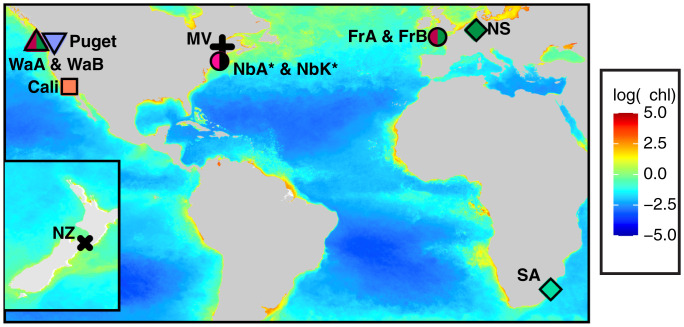
Phytoplankton support complex bacterial microbiomes that rely on phytoplankton-derived extracellular compounds and perform functions necessary for algal growth. Recent work has revealed sophisticated interactions and exchanges of molecules between specific phytoplankton-bacteria pairs, but the role of host genotype in regulating those interactions is unknown. Here, we show how phytoplankton microbiomes are shaped by intraspecific genetic variation in the host using global environmental isolates of the model phytoplankton host and a laboratory common garden experiment. A set of 81 environmental genotypes from three ocean basins and eight genetically distinct populations did not reveal a core microbiome. While no single bacterial phylotype was shared across all genotypes, we found strong genotypic influence of , with microbiomes associating more strongly with host genetic population than with environmental factors. The microbiome association with host genetic population persisted across different ocean basins, suggesting that microbiomes may be associated with host populations for decades. To isolate the impact of host genotype on microbiomes, a common garden experiment using eight genotypes from three distinct host populations again found that host genotype influenced microbial community composition, suggesting that a process we describe as genotypic filtering, analogous to environmental filtering, shapes phytoplankton microbiomes. In both the environmental and laboratory studies, microbiome variation between genotypes suggests that other factors influenced microbiome composition but did not swamp the dominant signal of host genetic background. The long-term association of microbiomes with specific host genotypes reveals a possible mechanism explaining the evolution and maintenance of complex phytoplankton-bacteria chemical exchanges.
浮游植物支持复杂的细菌微生物组,这些微生物组依赖于浮游植物衍生的细胞外化合物,并执行对藻类生长必不可少的功能。最近的研究揭示了特定浮游植物-细菌对之间复杂的分子相互作用和交换,但宿主基因型在调节这些相互作用中的作用尚不清楚。在这里,我们使用模式浮游植物宿主的全球环境分离株和实验室常见花园实验展示了浮游植物微生物组如何受到宿主种内遗传变异的影响。一组来自三个海洋盆地和八个遗传上不同种群的 81 个环境基因型没有揭示出核心微生物组。虽然没有一个细菌类群在所有基因型中共享,但我们发现了 的强烈遗传影响,微生物组与宿主遗传种群的关联比与环境因素更紧密。这种与宿主遗传种群的微生物组关联在不同的海洋盆地中持续存在,这表明微生物组可能与宿主种群相关联数十年。为了分离宿主基因型对微生物组的影响,我们使用来自三个不同宿主种群的 8 个基因型进行了常见花园实验,再次发现宿主基因型会影响微生物群落组成,这表明我们描述的类似于环境过滤的遗传过滤过程会影响浮游植物微生物组。在环境和实验室研究中,基因型之间的微生物组变异表明,其他因素影响了微生物组组成,但没有淹没宿主遗传背景的主要信号。微生物组与特定宿主基因型的长期关联揭示了一种可能的机制,可以解释复杂的浮游植物-细菌化学交换的进化和维持。