CIBER de Enfermedades Respiratorias, Instituto de Salud Carlos III, 28029, Madrid, Spain.
Research Unit, Hospital Universitario de Gran Canaria Dr. Negrín, 35019, Las Palmas de Gran Canaria, Spain.
Sci Rep. 2021 Nov 22;11(1):22702. doi: 10.1038/s41598-021-02100-w.
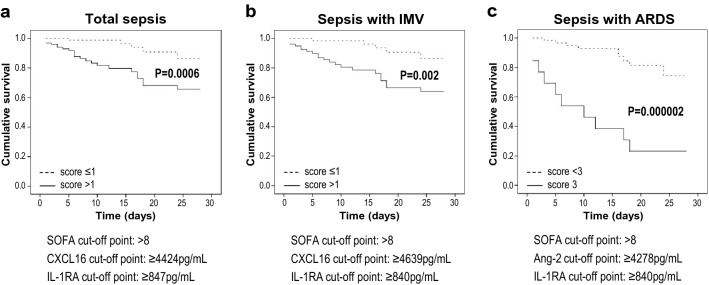
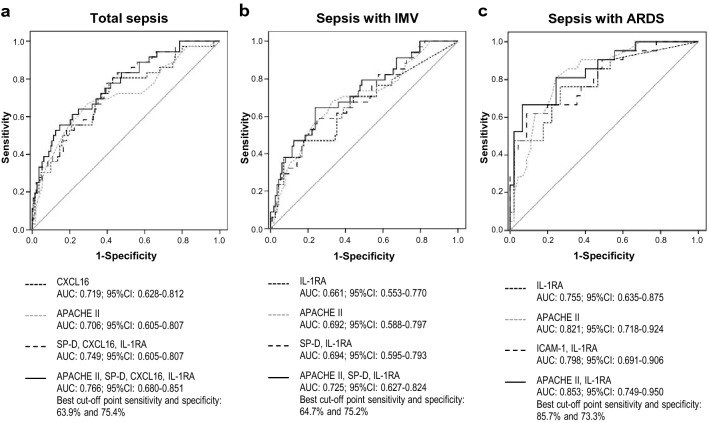
Sepsis is a common cause of acute respiratory distress syndrome (ARDS) associated with a high mortality. A panel of biomarkers (BMs) to identify septic patients at risk for developing ARDS, or at high risk of death, would be of interest for selecting patients for therapeutic trials, which could improve ARDS diagnosis and treatment, and survival chances in sepsis and ARDS. We measured nine protein BMs by ELISA in serum from 232 adult septic patients at diagnosis (152 required invasive mechanical ventilation and 72 had ARDS). A panel including the BMs RAGE, CXCL16 and Ang-2, plus PaO/FiO, was good in predicting ARDS (area under the curve = 0.88 in total septic patients). Best performing panels for ICU death are related to the presence of ARDS, need for invasive mechanical ventilation, and pulmonary/extrapulmonary origin of sepsis. In all cases, the use of BMs improved the prediction by clinical markers. Our study confirms the relevance of RAGE, Ang-2, IL-1RA and SP-D, and is novel supporting the inclusion of CXCL16, in BMs panels for predicting ARDS diagnosis and ARDS and sepsis outcome.
脓毒症是急性呼吸窘迫综合征(ARDS)的常见病因,与高死亡率相关。一组生物标志物(BMs)可以识别有发生 ARDS 风险或死亡风险高的脓毒症患者,这对于选择接受治疗试验的患者很有意义,这可以改善 ARDS 的诊断和治疗,并提高脓毒症和 ARDS 患者的生存机会。我们通过 ELISA 法检测了 232 例成年脓毒症患者的血清中的 9 种蛋白质生物标志物(152 例患者需要有创机械通气,72 例患者发生 ARDS)。包括 RAGE、CXCL16 和 Ang-2 以及 PaO/FiO 在内的生物标志物组合在预测 ARDS 方面表现良好(总脓毒症患者的曲线下面积为 0.88)。与 ICU 死亡相关的最佳性能面板与 ARDS 的存在、有创机械通气的需要以及脓毒症的肺部/肺外来源有关。在所有情况下,生物标志物的使用都提高了临床标志物的预测能力。我们的研究证实了 RAGE、Ang-2、IL-1RA 和 SP-D 的相关性,并支持将 CXCL16 纳入生物标志物面板,以预测 ARDS 诊断和 ARDS 及脓毒症的结局。