Precision Medicine for Obesity Program, Division of Gastroenterology and Hepatology, Department of Medicine, Mayo Clinic, Rochester, MN, USA.
Division of Gastroenterology and Hepatology, Department of Internal Medicine, and Fraternal Order of Eagles Diabetes Research Center, University of Iowa Carver College of Medicine, Iowa City, IA, USA.
Int J Obes (Lond). 2022 Mar;46(3):555-563. doi: 10.1038/s41366-021-01019-6. Epub 2021 Nov 22.
Randomized clinical trials have proven the efficacy and safety of Food and Drug Administration (FDA) approved anti-obesity medications (AOMs) for long-term use. It is unclear whether these outcomes can be replicated in real-world clinical practice where clinical complexities arise. The aim of this study was to evaluate the effectiveness and side effects of these medications in real-world multidisciplinary clinical practice settings.
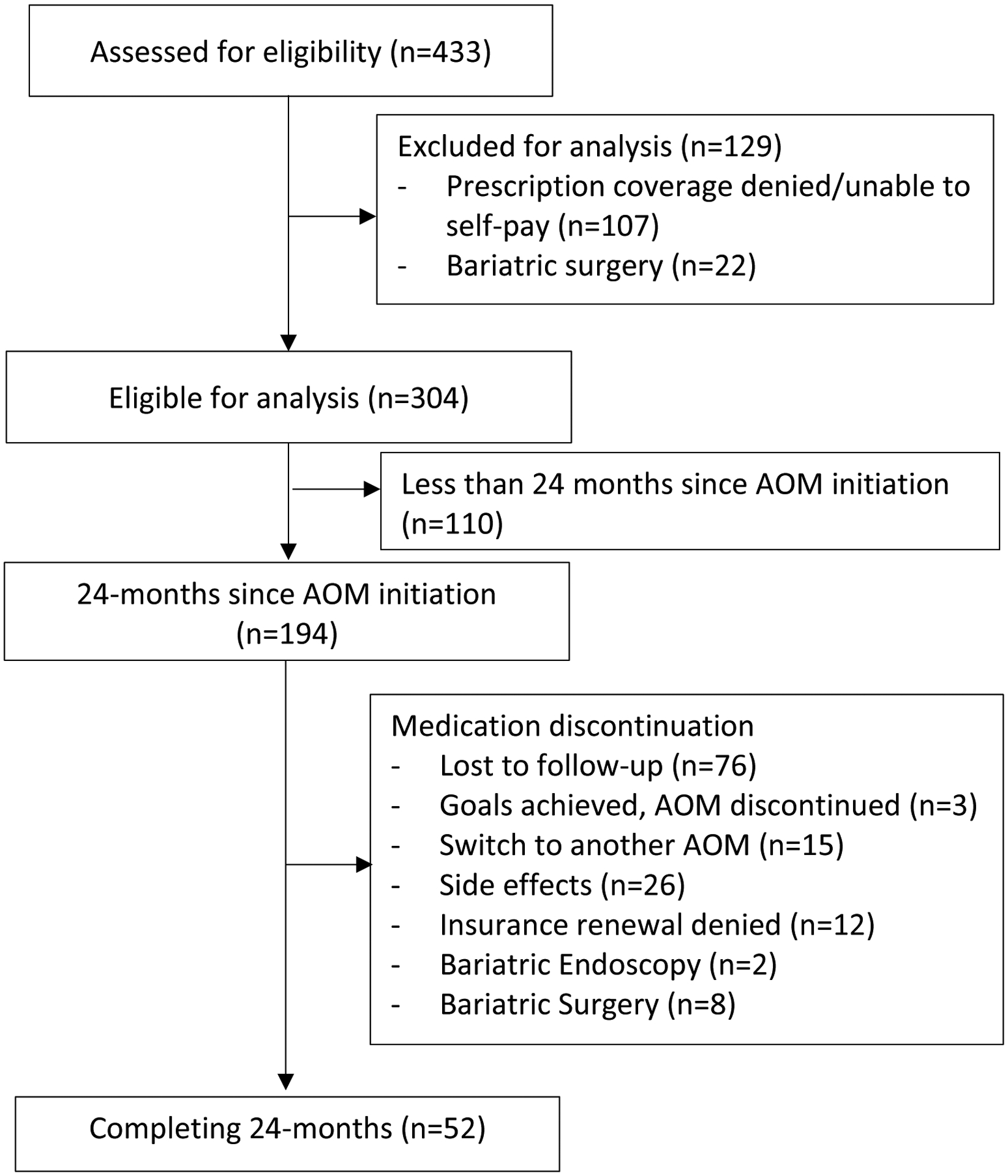
We reviewed the electronic medical records (EMR) of patients with obesity who were prescribed an FDA-approved AOM for long-term use in academic and community multidisciplinary weight loss programs between January 2016 and January 2020.
We assessed percentage total body weight loss (%TBWL), metabolic outcomes, and side effect profile up to 24 months after AOM initiation.
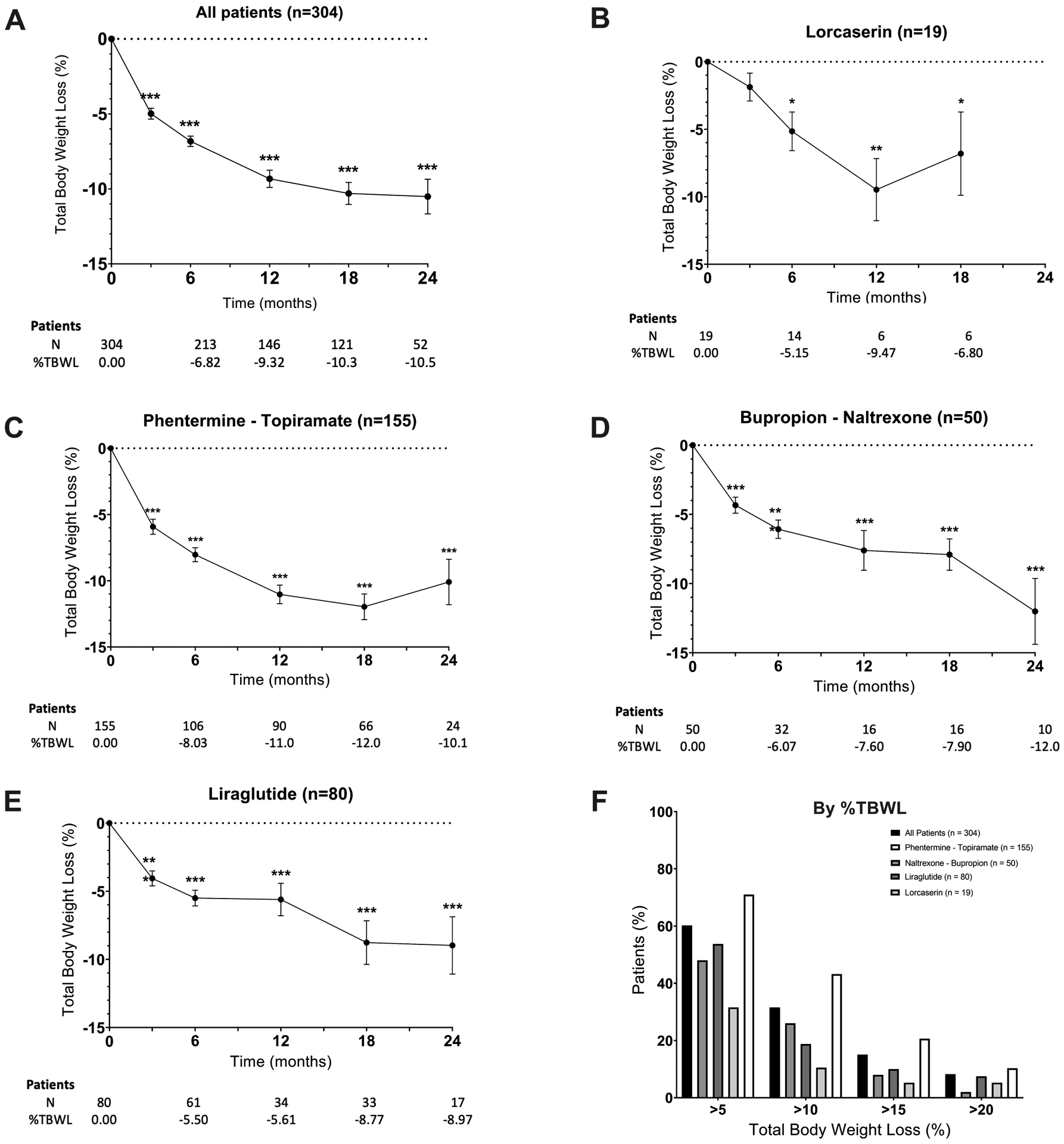
The full cohort consisted of 304 patients (76% women, 95.2% White, median age of 50 years old [IQR, 39-58]). The median follow-up time was 9.1 months [IQR, 4.2-14.1] with a median number of 3 visits [IQR, 2-4]. The most prescribed medication was phentermine/topiramate extended-release (ER) (51%), followed by liraglutide (26.3%), bupropion/naltrexone sustained-release (SR) (16.5%), and lorcaserin (6.2%). %TBWL was 5.0%, 6.8%, 9.3%, 10.3%, and 10.5% at 3, 6, 12, 18, and 24 months. 60.2% of the entire cohort achieved at least 5% TBWL. Overall, phentermine/topiramate-ER had the most robust weight loss response during follow-up, with the highest %TBWL at 12 months of 12.0%. Adverse events were reported in 22.4% of patients. Only 9% of patients discontinued the medication due to side effects.
AOMs resulted in significant long-term weight loss, that was comparable to outcomes previously reported in clinical trials.
随机临床试验已证明,美国食品和药物管理局(FDA)批准的抗肥胖药物(AOM)长期使用的疗效和安全性。但尚不清楚这些结果是否可以在出现临床复杂性的真实世界临床实践中得到复制。本研究旨在评估这些药物在真实世界多学科临床实践环境中的有效性和副作用。
我们回顾了 2016 年 1 月至 2020 年 1 月期间,在学术和社区多学科减肥项目中,因肥胖而长期服用 FDA 批准的 AOM 的患者的电子病历(EMR)。
我们评估了 AOM 起始后 24 个月时的总体重减轻百分比(%TBWL)、代谢结果和副作用谱。
全队列共 304 例患者(76%为女性,95.2%为白人,中位年龄为 50 岁[IQR,39-58])。中位随访时间为 9.1 个月[IQR,4.2-14.1],中位数就诊次数为 3 次[IQR,2-4]。最常开的药物是 phentermine/topiramate 缓释剂(ER)(51%),其次是 liraglutide(26.3%)、bupropion/naltrexone 缓释剂(SR)(16.5%)和 lorcaserin(6.2%)。3、6、12、18 和 24 个月时的%TBWL 分别为 5.0%、6.8%、9.3%、10.3%和 10.5%。整个队列中有 60.2%的患者至少达到 5%的 TBWL。总体而言,在整个随访期间,phentermine/topiramate-ER 的减重效果最为显著,12 个月时的最大%TBWL 为 12.0%。报告了 22.4%的患者出现不良反应。由于副作用,仅有 9%的患者停止服用该药。
AOM 可显著减轻体重,且长期效果与临床试验报告的结果相当。