Intensive Care Medicine, University College London and supported by NIHR University College London Hospitals Biomedical Research Centre, London, UK.
Pulmonary, Critical Care and Sleep Medicine, Case Western Reserve University, Cleveland, OH, USA.
Intensive Care Med. 2022 Jan;48(1):36-44. doi: 10.1007/s00134-021-06570-4. Epub 2021 Nov 23.
Bone marrow-derived, allogeneic, multipotent adult progenitor cells demonstrated safety and efficacy in preclinical models of acute respiratory distress syndrome (ARDS).
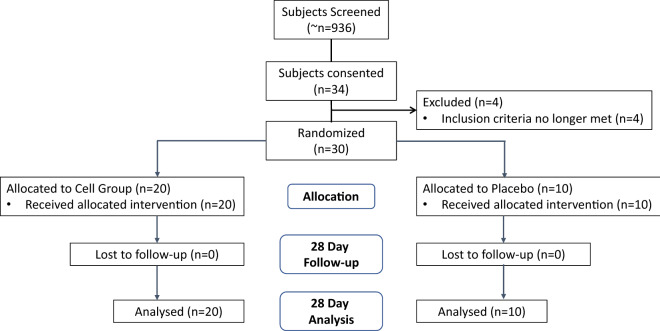
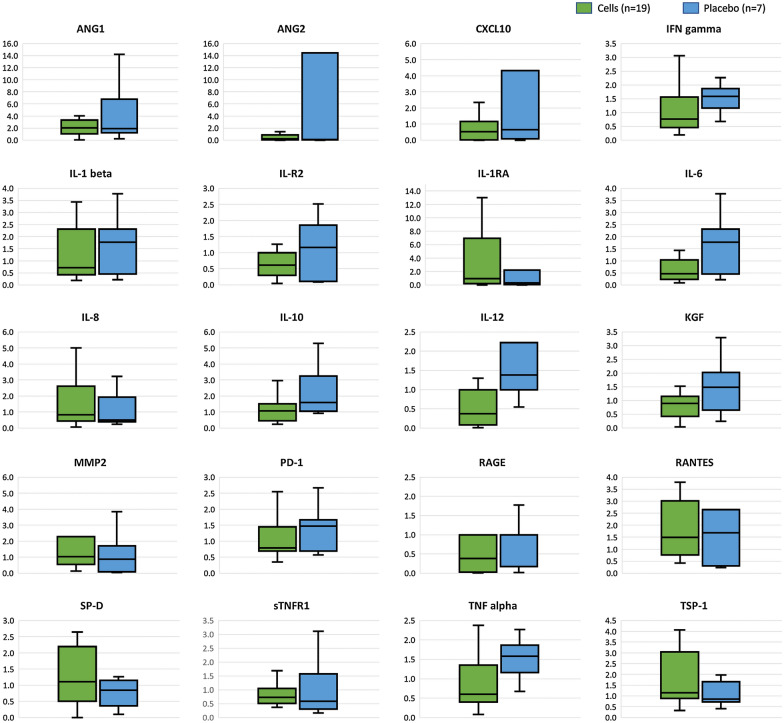
This phase 1/2 trial evaluated the safety and tolerability of intravenous multipotent adult progenitor cells in patients with moderate-to-severe ARDS in 12 UK and USA centres. Cohorts 1 and 2 were open-label, evaluating acute safety in three subjects receiving 300 or 900 million cells, respectively. Cohort 3 was a randomised, double-blind, placebo-controlled parallel trial infusing 900 million cells (n = 20) or placebo (n = 10) within 96 h of ARDS diagnosis. Primary outcomes were safety and tolerability. Secondary endpoints included clinical outcomes, quality of life (QoL) and plasma biomarkers.
No allergic or serious adverse reactions were associated with cell therapy in any cohort. At baseline, the cohort 3 cell group had less severe hypoxia. For cohort 3, 28-day mortality was 25% for cell vs. 45% for placebo recipients. Median 28-day free from intensive care unit (ICU) and ventilator-free days in the cell vs. placebo group were 12.5 (IQR 0,18.5) vs. 4.5 (IQR 0,16.8) and 18.5 (IQR 0,22) vs. 6.5 (IQR 0,18.3), respectively. A prospectively defined severe ARDS subpopulation (PaO/FiO < 150 mmHg (20 kPa); n = 16) showed similar trends in mortality, ICU-free days and ventilator-free days favouring cell therapy. Cell recipients showed greater recovery of QoL through Day 365.
Multipotent adult progenitor cells were safe and well tolerated in ARDS. The clinical outcomes warrant larger trials to evaluate the therapeutic efficacy and optimal patient population.
骨髓来源的同种异体多能成体祖细胞在急性呼吸窘迫综合征(ARDS)的临床前模型中表现出安全性和有效性。
这项 1/2 期临床试验在英国和美国的 12 个中心评估了静脉注射多能成体祖细胞在中重度 ARDS 患者中的安全性和耐受性。队列 1 和 2 为开放性,分别评估了 300 或 9000 万细胞治疗 3 例患者的急性安全性。队列 3 为随机、双盲、安慰剂对照平行试验,在 ARDS 诊断后 96 小时内输注 9000 万细胞(n=20)或安慰剂(n=10)。主要终点为安全性和耐受性。次要终点包括临床结局、生活质量(QoL)和血浆生物标志物。
任何队列中细胞治疗均未与过敏或严重不良反应相关。在基线时,队列 3 细胞组的缺氧程度较轻。对于队列 3,细胞组 28 天死亡率为 25%,安慰剂组为 45%。细胞组和安慰剂组 28 天无 ICU 天数和无呼吸机天数的中位数分别为 12.5(IQR 0,18.5)比 4.5(IQR 0,16.8)和 18.5(IQR 0,22)比 6.5(IQR 0,18.3)。一个预先定义的严重 ARDS 亚组(PaO/FiO<150mmHg(20kPa);n=16)的死亡率、无 ICU 天数和无呼吸机天数也有类似的趋势,细胞治疗组更有利。细胞组患者在第 365 天的 QoL 恢复更好。
多能成体祖细胞在 ARDS 中安全且耐受性良好。这些临床结局需要更大规模的试验来评估其治疗效果和最佳患者人群。