Biomarkers and Nutrimetabolomics Laboratory, Department of Nutrition, Food Sciences and Gastronomy, Faculty of Pharmacy and Food Sciences, University of Barcelona, Barcelona, Spain.
Centro de Investigación Biomédica en Red de Fragilidad y Envejecimiento Saludable (CIBERFES), Instituto de Salud Carlos III, Madrid, Spain.
BMC Med. 2021 Nov 24;19(1):280. doi: 10.1186/s12916-021-02154-7.
Dietary biomarkers may complement dietary intake assessment made by dietary questionnaires. We developed an a-posteriori dietary biomarkers score based on Mediterranean diet food groups and evaluated its association with mortality.
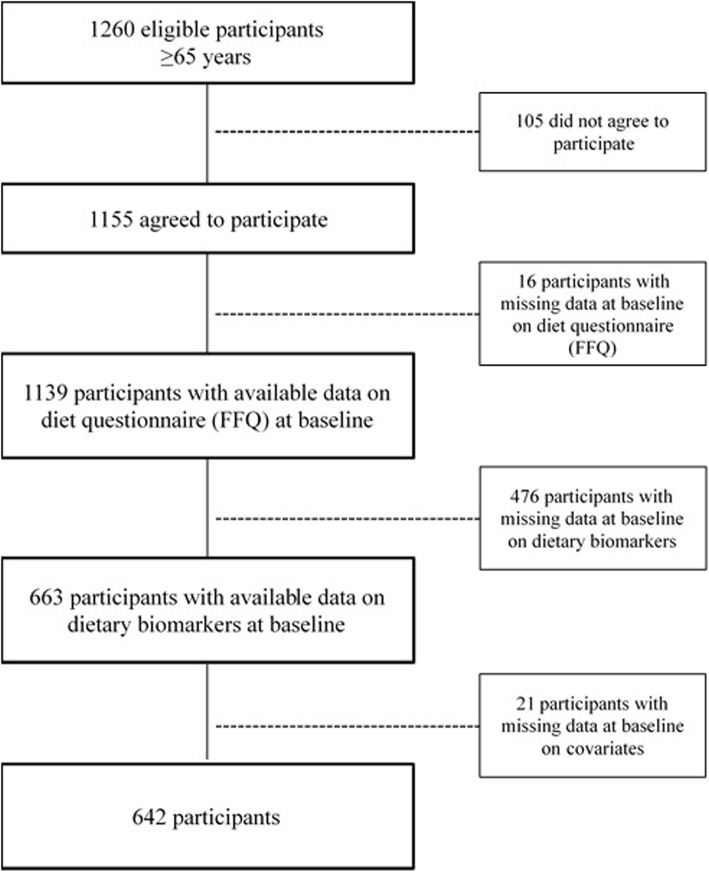
642 participants (56% female), aged ≥65 years, with complete data on dietary biomarkers were followed during 20 years in the InCHIANTI cohort study (Tuscany, Italy). The main outcomes were all-cause, cardiovascular, and cancer mortality. Dietary biomarkers were selected from literature and from correlation analyses with dietary intakes of Mediterranean diet food groups in the study. The baseline levels of the following dietary biomarkers were chosen: urinary total polyphenols and resveratrol metabolites, and plasma carotenoids, selenium, vitamin B12, linolenic, eicosapentaenoic and docosahexaenoic acids, and the mono-unsaturated/saturated fatty acid ratio. Associations of the Mediterranean diet score using dietary biomarkers and a validated food frequency questionnaire (FFQ) (as tertiles) with mortality were assessed through Cox regression.
During the 20-year follow-up [median (Q1-Q3), 14 (8-18) years], and 435 deaths occurred (139 from cardiovascular diseases and 89 from cancer-related causes). In the fully adjusted models, the dietary biomarker-Mediterranean diet score was inversely associated with all-cause (HR 0.72; 95%CI 0.56-0.91) and cardiovascular (HR 0.60; 95%CI 0.38-0.93), but not with cancer mortality. Associations between the FFQ-Mediterranean diet score and mortality were not statistically significant.
A greater adherence at baseline to a Mediterranean diet assessed by a dietary biomarker score was associated with a lower risk of mortality in older adults during a 20-year follow-up. The measurement of dietary biomarkers may contribute to guide individualized dietary counseling to older people.
NCT01331512.
饮食生物标志物可以补充饮食问卷进行的饮食摄入评估。我们基于地中海饮食食物组开发了一个事后饮食生物标志物评分,并评估了其与死亡率的相关性。
642 名参与者(56%为女性),年龄≥65 岁,在 INCHIANTI 队列研究(意大利托斯卡纳)中完成了 20 年的完整饮食生物标志物数据随访。主要结局是全因、心血管和癌症死亡率。饮食生物标志物从文献中选择,并从研究中与地中海饮食食物组的饮食摄入的相关分析中选择。选择了以下饮食生物标志物的基线水平:尿总多酚和白藜芦醇代谢物,以及血浆类胡萝卜素、硒、维生素 B12、亚麻酸、二十碳五烯酸和二十二碳六烯酸,以及单不饱和/饱和脂肪酸比。使用饮食生物标志物和经过验证的食物频率问卷(FFQ)(作为三分位数)评估地中海饮食评分与死亡率的相关性通过 Cox 回归进行评估。
在 20 年的随访期间[中位数(Q1-Q3),14(8-18)年],发生了 435 例死亡(139 例死于心血管疾病,89 例死于癌症相关原因)。在完全调整的模型中,饮食生物标志物-地中海饮食评分与全因死亡率呈负相关(HR 0.72;95%CI 0.56-0.91)和心血管死亡率(HR 0.60;95%CI 0.38-0.93),但与癌症死亡率无关。FFQ-地中海饮食评分与死亡率之间的关联无统计学意义。
在 20 年的随访中,基线时对地中海饮食的更高依从性通过饮食生物标志物评分与老年人的死亡率降低相关。饮食生物标志物的测量可能有助于指导老年人进行个体化饮食咨询。
NCT01331512。