Puttkammer Nancy, Parrish Canada, Desir Yrvel, Hyppolite Nathaelf, Joseph Nadjy, Hall Lara, Honoré Jean Guy, Robin Ermane, Perrin Georges, François Kesner
University of Washington Washington United States of America University of Washington, Washington, United States of America.
National Association of State and Territorial AIDS Directors Port-au-Prince Haiti National Association of State and Territorial AIDS Directors, Port-au-Prince, Haiti.
Rev Panam Salud Publica. 2021 Nov 19;45:e139. doi: 10.26633/RPSP.2021.139. eCollection 2021.
To describe trends in timing of ART initiation for newly diagnosed people living with HIV before and after Haiti adopted its Test and Start policy for universal HIV antiretroviral therapy (ART) in July 2016, and to explore predictors of timely ART initiation for both newly and previously diagnosed people living with HIV following Test and Start adoption.
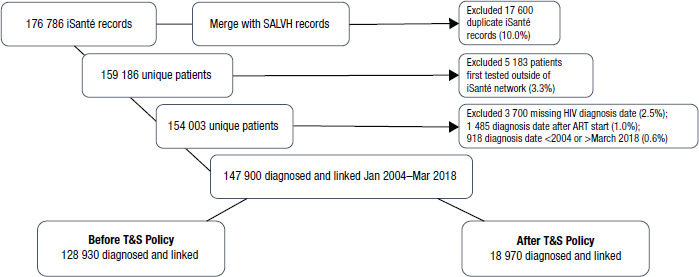
This retrospective cohort study explored timing of ART initiation among 147 900 patients diagnosed with HIV at 94 ART clinics in 2004-2018 using secondary electronic medical record data. The study used survival analysis methods to assess time trends and risk factors for ART initiation.
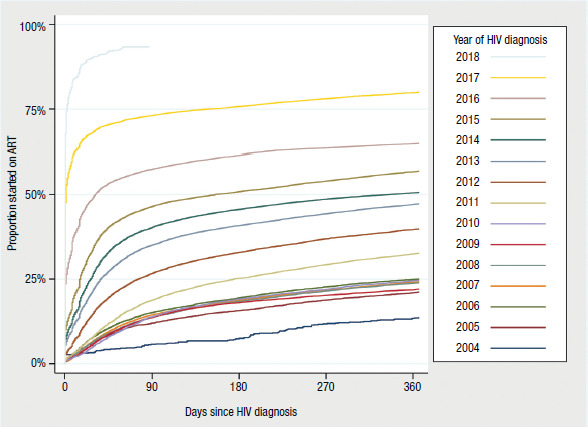
Timely uptake of ART expanded with Test and Start, such that same-day ART initiation rates increased from 3.7% to 45.0%. However, only 11.0% of previously diagnosed patients initiated ART after Test and Start. In adjusted analyses among newly diagnosed people living with HIV, factors negatively associated with timely ART initiation included being a pediatric patient aged 0-14 years (HR = 0.23, < 0.001), being male (HR = 0.92, = 0.03), being 50+ years (HR = 0.87, = 0.03), being underweight (HR = 0.79, < 0.001), and having WHO stage 3 (HR = 0.73, < 0.001) or stage 4 disease (HR = 0.49, < 0.001). Variation in timely ART initiation by geographic department and health facility was observed.
Haiti has made substantial progress in scaling up Test and Start, but further work is needed to enroll previously diagnosed patients and to ensure rapid ART in key patient subgroups. Further research is needed on facility and geographic factors and on strategies for improving timely ART initiation among vulnerable subgroups.
描述海地在2016年7月采用“检测即治疗”政策以实现普遍的艾滋病毒抗逆转录病毒疗法(ART)前后,新诊断的艾滋病毒感染者开始接受ART的时间趋势,并探讨在采用“检测即治疗”政策后,新诊断和既往诊断的艾滋病毒感染者及时开始接受ART的预测因素。
这项回顾性队列研究利用二次电子病历数据,探讨了2004年至2018年期间在94家ART诊所诊断出艾滋病毒的147900名患者开始接受ART的时间。该研究使用生存分析方法来评估开始接受ART的时间趋势和风险因素。
随着“检测即治疗”政策的实施,及时接受ART的情况有所增加,当日开始接受ART的比例从3.7%提高到了45.0%。然而,在“检测即治疗”政策实施后,只有11.0%的既往诊断患者开始接受ART。在对新诊断的艾滋病毒感染者进行的校正分析中,与及时开始接受ART呈负相关的因素包括:年龄在0至14岁的儿科患者(HR = 0.23,<0.001)、男性(HR = 0.92,= 0.03)、50岁及以上(HR = 0.87,= 0.03)、体重过轻(HR = 0.79,<0.001),以及处于世界卫生组织3期(HR = 0.73,<0.001)或4期疾病(HR = 0.49,<0.001)。观察到按地理区域和医疗机构划分,及时开始接受ART的情况存在差异。
海地在扩大“检测即治疗”政策方面取得了重大进展,但仍需要进一步努力让既往诊断的患者加入治疗,并确保关键患者亚组能够迅速接受ART。需要进一步研究医疗机构和地理因素,以及改善弱势群体及时开始接受ART的策略。