Boivin Michael J, Sikorskii Alla, Haan Pamela, Smith Stephanie S, Symonds Laura L, Khattree Ravindra, Giordani Bruno, Blow Adrian J, Osuch Janet R
Department of Psychiatry, Michigan State University, East Lancing, MI, United States.
Department of Neurology & Ophthalmology, Michigan State University, East Lancing, MI, United States.
Front Glob Womens Health. 2021 Aug 16;2:608787. doi: 10.3389/fgwh.2021.608787. eCollection 2021.
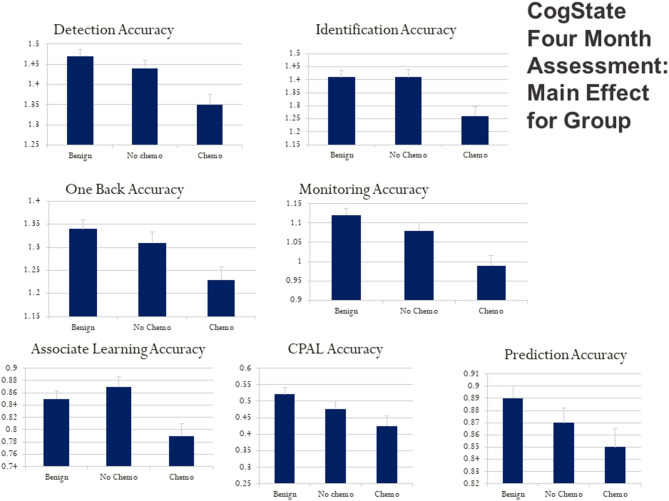
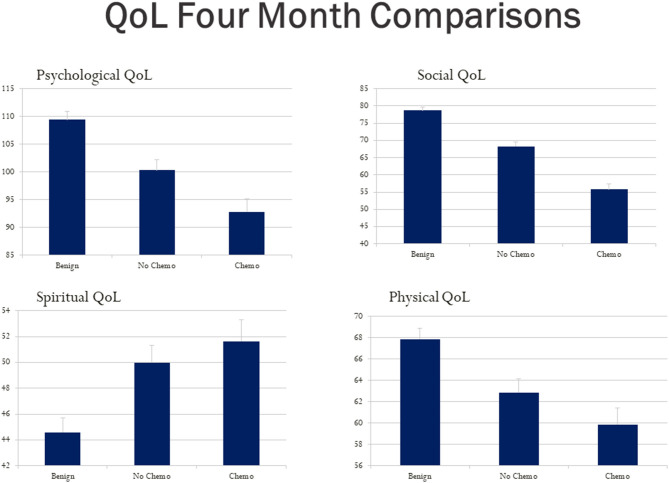
The physical, psychological, social, and spiritual quality of life (QoL) may be affected by breast cancer diagnosis and treatment, with mixed findings for psychological quality of life and cognitive ability performance. The present study aimed to evaluate QoL in women over 1 year from biopsy for a breast abnormality. Self-reported measures of physical, psychological, social, and spiritual QoL were obtained after biopsy results but prior to treatment initiation (baseline), 4 and 12 months later. CogState computerized neuropsychological screening battery also provided an evaluation of psychological QoL. Three groups of women including those with benign biopsy results, those with malignancy treated with chemotherapy, and those with malignancy not treated with chemotherapy were compared at 4 and 12 months after adjusting for baseline to isolate the effects of treatment. Additional covariates included are age, level of education, and income. Benign biopsy results group included 72 women, whereas malignancy was found in 87 women of whom 33 were treated with chemotherapy and 54 without chemotherapy. At the time of diagnosis, women with cancer had worse psychological and social QoL but better spiritual QoL than those with benign biopsy results. Only CogState monitoring accuracy was worse for women with cancer compared with the controls at the time of biopsy results. After adjusting for QoL at baseline, women treated for cancer had worse physical and social QoL at 4 and 12 months later. Psychological well-being was worse for women with cancer at 4th month but improved at 1 year. No differences in cognition were found at 4 and 12 months when adjusted for baseline cognition and covariates. Breast cancer is a traumatic life event for women, affecting psychological and social QoL domains, yet increasing spiritual QoL. Later, cancer treatment worsens physical, psychological, and social QoL compared with those without cancer. These findings suggest that interventions to improve psychological QoL may be especially important at the time of cancer diagnosis, while interventions to improve physical well-being are the most needed during and following cancer treatment. Support to improve social QoL is needed from the time of diagnosis into post-treatment survivorship.
乳腺癌的诊断和治疗可能会影响身体、心理、社会和精神生活质量(QoL),关于心理生活质量和认知能力表现的研究结果不一。本研究旨在评估乳腺异常活检后1年以上女性的生活质量。在活检结果出来后但在开始治疗前(基线)、4个月后和12个月后,获取了关于身体、心理、社会和精神生活质量的自我报告测量数据。CogState计算机化神经心理筛查量表也对心理生活质量进行了评估。在调整基线以分离治疗效果后,对三组女性进行了比较,包括活检结果为良性的女性、接受化疗治疗的恶性肿瘤患者以及未接受化疗治疗的恶性肿瘤患者。纳入的其他协变量包括年龄、教育水平和收入。活检结果为良性的组包括72名女性,而87名女性被发现患有恶性肿瘤,其中33名接受了化疗,54名未接受化疗。在诊断时,患有癌症的女性与活检结果为良性的女性相比,心理和社会生活质量较差,但精神生活质量较好。在活检结果出来时,与对照组相比,患有癌症的女性只有CogState监测准确性较差。在调整基线生活质量后,接受癌症治疗的女性在4个月和12个月后的身体和社会生活质量较差。患有癌症的女性在第4个月时心理健康状况较差,但在1年后有所改善。在调整基线认知和协变量后,在4个月和12个月时未发现认知方面的差异。乳腺癌对女性来说是一个创伤性的生活事件,会影响心理和社会生活质量领域,但会提高精神生活质量。后来,与没有患癌症的女性相比,癌症治疗会使身体、心理和社会生活质量恶化。这些发现表明,改善心理生活质量的干预措施在癌症诊断时可能尤为重要,而改善身体健康的干预措施在癌症治疗期间和治疗后最为需要。从诊断到治疗后的生存期都需要支持来改善社会生活质量。