Au Jacky
School of Education, University of California, Irvine, Irvine CA, 92697, USA.
medRxiv. 2021 Nov 15:2021.11.14.21266325. doi: 10.1101/2021.11.14.21266325.
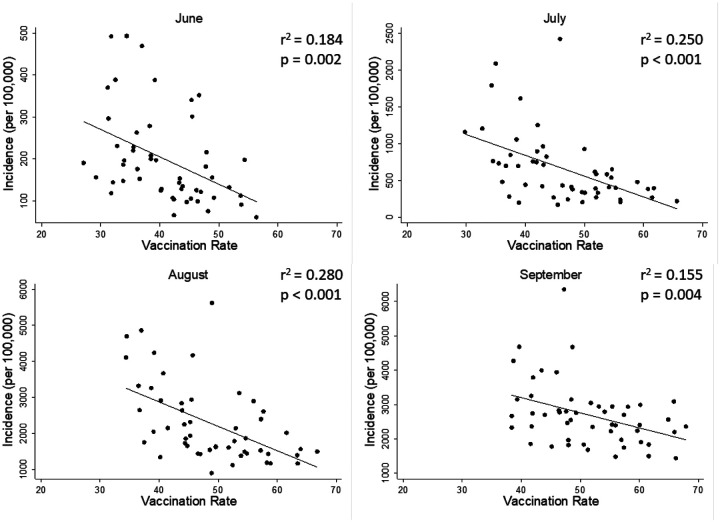
The severe acute respiratory syndrome coronavirus 2 (SARS-CoV-2) began proliferating widely throughout the world in late 2019/early 2020, creating a global pandemic and health crisis. Although vaccines became available to the public approximately one year after the onset of the pandemic, there still remains much hesitancy surrounding vaccination even two years into the pandemic. One key concern comes from reports of breakthrough infections among the vaccinated that show comparable levels of peak viral load as the unvaccinated, calling into question the ability of vaccines to slow or prevent transmission. Therefore young, healthy individuals who are at low risk of serious complications themselves have little incentive to receive a vaccine that they are not convinced will protect others around them. To address this important concern, this article analyzes COVID-19 incidence in the United States as a function of each state's vaccination rate. Results show that states with higher percentages of fully vaccinated individuals report fewer new cases among the remaining unvaccinated population. These data add to accumulating evidence that COVID-19 vaccinations can indeed slow the spread of SARS-CoV-2, and are an important tool in society's arsenal to put this pandemic behind us.
严重急性呼吸综合征冠状病毒2(SARS-CoV-2)于2019年末/2020年初开始在全球广泛传播,引发了全球大流行和健康危机。尽管在大流行开始约一年后公众就可以接种疫苗,但即使在大流行两年后,围绕疫苗接种仍存在很大的犹豫情绪。一个关键问题来自于接种疫苗后出现突破性感染的报告,这些报告显示,接种者的病毒载量峰值水平与未接种者相当,这让人质疑疫苗减缓或预防传播的能力。因此,本身严重并发症风险较低的年轻健康个体几乎没有动力去接种一种他们不相信能保护周围人的疫苗。为了解决这一重要问题,本文分析了美国新冠肺炎发病率与各州疫苗接种率之间的关系。结果显示,完全接种疫苗的个体比例较高的州,在其余未接种人群中报告的新病例较少。这些数据进一步证明,新冠疫苗接种确实可以减缓SARS-CoV-2的传播,是社会战胜这场大流行的重要工具。