• 文献检索
  • 文档翻译
  • 深度研究
  • 学术资讯
  • Suppr Zotero 插件Zotero 插件
  • 邀请有礼
  • 套餐&价格
  • 历史记录
应用&插件
Suppr Zotero 插件Zotero 插件浏览器插件Mac 客户端Windows 客户端微信小程序
定价
高级版会员购买积分包购买API积分包
服务
文献检索文档翻译深度研究API 文档MCP 服务
关于我们
关于 Suppr公司介绍联系我们用户协议隐私条款
关注我们

Suppr 超能文献

核心技术专利:CN118964589B侵权必究
粤ICP备2023148730 号-1Suppr @ 2026

文献检索

告别复杂PubMed语法,用中文像聊天一样搜索,搜遍4000万医学文献。AI智能推荐,让科研检索更轻松。

立即免费搜索

文件翻译

保留排版,准确专业,支持PDF/Word/PPT等文件格式,支持 12+语言互译。

免费翻译文档

深度研究

AI帮你快速写综述,25分钟生成高质量综述,智能提取关键信息,辅助科研写作。

立即免费体验

发热患者在 COVID-19 爆发前后就诊于急诊科的临床特征变化。

Changes in Clinical Characteristics among Febrile Patients Visiting the Emergency Department before and after the COVID-19 Outbreak.

机构信息

National Emergency Medical Center, National Medical Center, Seoul, Korea.

Department of Emergency Medicine, Yonsei University College of Medicine, Seoul, Korea.

出版信息

Yonsei Med J. 2021 Dec;62(12):1136-1144. doi: 10.3349/ymj.2021.62.12.1136.

DOI:10.3349/ymj.2021.62.12.1136
PMID:34816644
原文链接:https://pmc.ncbi.nlm.nih.gov/articles/PMC8612855/
Abstract

PURPOSE

Considering the risk of coronavirus disease (COVID-19) transmission through infected droplets, emergency department (ED) operations in response to febrile patients should be planned. We investigated the general and clinical characteristics of febrile patients visiting the ED and changes in admission rates via the ED during the COVID-19 outbreak.

MATERIALS AND METHODS

We performed a retrospective analysis of prospectively collected patients who visited 402 EDs in the Republic of Korea with febrile symptoms between January 27 and May 31, 2020 and compared them to those enrolled before the COVID-19 outbreak. The primary outcome was admission rate; the secondary outcome was length of stay (LOS) in the ED.

RESULTS

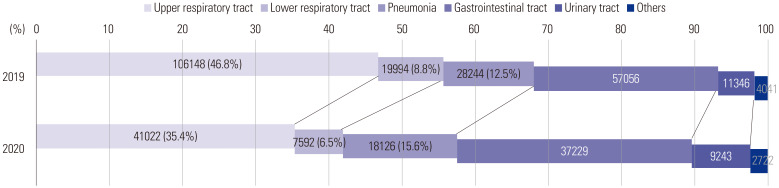
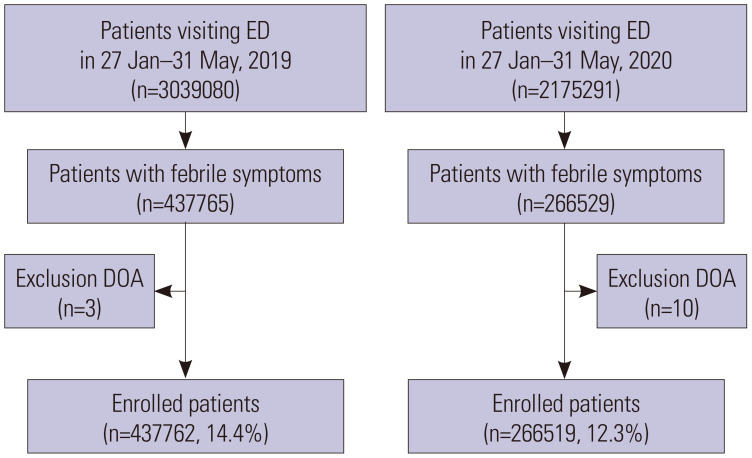
In total, 266519 patients had febrile symptoms at ED presentation after the COVID-19 outbreak. In 2019, before the outbreak, there were 437762 patients. The rate of ED visits among pediatric patients (aged <15 years) decreased to 21.4% after the COVID-19 outbreak, compared with 41.8% in 2019. The proportion of patients admitted after ED management was higher after the outbreak (31.3%) than before (25.2%). The adjusted odds ratio for admission was 1.04 (95% confidence interval: 1.02-1.05) after the outbreak. Compared to before the COVID-19 outbreak, the median ED LOS increased by 16 min after the outbreak.

CONCLUSION

This study confirmed that admission rates and ED LOS increased for febrile patients visiting the ED after the COVID-19 outbreak. This could provide evidence for developing ED-related strategies in response to the ongoing COVID-19 outbreak and other infectious disease pandemics.

摘要

目的

考虑到感染飞沫传播冠状病毒病(COVID-19)的风险,应计划应对发热患者的急诊(ED)操作。我们调查了 COVID-19 爆发期间访问 ED 的发热患者的一般和临床特征以及通过 ED 入院率的变化。

材料和方法

我们对 2020 年 1 月 27 日至 5 月 31 日期间在韩国共和国因发热症状访问 402 个 ED 的前瞻性收集的患者进行了回顾性分析,并将其与 COVID-19 爆发前登记的患者进行了比较。主要结局是入院率;次要结局是 ED 停留时间(LOS)。

结果

共有 266519 名患者在 COVID-19 爆发后在 ED 出现发热症状。在 COVID-19 爆发前的 2019 年,有 437762 名患者。ED 就诊的儿科患者(<15 岁)比例从 COVID-19 爆发前的 41.8%下降到 21.4%。ED 管理后住院的患者比例高于爆发前(31.3%比 25.2%)。爆发后,住院的调整优势比为 1.04(95%置信区间:1.02-1.05)。与 COVID-19 爆发前相比,爆发后 ED LOS 中位数增加了 16 分钟。

结论

本研究证实,COVID-19 爆发后,访问 ED 的发热患者的入院率和 ED LOS 增加。这可为制定与 ED 相关的策略提供证据,以应对当前的 COVID-19 爆发和其他传染病大流行。
https://cdn.ncbi.nlm.nih.gov/pmc/blobs/46ad/8612855/a4cce6cb3159/ymj-62-1136-g004.jpg
https://cdn.ncbi.nlm.nih.gov/pmc/blobs/46ad/8612855/b0f0472ad0de/ymj-62-1136-g001.jpg
https://cdn.ncbi.nlm.nih.gov/pmc/blobs/46ad/8612855/9536611b2b11/ymj-62-1136-g002.jpg
https://cdn.ncbi.nlm.nih.gov/pmc/blobs/46ad/8612855/0d6ad0cdc34a/ymj-62-1136-g003.jpg
https://cdn.ncbi.nlm.nih.gov/pmc/blobs/46ad/8612855/a4cce6cb3159/ymj-62-1136-g004.jpg
https://cdn.ncbi.nlm.nih.gov/pmc/blobs/46ad/8612855/b0f0472ad0de/ymj-62-1136-g001.jpg
https://cdn.ncbi.nlm.nih.gov/pmc/blobs/46ad/8612855/9536611b2b11/ymj-62-1136-g002.jpg
https://cdn.ncbi.nlm.nih.gov/pmc/blobs/46ad/8612855/0d6ad0cdc34a/ymj-62-1136-g003.jpg
https://cdn.ncbi.nlm.nih.gov/pmc/blobs/46ad/8612855/a4cce6cb3159/ymj-62-1136-g004.jpg

相似文献

1
Changes in Clinical Characteristics among Febrile Patients Visiting the Emergency Department before and after the COVID-19 Outbreak.发热患者在 COVID-19 爆发前后就诊于急诊科的临床特征变化。
Yonsei Med J. 2021 Dec;62(12):1136-1144. doi: 10.3349/ymj.2021.62.12.1136.
2
Impact of the COVID-19 pandemic on emergency department utilization patterns in South Korea: A retrospective observational study.COVID-19 大流行对韩国急诊科利用模式的影响:一项回顾性观察研究。
Medicine (Baltimore). 2022 Feb 25;101(8):e29009. doi: 10.1097/MD.0000000000029009.
3
Pediatric Emergency Department Utilization and Coronavirus Disease in Daegu, Korea.韩国大邱市儿科急诊就诊情况与冠状病毒病。
J Korean Med Sci. 2021 Jan 4;36(1):e11. doi: 10.3346/jkms.2021.36.e11.
4
Impact of the COVID-19 Outbreak on Emergency Care Utilization in Patients with Acute Myocardial Infarction: a Nationwide Population-based Study.COVID-19 疫情对急性心肌梗死患者急诊利用的影响:一项全国范围内基于人群的研究。
J Korean Med Sci. 2021 Apr 26;36(16):e111. doi: 10.3346/jkms.2021.36.e111.
5
Comparison of the Clinical Process and Outcomes in Patients after Coronavirus Infection 2019 Outbreak.2019年冠状病毒感染爆发后患者临床过程及结局的比较
Medicina (Kaunas). 2021 Oct 11;57(10):1086. doi: 10.3390/medicina57101086.
6
Identifying the effects of an upgraded 'fever clinic' on COVID-19 control and the workload of emergency department: retrospective study in a tertiary hospital in China.识别升级后的“发热门诊”对 COVID-19 控制和急诊科工作量的影响:中国一家三级医院的回顾性研究。
BMJ Open. 2020 Aug 20;10(8):e039177. doi: 10.1136/bmjopen-2020-039177.
7
Effects of Emergency Care-related Health Policies during the COVID-19 Pandemic in Korea: a Quasi-Experimental Study.韩国 COVID-19 大流行期间的急救护理相关卫生政策效果:一项准实验研究。
J Korean Med Sci. 2021 Apr 26;36(16):e121. doi: 10.3346/jkms.2021.36.e121.
8
How Covid-19 changed the epidemiology of febrile urinary tract infections in children in the emergency department during the first outbreak.新冠疫情如何改变了急诊科首发期间儿童发热性尿路感染的流行病学特征。
BMC Pediatr. 2022 Sep 15;22(1):550. doi: 10.1186/s12887-022-03516-7.
9
Impact of the COVID-19 Outbreak on Trends in Emergency Department Utilization in Children: a Multicenter Retrospective Observational Study in Seoul Metropolitan Area, Korea.新型冠状病毒肺炎疫情对儿童急诊科就诊趋势的影响:韩国首尔大都市区的一项多中心回顾性观察研究
J Korean Med Sci. 2021 Feb 1;36(5):e44. doi: 10.3346/jkms.2021.36.e44.
10
Clinical Characteristics Associated with Return Visits to the Emergency Department after COVID-19 Diagnosis.临床特征与 COVID-19 诊断后急诊复诊相关。
West J Emerg Med. 2021 Nov 5;22(6):1257-1261. doi: 10.5811/westjem.2021.9.52824.

引用本文的文献

1
Impact of the Early COVID-19 Pandemic on Emergency Department Visits of Adult Cancer Patients With Fever or Respiratory Symptoms: A Korean Nationwide Population-Based Study, 2016-2020.COVID-19 大流行早期对发热或呼吸道症状的成年癌症患者急诊就诊的影响:2016-2020 年韩国全国基于人群的研究。
J Korean Med Sci. 2024 Jun 17;39(23):e187. doi: 10.3346/jkms.2024.39.e187.
2
Comparison of modified quick Sequential Organ Failure Assessment models as triage tools for febrile patients.改良快速序贯器官衰竭评估模型作为发热患者分诊工具的比较
Clin Exp Emerg Med. 2024 Sep;11(3):286-294. doi: 10.15441/ceem.23.125. Epub 2024 Jan 29.
3

本文引用的文献

1
Efficacy of a four-tier infection response system in the emergency department during the coronavirus disease-2019 outbreak.新冠疫情期间急诊科四层感染反应系统的效果。
PLoS One. 2021 Aug 12;16(8):e0256116. doi: 10.1371/journal.pone.0256116. eCollection 2021.
2
An Analysis of Changes in Emergency Department Visits After a State Declaration During the Time of COVID-19.新冠疫情期间,国家宣布进入紧急状态后,对急诊科就诊人数变化的分析。
Ann Emerg Med. 2020 Nov;76(5):595-601. doi: 10.1016/j.annemergmed.2020.06.019. Epub 2020 Jun 11.
3
The impact of social distancing and public behavior changes on COVID-19 transmission dynamics in the Republic of Korea.
Prediction of inappropriate pre-hospital transfer of patients with suspected cardiovascular emergency diseases using machine learning: a retrospective observational study.
使用机器学习预测疑似心血管急症患者的不当院前转院:一项回顾性观察研究。
BMC Med Inform Decis Mak. 2023 Apr 6;23(1):56. doi: 10.1186/s12911-023-02149-9.
4
Forecasting Hospital Visits Due to Influenza Based on Emergency Department Visits for Fever: A Feasibility Study on Emergency Department-Based Syndromic Surveillance.基于发热急诊就诊情况预测流感所致医院就诊量:基于急诊的症候群监测可行性研究。
Int J Environ Res Public Health. 2022 Oct 10;19(19):12954. doi: 10.3390/ijerph191912954.
5
Advantage of Vital Sign Monitoring Using a Wireless Wearable Device for Predicting Septic Shock in Febrile Patients in the Emergency Department: A Machine Learning-Based Analysis.基于机器学习的分析:使用无线可穿戴设备对急诊科发热患者进行生命体征监测在预测感染性休克方面的优势。
Sensors (Basel). 2022 Sep 17;22(18):7054. doi: 10.3390/s22187054.
6
Effect of Applying a Real-Time Medical Record Input Assistance System With Voice Artificial Intelligence on Triage Task Performance in the Emergency Department: Prospective Interventional Study.应用带语音人工智能的实时病历输入辅助系统对急诊科分诊任务绩效的影响:前瞻性干预研究。
JMIR Med Inform. 2022 Aug 31;10(8):e39892. doi: 10.2196/39892.
7
The impact of COVID-19 on cancer care in a tertiary hospital in Korea: possible collateral damage to emergency care.COVID-19 对韩国一家三级医院癌症治疗的影响:急诊治疗可能受到附带损害。
Epidemiol Health. 2022;44:e2022044. doi: 10.4178/epih.e2022044. Epub 2022 May 1.
社交距离和公众行为改变对韩国 COVID-19 传播动力学的影响。
PLoS One. 2020 Sep 24;15(9):e0238684. doi: 10.1371/journal.pone.0238684. eCollection 2020.
4
Identifying the effects of an upgraded 'fever clinic' on COVID-19 control and the workload of emergency department: retrospective study in a tertiary hospital in China.识别升级后的“发热门诊”对 COVID-19 控制和急诊科工作量的影响:中国一家三级医院的回顾性研究。
BMJ Open. 2020 Aug 20;10(8):e039177. doi: 10.1136/bmjopen-2020-039177.
5
Epidemiological and clinical characteristics of coronavirus disease 2019 in Daegu, South Korea.韩国大邱市 2019 年冠状病毒病的流行病学和临床特征。
Int J Infect Dis. 2020 Sep;98:462-466. doi: 10.1016/j.ijid.2020.07.017. Epub 2020 Jul 21.
6
Consequences of physical distancing emanating from the COVID-19 pandemic: An Australian perspective.COVID-19 大流行期间物理隔离的后果:澳大利亚的观点。
Paediatr Respir Rev. 2020 Sep;35:25-30. doi: 10.1016/j.prrv.2020.06.005. Epub 2020 Jun 11.
7
Strategic planning and response to COVID-19 in a London emergency department.伦敦急诊科应对 COVID-19 的战略规划与响应。
Emerg Med J. 2020 Sep;37(9):567-570. doi: 10.1136/emermed-2020-209797. Epub 2020 Jul 15.
8
Coronavirus Disease Exposure and Spread from Nightclubs, South Korea.韩国夜店的冠状病毒病暴露和传播。
Emerg Infect Dis. 2020 Oct;26(10):2499-2501. doi: 10.3201/eid2610.202573. Epub 2020 Jul 7.
9
Impact of COVID-19 pandemic on emergency department services acuity and possible collateral damage.新冠疫情对急诊科服务急症程度的影响及可能的附带损害。
Resuscitation. 2020 Aug;153:185-186. doi: 10.1016/j.resuscitation.2020.06.021. Epub 2020 Jun 22.
10
Accuracy of Emergency Department Clinical Findings for Diagnosis of Coronavirus Disease 2019.急诊科临床检查对 2019 年冠状病毒病诊断的准确性。
Ann Emerg Med. 2020 Oct;76(4):405-412. doi: 10.1016/j.annemergmed.2020.05.022. Epub 2020 May 21.