
基于发热急诊就诊情况预测流感所致医院就诊量:基于急诊的症候群监测可行性研究。
Forecasting Hospital Visits Due to Influenza Based on Emergency Department Visits for Fever: A Feasibility Study on Emergency Department-Based Syndromic Surveillance.
机构信息
Department of Preventive Medicine, Hanyang University College of Medicine, Seoul 04763, Korea.
Department of Statistics and Data Science, Graduate School, Dongguk University, Seoul 04620, Korea.
出版信息
Int J Environ Res Public Health. 2022 Oct 10;19(19):12954. doi: 10.3390/ijerph191912954.
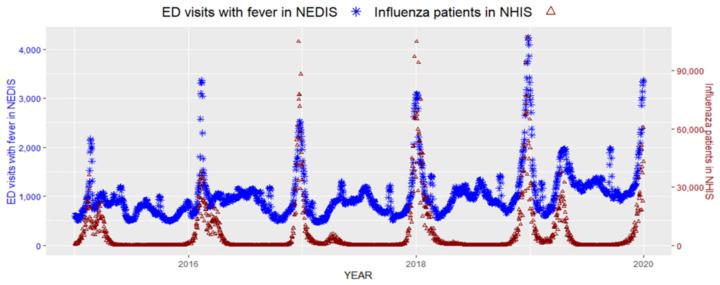
This study evaluated the use of chief complaint data from emergency departments (EDs) to detect the increment of influenza cases identified from the nationwide medical service usage and developed a forecast model to predict the number of patients with influenza using the daily number of ED visits due to fever. The National Health Insurance Service (NHIS) and the National Emergency Department Information System (NEDIS) databases from 2015 to 2019 were used. The definition of fever included having an initial body temperature ≥ 38.0 °C at an ED department or having a report of fever as a patient's chief complaint. The moving average number of visits to the ED due to fever for the previous seven days was used. Patients in the NHIS with the International Classification of Diseases-10 codes of J09, J10, or J11 were classified as influenza cases, with a window duration of 100 days, assuming the claims were from the same season. We developed a forecast model according to an autoregressive integrated moving average (ARIMA) method using the data from 2015 to 2017 and validated it using the data from 2018 to 2019. Of the 29,142,229 ED visits from 2015 to 2019, 39.9% reported either a fever as a chief complaint or a ≥38.0 °C initial body temperature at the ED. ARIMA (1,1,1) (0,0,1) was the most appropriate model for predicting ED visits due to fever. The mean absolute percentage error (MAPE) value showed the prediction accuracy of the model. The correlation coefficient between the number of ED visits and the number of patients with influenza in the NHIS up to 14 days before the forecast, with the exceptions of the eighth, ninth, and twelfth days, was higher than 0.70 (-value = 0.001). ED-based syndromic surveillances of fever were feasible for the early detection of hospital visits due to influenza.
本研究评估了使用急诊科(ED)的主要投诉数据来检测全国医疗服务使用情况中流感病例的增加,并开发了一种预测模型,使用因发热而每天到 ED 就诊的人数来预测流感患者的数量。使用了 2015 年至 2019 年的国民健康保险服务(NHIS)和国家急诊部信息系统(NEDIS)数据库。发热的定义包括在 ED 部门初始体温≥38.0°C,或患者主诉有发热。使用前七天因发热到 ED 就诊的移动平均值。NHIS 中患有 J09、J10 或 J11 的国际疾病分类-10 代码的患者被归类为流感病例,假设申报来自同一季节,窗口期为 100 天。我们根据自回归综合移动平均(ARIMA)方法使用 2015 年至 2017 年的数据开发了一个预测模型,并使用 2018 年至 2019 年的数据进行了验证。在 2015 年至 2019 年的 29142229 次 ED 就诊中,39.9%的患者报告了发热作为主要投诉,或在 ED 部门初始体温≥38.0°C。ARIMA(1,1,1)(0,0,1)是预测因发热而到 ED 就诊的最适用模型。平均绝对百分比误差(MAPE)值显示了模型的预测准确性。在预测前 14 天内,NHIS 中因发热而到 ED 就诊的人数与流感患者人数之间的相关系数(除第 8、9 和 12 天外)高于 0.70(-值=0.001)。基于 ED 的发热综合征监测可用于早期发现因流感而到医院就诊的情况。



 Zotero 插件