Department of Orthopaedics and Trauma Surgery, Musculoskeletal University Center Munich (MUM), University Hospital, LMU Munich, Marchioninistr. 15, 81377, Munich, Germany.
Osteoporos Int. 2022 Apr;33(4):901-907. doi: 10.1007/s00198-021-06246-1. Epub 2021 Nov 24.
This is the first study that highlighted the amount of missed information related on bone health in orthogeriatric patients suffering fragility fractures of the pelvis and also evaluated its prevalence and differing etiology in the assessed patients, regarding osteoporosis and/or osteomalacia, based on laboratory and instrumental measurements. This evaluation should become a standardized procedure in the treatment of orthogeriatric patients presenting with a FFP.
Fragility fractures of the pelvis (FFP) are common in orthogeriatric patients. Secondary fracture prevention regarding evaluation and treatment of an underlying osteoporosis or osteomalacia is still often neglected. The purpose of this study was to evaluate the amount of missed information related on bone health in older adult FFP patients, the prevalence of vitamin D deficiency in assessed patients, and if fracture type-dependent distribution patterns could be observed.
A retrospective analysis of prospectively collected data of an institutional register was performed. Patients aged 80 years and older (n = 456) admitted with a FFP from 01/2003 until 12/2019 to a level I trauma center were included.
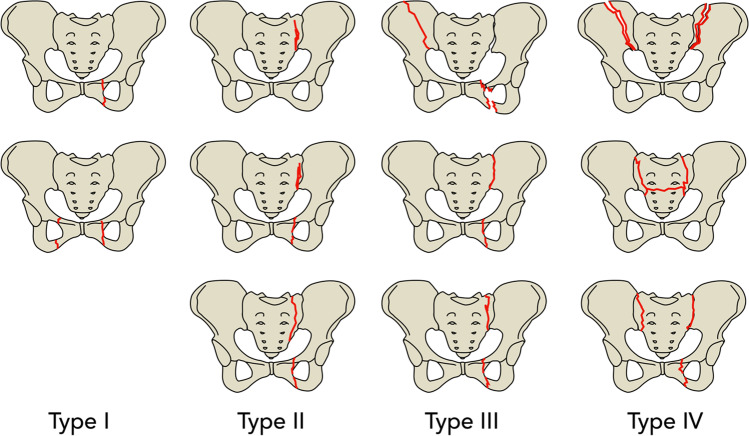
In 456 patients, FFP type II were leading (66.7%). Diagnostics were conducted in 37.1% of the patients regarding measurement of vitamin D levels and 21.7% regarding DXA measurements; vitamin D deficiency was observed in 62.7%, indicators for an underlying osteomalacia in 45.8%, and an osteoporosis in 46.5% of the assessed patients.
Although FFP are common and will increase, there is still a lack of secondary fracture prevention, starting with information related on bone health. In the assessed patients, a high prevalence of vitamin D deficiency was present, but no significant correlation between vitamin D level and type of fracture was observed. Ongoing education for varying etiology and specific treatment of these fractures is necessary, as surgical treatment was unified, but drug therapy remains different.
这是第一项研究,强调了与患有脆性骨盆骨折的老年骨科患者的骨骼健康相关的漏诊信息的数量,还根据实验室和仪器测量评估了在所评估患者中骨质疏松症和/或骨软化症的发生率和不同病因。这种评估应该成为治疗伴有 FFP 的老年骨科患者的标准程序。
对机构登记处前瞻性收集的数据进行回顾性分析。纳入 2003 年 1 月至 2019 年 12 月期间因 FFP 入住 I 级创伤中心的 80 岁及以上的患者(n = 456)。
尽管 FFP 很常见并且会增加,但仍然缺乏二级骨折预防,首先是与骨骼健康相关的信息。在所评估的患者中,维生素 D 缺乏的发生率很高,但未观察到维生素 D 水平与骨折类型之间存在显著相关性。需要对这些骨折的不同病因和特定治疗进行持续教育,因为手术治疗是统一的,但药物治疗仍然不同。
脆性骨盆骨折(FFP)在老年骨科患者中很常见。关于评估和治疗潜在骨质疏松症或骨软化症的继发性骨折预防仍然经常被忽视。本研究的目的是评估老年脆性骨盆骨折患者骨骼健康相关漏诊信息的数量、评估患者中维生素 D 缺乏的发生率,以及是否可以观察到骨折类型相关的分布模式。
在 456 例患者中,FFP Ⅱ型为主(66.7%)。对 37.1%的患者进行了维生素 D 水平测量,对 21.7%的患者进行了 DXA 测量;在评估患者中,维生素 D 缺乏发生率为 62.7%,存在潜在骨软化症的指标发生率为 45.8%,骨质疏松症发生率为 46.5%。
这是第一项研究,强调了与患有脆性骨盆骨折的老年骨科患者的骨骼健康相关的漏诊信息的数量,还根据实验室和仪器测量评估了在所评估患者中骨质疏松症和/或骨软化症的发生率和不同病因,基于实验室和仪器测量。这种评估应该成为治疗伴有 FFP 的老年骨科患者的标准程序。