State Key laboratory of Applied Optics, Changchun Institute of Optics, Fine Mechanics and Physics, Chinese Academy of Sciences, Changchun, People's Republic of China.
University of Chinese Academy of Sciences, Beijing, People's Republic of China.
Appl Environ Microbiol. 2022 Feb 8;88(3):e0116521. doi: 10.1128/AEM.01165-21. Epub 2021 Nov 24.
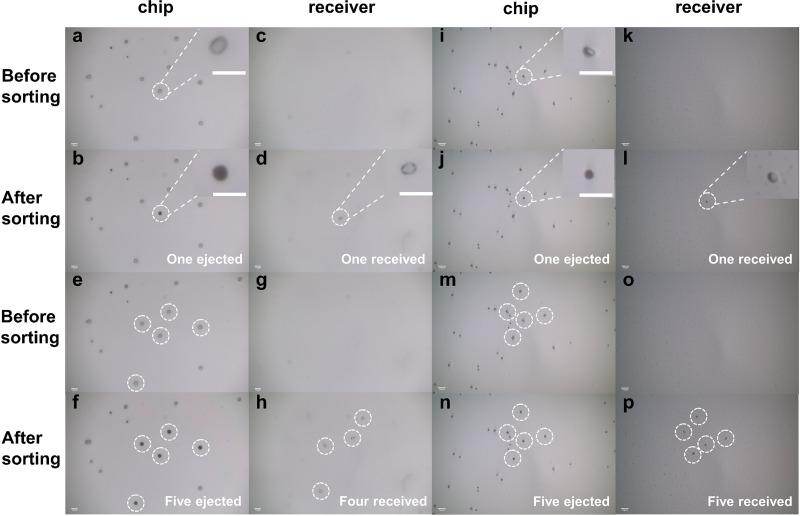
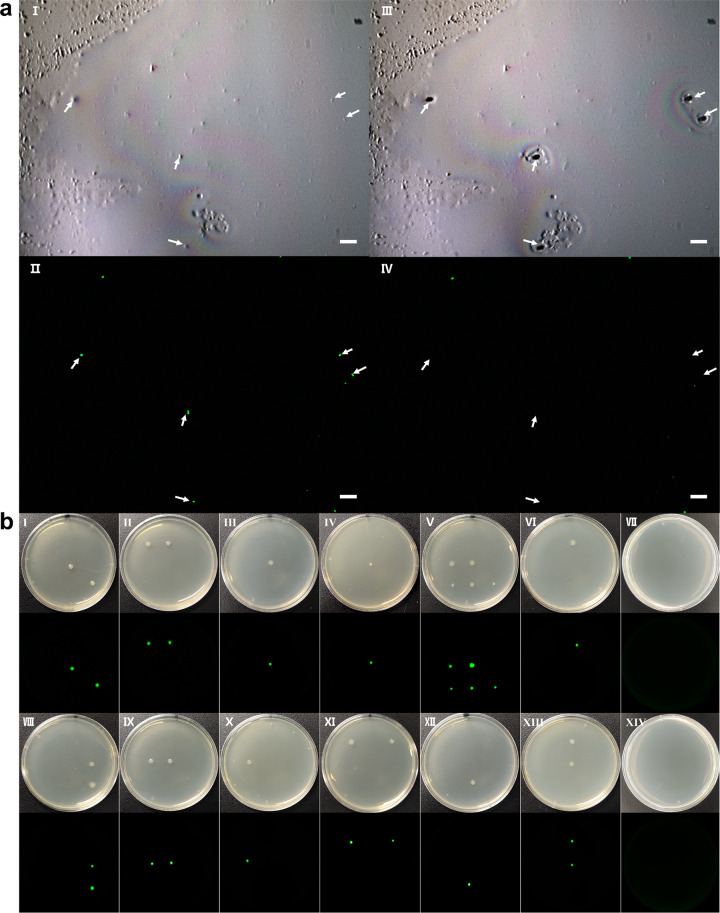
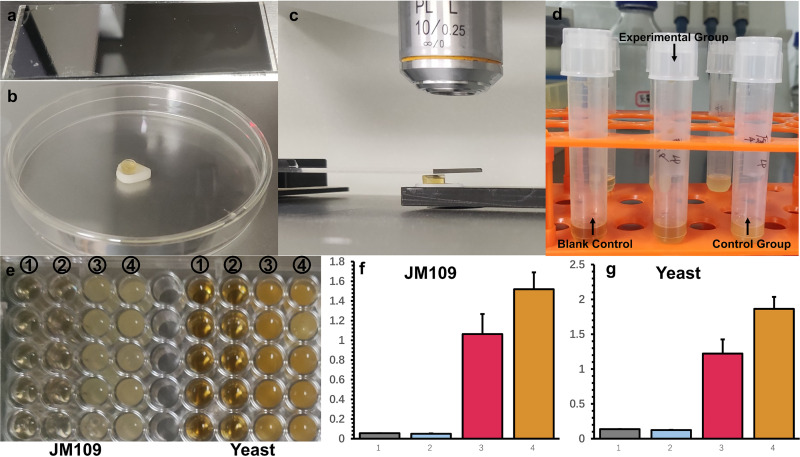
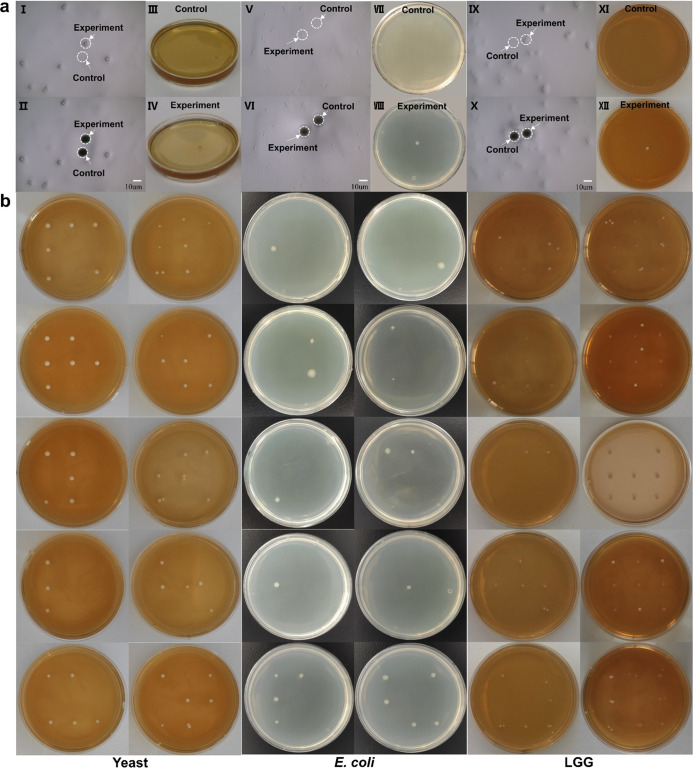
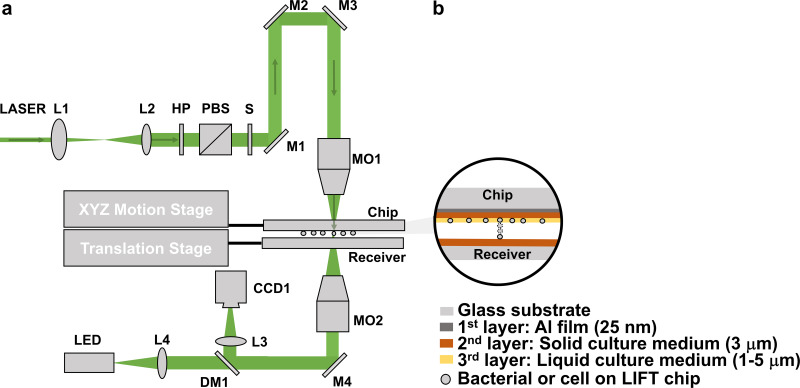
Single-cell isolation and cultivation play an important role in studying physiology, gene expression, and functions of microorganisms. A series of single-cell isolation technologies have been developed, among which single-cell ejection technology is one of the most promising. Single-cell ejection technology has applied laser-induced forward transfer (LIFT) techniques to isolate bacteria, but the viability (or recovery rate) of cells after sorting has not been clarified in current research. In this work, to keep the cells alive as long as possible, we propose a three-layer LIFT system (top layer, 25-nm aluminum film; second layer, 3 μm agar media; third layer, liquid containing bacteria) for the isolation and cultivation of single Gram-negative (Escherichia coli), Gram-positive (Lactobacillus rhamnosus GG [LGG]), and eukaryotic (Saccharomyces cerevisiae) microorganisms. The experiment results showed that the average survival rates for ejected pure single cells were 63% for Saccharomyces cerevisiae, 22% for E. coli DH5α, and 74% for LGG. In addition, we successfully isolated and cultured the green fluorescent protein (GFP)-expressing E. coli JM109 from a mixture containing complex communities of soil bacteria by fluorescence signal. The average survival rate of E. coli JM109 was demonstrated to be 25.3%. In this study, the isolated and cultured single colonies were further confirmed by colony PCR and sequencing. Such precise sorting and cultivation techniques of live single microbial cells could be coupled with other microscopic approaches to isolate single microorganisms with specific functions, revealing their roles in the natural community. We developed a laser-induced forward transfer (LIFT) technology to accurately isolate single live microbial cells. The cultivation recovery rates of the ejected single cells were 63% for Saccharomyces cerevisiae, 22% for E. coli DH5α, and 74% for Lactobacillus rhamnosus GG (LGG). With coupled LIFT with a fluorescence microscope, we demonstrated that single cells of GFP-expressing E. coli JM109 were sorted according to fluorescence signal from a complex community of soil bacteria and subsequently cultured with 25% cultivation recovery rate. This single-cell live sorting technology could isolate single microbes with specific functions, revealing their roles in the natural community.
单细胞分离和培养在研究微生物的生理学、基因表达和功能方面发挥着重要作用。已经开发出一系列单细胞分离技术,其中单细胞喷射技术是最有前途的技术之一。单细胞喷射技术将激光诱导正向转移(LIFT)技术应用于分离细菌,但目前的研究并未阐明分选后细胞的活力(或回收率)。在这项工作中,为了使细胞尽可能长时间地存活,我们提出了一种三层 LIFT 系统(顶层为 25nm 铝膜;第二层为 3μm 琼脂培养基;第三层为含有细菌的液体),用于分离和培养革兰氏阴性(大肠杆菌)、革兰氏阳性(鼠李糖乳杆菌 GG [LGG])和真核(酿酒酵母)微生物的单个细胞。实验结果表明,对于喷射出的纯单细胞,酿酒酵母的平均存活率为 63%,大肠杆菌 DH5α 的存活率为 22%,LGG 的存活率为 74%。此外,我们还通过荧光信号成功地从含有复杂土壤细菌群落的混合物中分离和培养了绿色荧光蛋白(GFP)表达的大肠杆菌 JM109。大肠杆菌 JM109 的平均存活率为 25.3%。在本研究中,通过菌落 PCR 和测序进一步证实了分离和培养的单菌落。这种精确分离和培养活单细胞的技术可以与其他显微镜方法结合使用,以分离具有特定功能的单个微生物,揭示它们在自然群落中的作用。我们开发了一种激光诱导正向转移(LIFT)技术,可以准确地分离单个活微生物细胞。喷射出的单细胞的培养回收率分别为:酿酒酵母 63%,大肠杆菌 DH5α 22%,鼠李糖乳杆菌 GG(LGG)74%。通过与荧光显微镜结合的 LIFT,我们证明了根据土壤细菌复杂群落的荧光信号可以分选 GFP 表达的大肠杆菌 JM109 的单细胞,并随后以 25%的培养回收率进行培养。这种单细胞活分选技术可以分离具有特定功能的单个微生物,揭示它们在自然群落中的作用。