Regnault Sophie, Fahn-Lai Philip, Pierce Stephanie E
Museum of Comparative Zoology and Department of Organismic and Evolutionary Biology, Harvard University, Cambridge, MA, United States.
Institute of Biological, Environment and Rural Sciences, Aberystwyth University, Aberystwyth, United Kingdom.
Front Bioeng Biotechnol. 2021 Nov 8;9:751518. doi: 10.3389/fbioe.2021.751518. eCollection 2021.
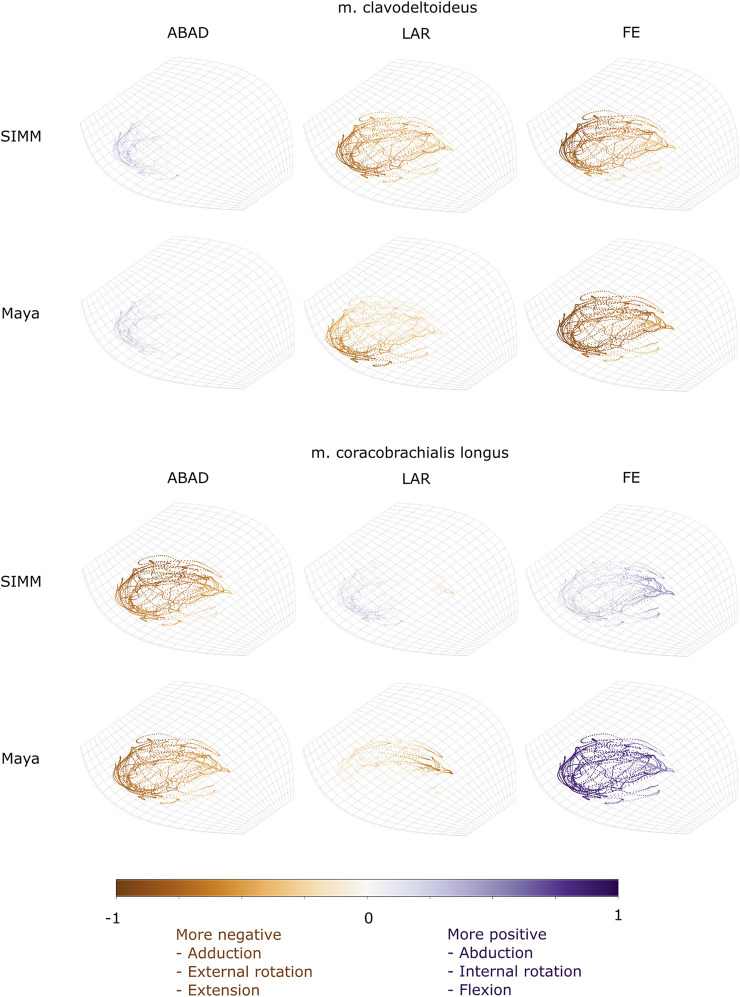
In evolutionary biomechanics, musculoskeletal computer models of extant and extinct taxa are often used to estimate joint range of motion (ROM) and muscle moment arms (MMAs), two parameters which form the basis of functional inferences. However, relatively few experimental studies have been performed to validate model outputs. Previously, we built a model of the short-beaked echidna () forelimb using a traditional modelling workflow, and in this study we evaluate its behaviour and outputs using experimental data. The echidna is an unusual animal representing an edge-case for model validation: it uses a unique form of sprawling locomotion, and possesses a suite of derived anatomical features, in addition to other features reminiscent of extinct early relatives of mammals. Here we use diffusible iodine-based contrast-enhanced computed tomography (diceCT) alongside digital and traditional dissection to evaluate muscle attachments, modelled muscle paths, and the effects of model alterations on the MMA outputs. We use X-ray Reconstruction of Moving Morphology (XROMM) to compare joint ROM to model estimates based on osteological limits predicted via single-axis rotation, and to calculate experimental MMAs from implanted muscles using a novel geometric method. We also add additional levels of model detail, in the form of muscle architecture, to evaluate how muscle torque might alter the inferences made from MMAs alone, as is typical in evolutionary studies. Our study identifies several key findings that can be applied to future models. 1) A light-touch approach to model building can generate reasonably accurate muscle paths, and small alterations in attachment site seem to have minimal effects on model output. 2) Simultaneous movement through multiple degrees of freedom, including rotations and translation at joints, are necessary to ensure full joint ROM is captured; however, single-axis ROM can provide a reasonable approximation of mobility depending on the modelling objectives. 3) Our geometric method of calculating MMAs is consistent with model-predicted MMAs calculated via partial velocity, and is a potentially useful tool for others to create and validate musculoskeletal models. 4) Inclusion of muscle architecture data can change some functional inferences, but in many cases reinforced conclusions based on MMA alone.
在进化生物力学中,现存和已灭绝分类群的肌肉骨骼计算机模型常被用于估计关节活动范围(ROM)和肌肉力臂(MMA),这两个参数构成了功能推断的基础。然而,进行验证模型输出的实验研究相对较少。此前,我们使用传统建模工作流程构建了短喙针鼹()前肢模型,在本研究中,我们使用实验数据评估其行为和输出。针鼹是一种不寻常的动物,代表了模型验证的极端情况:它采用独特的 spraw 运动形式,拥有一系列特化的解剖特征,以及其他让人联想到已灭绝的早期哺乳动物亲属的特征。在这里,我们使用基于扩散碘的对比增强计算机断层扫描(diceCT)以及数字和传统解剖来评估肌肉附着、模拟的肌肉路径,以及模型改变对MMA输出的影响。我们使用运动形态的X射线重建(XROMM)将关节ROM与基于通过单轴旋转预测的骨学极限的模型估计值进行比较,并使用一种新颖的几何方法从植入肌肉计算实验性MMA。我们还以肌肉结构的形式添加了额外的模型细节层次,以评估肌肉扭矩如何改变仅基于MMA所做的推断,这在进化研究中很常见。我们的研究确定了几个可应用于未来模型的关键发现。1)轻触式建模方法可以生成相当准确的肌肉路径,附着位点的小变化似乎对模型输出影响最小。2)通过多个自由度同时运动,包括关节处的旋转和平移,对于确保捕获完整的关节ROM是必要的;然而,根据建模目标,单轴ROM可以提供合理的运动近似值。3)我们计算MMA的几何方法与通过部分速度计算的模型预测MMA一致,并且是其他人创建和验证肌肉骨骼模型的潜在有用工具。4)纳入肌肉结构数据可以改变一些功能推断,但在许多情况下强化了仅基于MMA的结论。