Nwafor Chioma Dan, Ilori Elsie, Olayinka Adebola, Ochu Chinwe, Olorundare Rosemary, Edeh Edwin, Okwor Tochi, Oyebanji Oyeronke, Namukose Esther, Ukponu Winifred, Olugbile Michael, Adekanye Usman, Chandra Nastassya, Bolt Hikaru, Namara Geofrey, Ipadeola Oladipupo, Furuse Yuki, Woldetsadik Solomon, Akano Adejoke, Iniobong Akanimo, Amedu Michael, Anueyiagu Chimezie, Bakare Lawal, Ahumibe Anthony, Joseph Gbenga, Eneh Chibuzo, Saleh Muhammad, Dhamari Naidoo, Okoli Ihekerenma, Kachalla Mairo, Okea Rita, Okenyi Collins, Makava Favour, Makwe Catherine, Ugbogulu Nkem, Fonkeng Fritz, Aniaku Everistus, Agogo Emmanuel, Mba Nwando, Aruna Olusola, Nguku Patrick, Ihekweazu Chikwe
Nigeria Centre for Disease Control, Abuja, Nigeria.
World Health Organisation, Abuja, Nigeria.
One Health. 2021 Nov 8;13:100346. doi: 10.1016/j.onehlt.2021.100346. eCollection 2021 Dec.
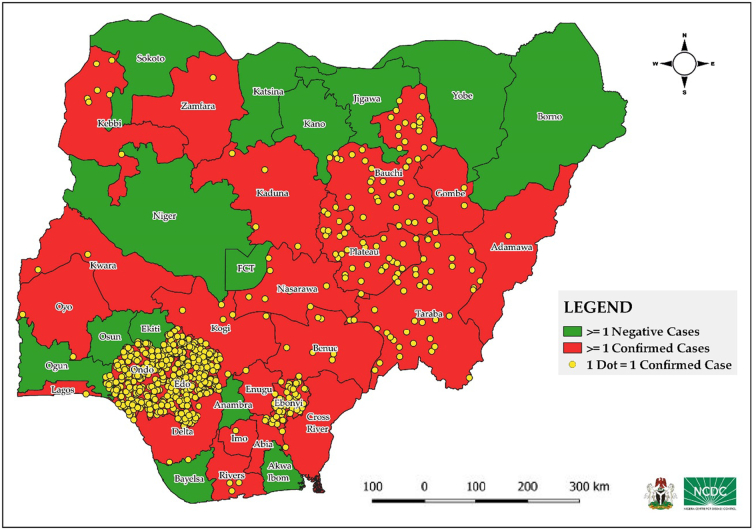
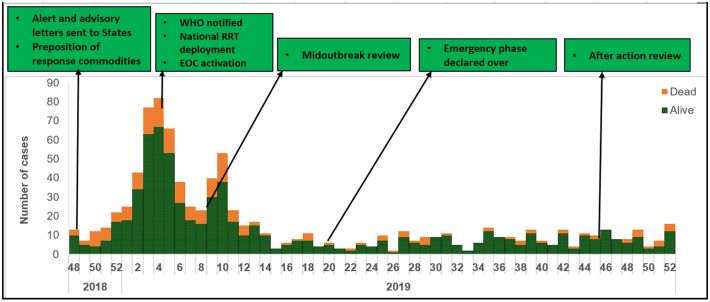
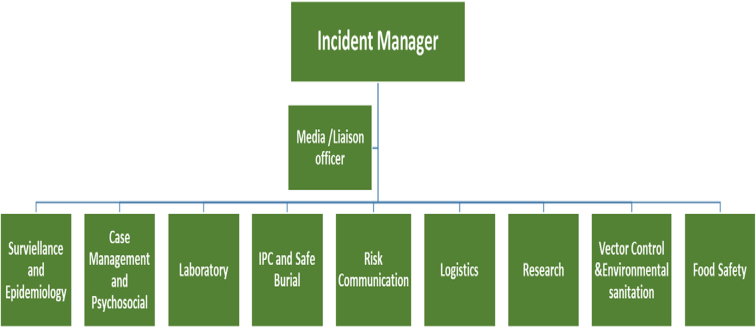
Globally, effective emergency response to disease outbreaks is usually affected by weak coordination. However, coordination using an incident management system (IMS) in line with a One Health approach involving human, environment, and animal health with collaborations between government and non-governmental agencies result in improved response outcome for zoonotic diseases such as Lassa fever (LF). We provide an overview of the 2019 LF outbreak response in Nigeria using the IMS and One Health approach. The response was coordinated via ten Emergency Operation Centre (EOC) response pillars. Cardinal response activities included activation of EOC, development of an incident action plan, deployment of One Health rapid response teams to support affected states, mid-outbreak review and after-action review meetings. Between 1st January and 29th December 2019, of the 5057 people tested for LF, 833 were confirmed positive from 23 States, across 86 Local Government Areas. Of the 833 confirmed cases, 650 (78%) were from hotspot States of Edo (36%), Ondo (26%) and Ebonyi (16%). Those in the age-group 21-40 years (47%) were mostly affected, with a male to female ratio of 1:1. Twenty healthcare workers were affected. Two LF naïve states Kebbi and Zamfara, reported confirmed cases for the first time during this period. The outbreak peaked earlier in the year compared to previous years, and the emergency phase of the outbreak was declared over by epidemiological week 17 based on low national threshold composite indicators over a period of six consecutive weeks. Multisectoral and multidisciplinary strategic One Health EOC coordination at all levels facilitated the swift containment of Nigeria's large LF outbreak in 2019. It is therefore imperative to embrace One Health approach embedded within the EOC to holistically address the increasing LF incidence in Nigeria.
在全球范围内,对疾病爆发的有效应急响应通常受到协调不力的影响。然而,使用符合“同一个健康”方法的事件管理系统(IMS)进行协调,该方法涉及人类、环境和动物健康,并在政府和非政府机构之间开展合作,可改善对拉沙热(LF)等人畜共患病的应对结果。我们概述了尼日利亚在2019年使用IMS和“同一个健康”方法应对拉沙热疫情的情况。此次应对行动通过十个应急行动中心(EOC)响应支柱进行协调。主要的应对活动包括启动应急行动中心、制定事件行动计划、部署“同一个健康”快速反应小组以支持受影响的州、疫情中期审查和事后审查会议。在2019年1月1日至12月29日期间,在接受拉沙热检测的5057人中,有833人被确诊为阳性,来自23个州的86个地方政府辖区。在这833例确诊病例中,650例(78%)来自热点州埃多(36%)、翁多(26%)和埃邦伊(16%)。年龄在21至40岁之间的人群受影响最大(47%),男女比例为1:1。有20名医护人员受到感染。此前未出现过拉沙热病例的凯比州和赞法拉州在此期间首次报告了确诊病例。与前几年相比,此次疫情在当年早些时候达到峰值,基于连续六周的低国家阈值综合指标,在第17个流行病学周宣布疫情的应急阶段结束。各级多部门和多学科的“同一个健康”应急行动中心战略协调促进了对2019年尼日利亚大规模拉沙热疫情的迅速控制。因此,必须采用应急行动中心所包含的“同一个健康”方法,以全面应对尼日利亚日益增加的拉沙热发病率。