Bisaccia Giandomenico, Ricci Fabrizio, Recce Vittoria, Serio Antonio, Iannetti Giovanni, Chahal Anwar A, Ståhlberg Marcus, Khanji Mohammed Yunus, Fedorowski Artur, Gallina Sabina
Department of Neuroscience, Imaging and Clinical Sciences, Institute for Advanced Biomedical Technologies, "G. d'Annunzio" University of Chieti-Pescara, Via Luigi Polacchi, 66100 Chieti, Italy.
Department of Clinical Sciences, Lund University, 20502 Malmö, Sweden.
J Cardiovasc Dev Dis. 2021 Nov 15;8(11):156. doi: 10.3390/jcdd8110156.
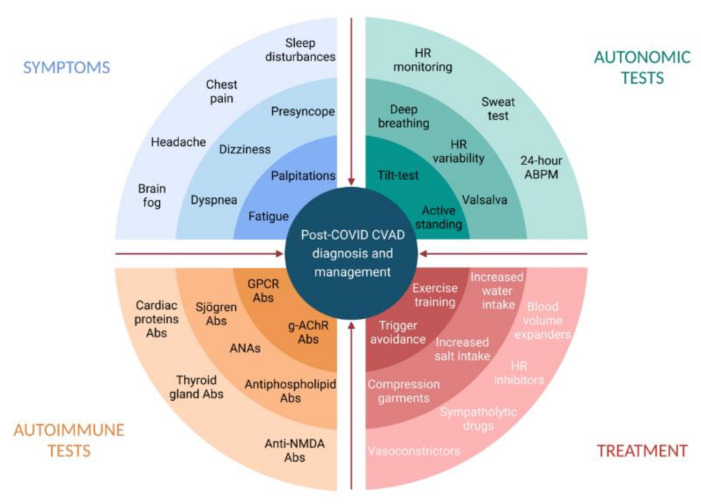
Post-acute sequelae of SARS-CoV-2 (PASC), or long COVID syndrome, is emerging as a major health issue in patients with previous SARS-CoV-2 infection. Symptoms commonly experienced by patients include fatigue, palpitations, chest pain, dyspnea, reduced exercise tolerance, and "brain fog". Additionally, symptoms of orthostatic intolerance and syncope suggest the involvement of the autonomic nervous system. Signs of cardiovascular autonomic dysfunction appear to be common in PASC and are similar to those observed in postural orthostatic tachycardia syndrome and inappropriate sinus tachycardia. In this review, we report on the epidemiology of PASC, discuss current evidence and possible mechanisms underpinning the dysregulation of the autonomic nervous system, and suggest nonpharmacological and pharmacological interventions to treat and relieve symptoms of PASC-associated dysautonomia.
2019冠状病毒病的急性后遗症(PASC),即长新冠综合征,正成为既往感染2019冠状病毒病患者的一个主要健康问题。患者常见的症状包括疲劳、心悸、胸痛、呼吸困难、运动耐量下降和“脑雾”。此外,体位性不耐受和晕厥症状提示自主神经系统受累。心血管自主神经功能障碍的体征在PASC中似乎很常见,与体位性直立性心动过速综合征和不适当窦性心动过速中观察到的体征相似。在这篇综述中,我们报告了PASC的流行病学情况,讨论了目前的证据以及自主神经系统失调的可能机制,并提出了治疗和缓解PASC相关自主神经功能障碍症状的非药物和药物干预措施。