Zeng Xiying, Huang Yinxiang, Zhang Mulin, Chen Yun, Ye Jiawen, Han Yan, Ma Danyan, Zheng Xin, Yan Xiaohong, Liu Changqin
The Third Clinical Medical College, Fujian Medical University, Fuzhou, China.
Department of Endocrinology and Diabetes, The First Affiliated Hospital, Xiamen University, Xiamen, China.
Endocr Connect. 2022 Jan 10;11(1):e210243. doi: 10.1530/EC-21-0243.
Anti-Müllerian hormone (AMH) is recognized as the most important biomarker for ovarian reserve. In this cross-sectional study, we aimed to explore the potential association of AMH with central obesity or general obesity in women with polycystic ovary syndrome (PCOS).
In this cross-sectional study, 179 patients with PCOS were enrolled and underwent anthropometric measurements (BMI and waist circumference (WC)) and serum AMH level detection. Pearson's correlation and multivariable logistic regression analyses were performed to determine the associations of AMH with central obesity and general obesity.
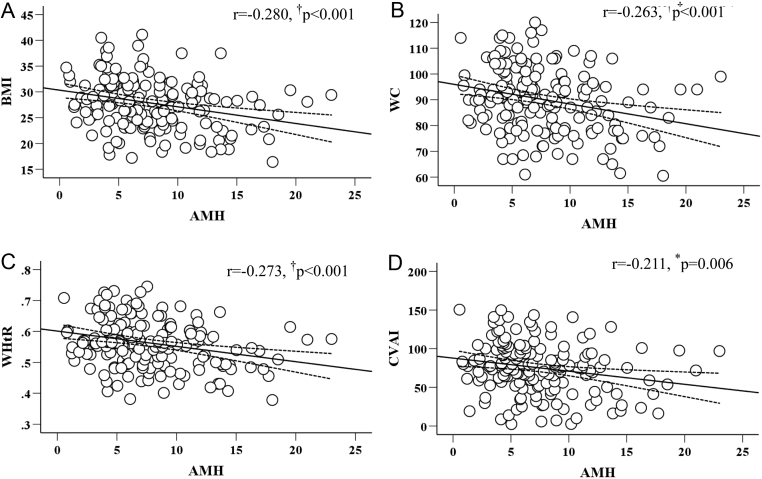
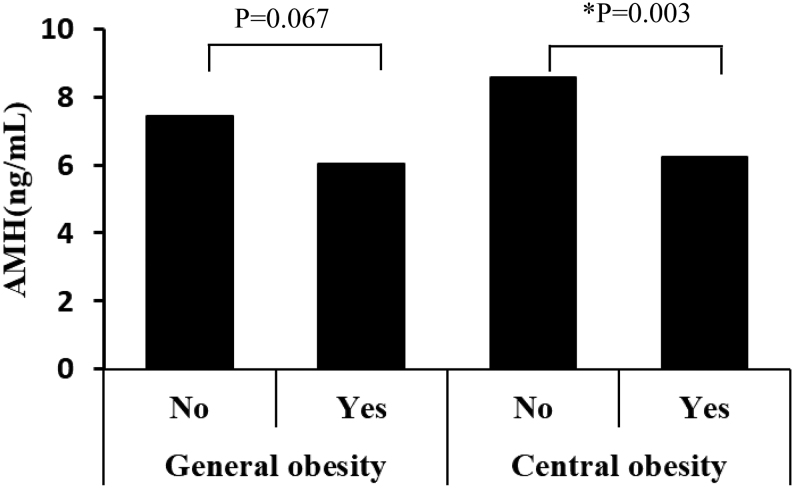
Subjects with increasing BMI showed significantly lower values of AMH (median (interquartile range (IQR)) 8.95 (6.03-13.60) ng/mL in normal weight group, 6.57 (4.18-8.77) ng/mL in overweight group, and 6.03 (4.34-9.44) ng/mL in obesity group, P = 0.001), but higher levels of systolic blood pressure, fasting insulin, total cholesterol, triglycerides, LDL-c, obesity indices (WC, hip circumferences, waist-to-hip ratio, waist-to-height ratio (WHtR), and Chinese visceral adiposity index (CVAI)). Compared with the group of PCOS women without central obesity, the group with central obesity had significantly lower value of AMH (median (IQR) 8.56 (5.29-12.96) ng/mL vs 6.22 (4.33-8.82) ng/mL; P = 0.003). Pearson's correlation analysis showed that AMH was significantly and negatively correlated with BMI (r = -0.280; P < 0.001), WC (r = -0.263; P < 0.001), WHtR (r = -0.273; P < 0.001), and CVAI (r = -0.211; P = 0.006). Multivariate logistic regression analysis with adjustment for potential confounding factors showed that AMH was independently and negatively associated with central obesity but was not significantly associated with general obesity.
AMH was independently and negatively associated with central obesity. Closely monitoring the WC and AMH should be addressed in terms of assessing ovarian reserve in women with PCOS.
抗苗勒管激素(AMH)被认为是评估卵巢储备功能最重要的生物标志物。在这项横断面研究中,我们旨在探讨多囊卵巢综合征(PCOS)女性中AMH与中心性肥胖或全身性肥胖之间的潜在关联。
在这项横断面研究中,纳入了179例PCOS患者,对其进行人体测量(体重指数(BMI)和腰围(WC))以及血清AMH水平检测。采用Pearson相关性分析和多变量逻辑回归分析来确定AMH与中心性肥胖和全身性肥胖之间的关联。
BMI升高的受试者AMH值显著降低(正常体重组中位数(四分位间距(IQR))为8.95(6.03 - 13.60)ng/mL,超重组为6.57(4.18 - 8.77)ng/mL,肥胖组为6.03(4.