Laboratory of Clinical Nuclear Medicine, Department of Nuclear Medicine, West China Hospital, Sichuan University, No.37 Guo Xue Alley, Chengdu, 610041, People's Republic of China.
Machine Intelligence Laboratory, College of Computer Science, Sichuan University, Chengdu, 610065, People's Republic of China.
BMC Med Imaging. 2021 Nov 25;21(1):179. doi: 10.1186/s12880-021-00710-4.
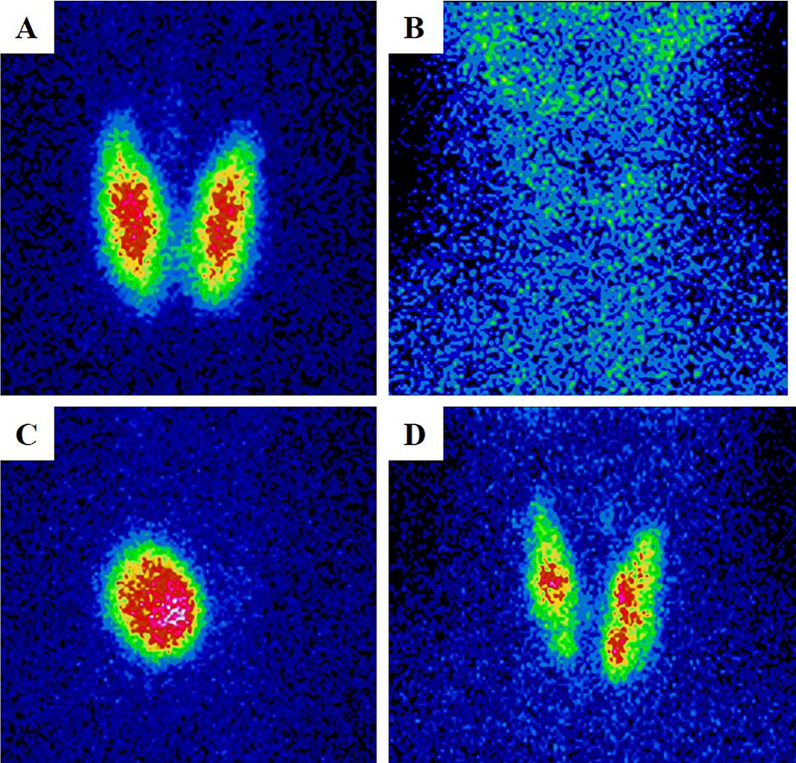
Tc-pertechnetate thyroid scintigraphy is a valid complementary avenue for evaluating thyroid disease in the clinic, the image feature of thyroid scintigram is relatively simple but the interpretation still has a moderate consistency among physicians. Thus, we aimed to develop an artificial intelligence (AI) system to automatically classify the four patterns of thyroid scintigram.
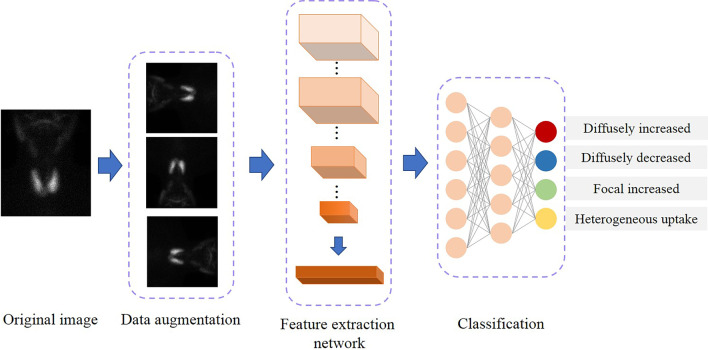
We collected 3087 thyroid scintigrams from center 1 to construct the training dataset (n = 2468) and internal validating dataset (n = 619), and another 302 cases from center 2 as external validating datasets. Four pre-trained neural networks that included ResNet50, DenseNet169, InceptionV3, and InceptionResNetV2 were implemented to construct AI models. The models were trained separately with transfer learning. We evaluated each model's performance with metrics as following: accuracy, sensitivity, specificity, positive predictive value (PPV), negative predictive value (NPV), recall, precision, and F1-score.
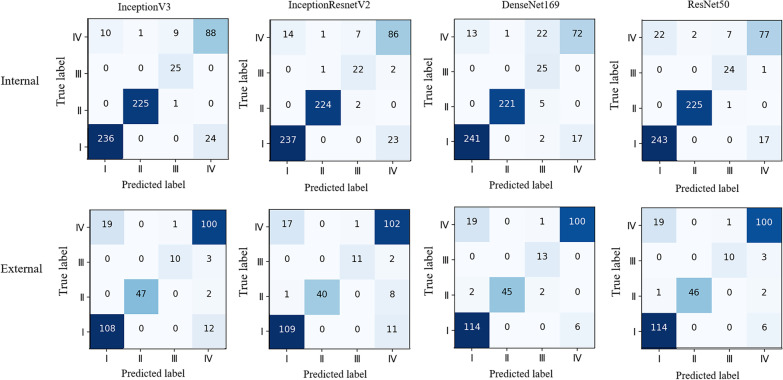
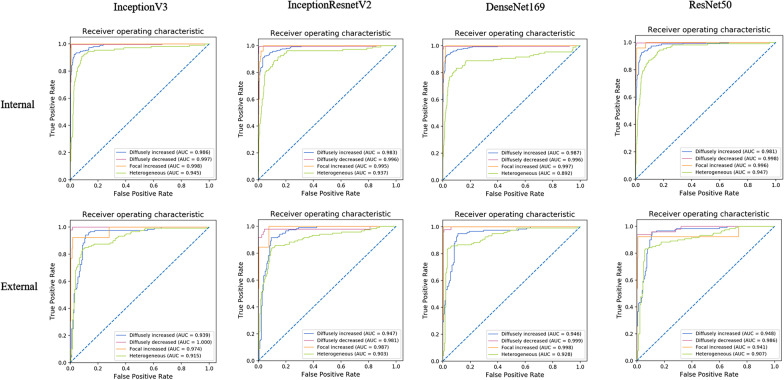
The overall accuracy of four pre-trained neural networks in classifying four common uptake patterns of thyroid scintigrams all exceeded 90%, and the InceptionV3 stands out from others. It reached the highest performance with an overall accuracy of 92.73% for internal validation and 87.75% for external validation, respectively. As for each category of thyroid scintigrams, the area under the receiver operator characteristic curve (AUC) was 0.986 for 'diffusely increased,' 0.997 for 'diffusely decreased,' 0.998 for 'focal increased,' and 0.945 for 'heterogeneous uptake' in internal validation, respectively. Accordingly, the corresponding performances also obtained an ideal result of 0.939, 1.000, 0.974, and 0.915 in external validation, respectively.
Deep convolutional neural network-based AI model represented considerable performance in the classification of thyroid scintigrams, which may help physicians improve the interpretation of thyroid scintigrams more consistently and efficiently.
锝-过锝酸盐甲状腺闪烁显像术是评估临床甲状腺疾病的有效补充方法,甲状腺闪烁显像的图像特征相对简单,但在医生之间的解释仍然存在一定的一致性。因此,我们旨在开发一种人工智能(AI)系统,以自动对甲状腺闪烁图的四种模式进行分类。
我们从中心 1 收集了 3087 个甲状腺闪烁图来构建训练数据集(n=2468)和内部验证数据集(n=619),并从中心 2 收集了另外 302 个甲状腺闪烁图作为外部验证数据集。我们使用了四个预先训练的神经网络,包括 ResNet50、DenseNet169、InceptionV3 和 InceptionResNetV2,来构建 AI 模型。这些模型分别通过迁移学习进行训练。我们使用以下指标评估每个模型的性能:准确率、敏感度、特异性、阳性预测值(PPV)、阴性预测值(NPV)、召回率、精度和 F1 分数。
四个预先训练的神经网络在分类甲状腺闪烁图的四种常见摄取模式方面的总体准确率均超过 90%,其中 InceptionV3 表现尤为突出。在内部验证中,它的总体准确率最高,为 92.73%,在外部验证中,为 87.75%。对于每一种甲状腺闪烁图类型,内部验证的受试者工作特征曲线下面积(AUC)分别为弥漫性增加的 0.986、弥漫性减少的 0.997、局灶性增加的 0.998 和异质性摄取的 0.945。相应地,在外部验证中,这些类别也分别获得了理想的 0.939、1.000、0.974 和 0.915 的性能。
基于深度卷积神经网络的 AI 模型在甲状腺闪烁图的分类中表现出相当的性能,这可能有助于医生更一致、更有效地解释甲状腺闪烁图。